---
description: Is your PD testing workflow inefficient? Find partial discharge bottlenecks, reduce avoidable retests and compare integration costs with a payback example.
title: PD Testing Workflow Inefficient? 7 Fixes That Matter - DEMIKS
image: https://demikspower.com/wp-content/uploads/2026/10/pd-testing-workflow-inefficient-featured.png
---
[Skip to content](#content)
# Why Your Partial Discharge Testing Workflow Is Inefficient
- [by XCX](https://demikspower.com/author/xcx/)
- [on October 26, 2026](https://demikspower.com/blog/2026/10/26/)
- [No Comments](https://demikspower.com/blog/pd-testing-workflow-inefficient/#respond)
If you find your **PD testing workflow inefficient**, measure where each job waits or repeats. For files stalled before review, separate measurement time from waiting time. Electrical partial discharge testing becomes more productive when the identified causes of delays and repeat runs are corrected and the required measurement quality and safety steps are maintained.
**Contents** show
[1 Find the bottleneck before replacing PD equipment](#Find_the_bottleneck_before_replacing_PD_equipment)
[2 Measure useful results per shift, including retests](#Measure_useful_results_per_shift_including_retests)
[3 Remove noise-driven rework without weakening the test](#Remove_noise-driven_rework_without_weakening_the_test)
[3.1 What Are the Main Methods of PD Detection?](#What_Are_the_Main_Methods_of_PD_Detection)
[4 Keep PD data moving from capture to an accepted report](#Keep_PD_data_moving_from_capture_to_an_accepted_report)
[4.1 How Is PD Data Analyzed?](#How_Is_PD_Data_Analyzed)
[5 Compare integrated systems against your actual workflow](#Compare_integrated_systems_against_your_actual_workflow)
[6 Calculate the cost of rework and a conditional payback](#Calculate_the_cost_of_rework_and_a_conditional_payback)
[6.1 PD Rework Cost Sheet](#PD_Rework_Cost_Sheet)
[7 Run a controlled workflow improvement trial](#Run_a_controlled_workflow_improvement_trial)
[8 Account for method changes in the 2025 standard](#Account_for_method_changes_in_the_2025_standard)
[9 Frequently Asked Questions](#Frequently_Asked_Questions)
[9.1 What Does PD Test Stand For?](#What_Does_PD_Test_Stand_For)
[9.2 How Does PD Testing Work?](#How_Does_PD_Testing_Work)
[9.3 What is Partial Discharge Test in Transformer?](#What_is_Partial_Discharge_Test_in_Transformer)
[9.4 Can faster capture remove every repeat test?](#Can_faster_capture_remove_every_repeat_test)
[9.5 How do I calculate a PD workflow upgrade payback?](#How_do_I_calculate_a_PD_workflow_upgrade_payback)
[9.6 Do all PD methods report picocoulombs?](#Do_all_PD_methods_report_picocoulombs)
[9.7 Which suppliers offer automated PD data and reports?](#Which_suppliers_offer_automated_PD_data_and_reports)
[9.8 Discuss the stage limiting your PD testing program](#Discuss_the_stage_limiting_your_PD_testing_program)
[9.9 References & Sources](#References_Sources)
Updated October 2026
**Workflow diagnosis at a glance**
- **Start and finish:** test request to technically reviewed report.
- **Keep separate:** elapsed time, staff-hours and prescribed observation.
- **Count rework:** avoidable repeat runs by cause, outside necessary defect investigations.
- **Buying decision:** compare the manual tasks removed and the deliverables retained.
An inefficient PD testing workflow needs a stage-by-stage time record. Separate access delays, measurement rework and report review. Improve the constrained stage while preserving the approved test method and required observation.
**Key points**
- A faster capture can leave report turnaround unchanged.
- Corrective retesting after a defect is found is useful technical work.
- Report generation and a complete, reopenable measurement record are different deliverables.
- Released employee time can increase capacity without reducing cash spending.
## Find the bottleneck before replacing PD equipment

A PD workflow bottleneck occurs at the stage that limits delivery of usable, reviewed results for high-voltage assets. Follow a job through access, setup, measurement and reporting to select an upgrade. Record both active work and waiting; otherwise a permit delay or an unavailable analyst can be mistaken for slow test equipment.
Use the test request, access-ready time, measurement completion and report approval as clock events. Two engineers working together consume two staff-hours in one elapsed hour. Waiting for an outage can add elapsed time without adding continuous labor.
Locate the delay and assign the person who can remove it.
| Stage or cause | Record | First action and owner |
| --- | --- | --- |
| Request queue | Request received to test scheduled | Planner groups jobs with the same access needs. |
| Asset access | Scheduled start to approved access | Site coordinator resolves missing access arrangements. |
| Required safety preparation | Actual prescribed preparation time | Test lead retains required checks and controls. |
| Measurement setup | Hands-on assembly and configuration | Engineer standardizes the approved arrangement. |
| Background interference | Investigations and affected repeat runs | Diagnostic engineer reviews the signal path. |
| Required observation | Acquisition window and conditions | Technical lead preserves the specified observation. |
| Data transfer | Copying, renaming and missing-file returns | Data owner defines the handoff package. |
| Technical review queue | File ready to review completed | Review lead allocates qualified analysis time. |
| Report correction | Returns for missing context or wrong asset identity | Report owner corrects the originating record. |
Consider a factory team that captures its scheduled tests before lunch but sends reports the following afternoon. The measurement equipment is available, but the review engineer is occupied by other tasks and several files arrive without clear sample identifiers. A faster digitizer would still leave that queue. The immediate changes are to assign the identifier at job creation, send a complete file package and reserve review time. The plant manager focuses on reducing the approval queue, while the test engineer focuses on holding the original measurement window. Procurement can then compare a reporting upgrade with the cost of improving the existing handoff, rather than replacing the complete measurement system by default.
Required safety work must be classified in its own time category. For interim high-voltage or high-power testing within [29 CFR 1910.269(o)](https://www.ecfr.gov/current/title-29/subtitle-B/chapter-XVII/part-1910/subpart-R/section-1910.269), the rule addresses test-area protection, grounding practices and checks before each series of tests. It states its scope and exclusions. Scheduling improvements must leave the applicable checks, discharge and grounding procedures intact.
## Measure useful results per shift, including retests
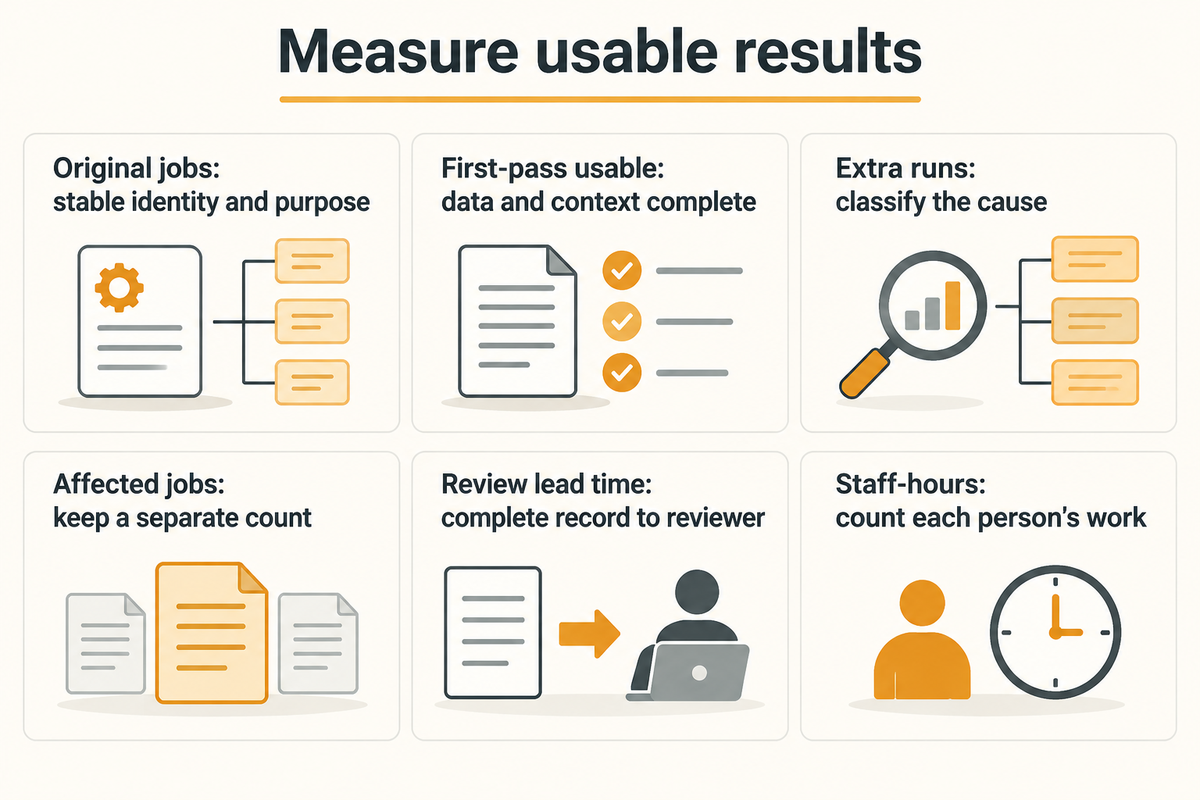
Throughput counts jobs that create the agreed technical result and a complete review package. Track throughput with first-pass usability, repeat runs and report lead time. Before comparing shifts, agree upon what constitutes a job. Define the job consistently before comparing shifts; a routine test and a difficult diagnostic investigation should not silently become interchangeable units.
Start with a small number of operational measures. First-pass usability is the number of original jobs with usable data and complete records on the first attempt divided by all original jobs. It measures record and measurement readiness, not the fraction of assets that pass their technical acceptance criteria. A diagnostic test defines success through usable findings.
Another measure is extra repeat runs per original job. A job repeated twice is two repeat runs. Keep a separate count of jobs affected, because a small number of difficult jobs can absorb a large number of repeats. Lead time is the time it takes to move individual jobs from request to approved report. For lead time, retain individual job timestamps and compare the median with the slower tail, such as the 90th percentile, when the sample is large enough to make that statistic useful. The 90th percentile indicates how long the system took to process the majority of jobs.
- **Original jobs:** use a stable asset or sample identifier and the same test purpose.
- **First-pass usable jobs:** require the agreed data quality and complete context.
- **Extra runs:** classify the reason before assigning an avoidable cost.
- **Review lead time:** start when the complete record reaches the reviewer.
- **Staff-hours:** count each person’s affected work, including later report corrections.
Separate repeat causes into setup errors, interference investigation, missing metadata, procedure-required verification and confirmed defect follow-up. The last two categories concern technical work. Reducing them by shortening a test or leaving a fault unresolved would improve the count while weakening the result.
A grid maintenance planning team running regular PD testing should also retain operating conditions for periodic comparisons. Load or measurement configuration changes can affect the trend. Use the same asset and method grouping when evaluating an insulation deterioration signal. Reports about insulation degradation need the technical review along with the administrative issue of turnaround. Keep historical exports from PD monitoring systems within their original method group. When comparing shifts, record the operator and operating conditions; the [NIST handbook’s discussion of nuisance factors](https://www.itl.nist.gov/div898/handbook/pri/section3/pri332.htm) explains why such differences can affect a measured result.
## Remove noise-driven rework without weakening the test
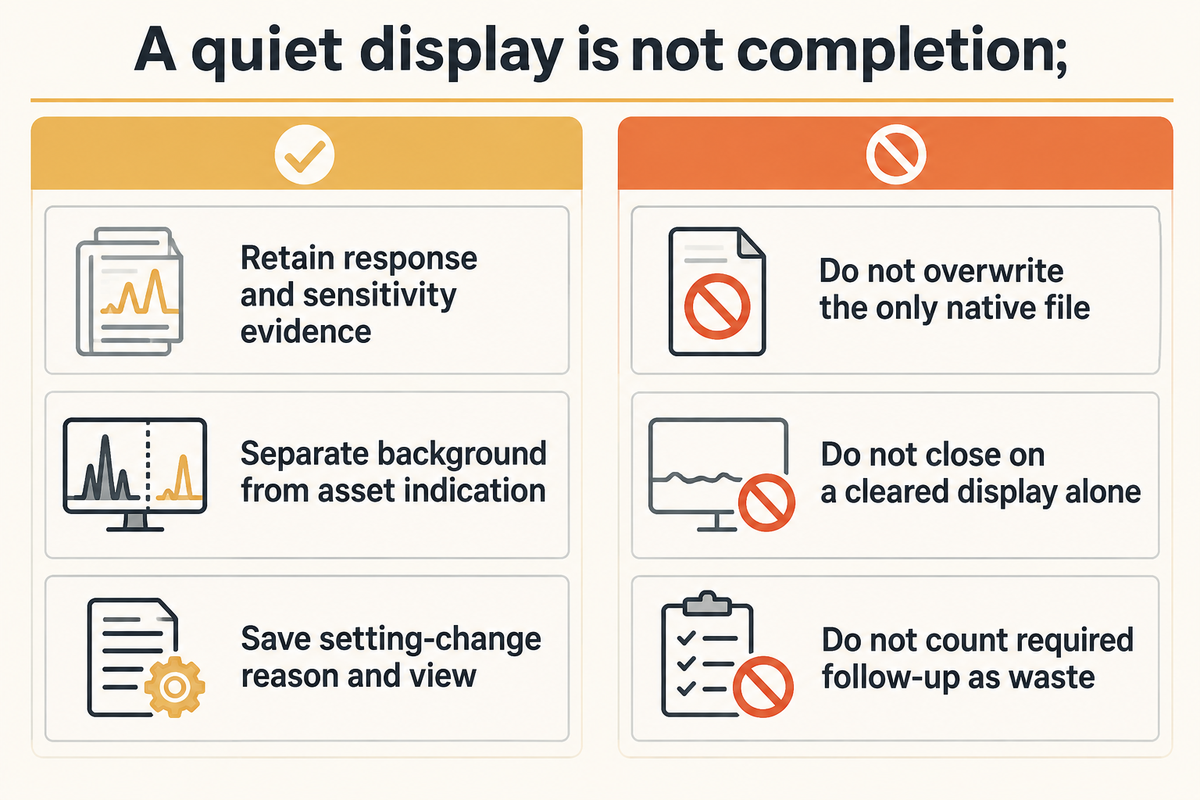
Noise-driven rework falls when the team identifies interference and preserves the configured measurement response and sufficient data. A display with no noise isn’t an adequate finish criterion. Review the sensor path, background and settings to determine if an additional capture is required or to assess if a suspected defect should be investigated.
Filtering changes the signal that reaches the analysis. In [Kindl and colleagues’ 2018 physical HV filter study](https://pmc.ncbi.nlm.nih.gov/articles/PMC5856033/), the test circuit and supply cable affected pulse response, and measurements with and without the filter produced different waveforms. That laboratory arrangement concerned a supply filter; software gating requires its own configured response checks.
Keep the unedited measurement file where the instrument supports it, along with the filter and gating settings used for the reported PD activity. If an engineer changes a setting to separate interference, have that engineer save the reason and the corresponding view. The next reviewer should be able to tell a new interpretation from a newly measured quantity.
**Do**
- Retain the configured response and sensitivity evidence.
- Separate background observations from the asset indication.
- Escalate unresolved signals to the assigned reviewer.
**Don’t**
- Close a job solely because filtering cleared the display.
- Overwrite the only native file with a processed screenshot.
- Count necessary defect follow-up as preventable handling waste.
### What Are the Main Methods of PD Detection?
Methods for PD detection include charge-based electrical measurement, electromagnetic and acoustic detection. They observe different effects and require different PD sensors, suited to the insulation system. Apparent charge is a charge-based result; an acoustic or electromagnetic indication needs its own units, response and interpretation. Therefore, select the most appropriate method for the electrical insulation under investigation, and don’t force all channels through one number.
A coupling arrangement on a transformer, an installed GIS sensor and an accessible observation on air-insulated MV switchgear provide different signal paths. In a medium voltage investigation, determine if the inquiry is about a suspected internal void or external corona case. A cable termination, bushing, or instrument transformer, too, can change what’s observable. The sensor position, conductor arrangement and electric field belong to the technical assessment. Site access and protective-earth arrangements stay within the approved procedure.
Application conditions also play a role. [John Meadors’ 2021 university thesis abstract](https://trace.tennessee.edu/utk_gradthes/6315/) describes how PWM switching noise complicates PD detection. A method selected for that environment cannot be assumed to behave identically in a utility-frequency insulation test.
## Keep PD data moving from capture to an accepted report
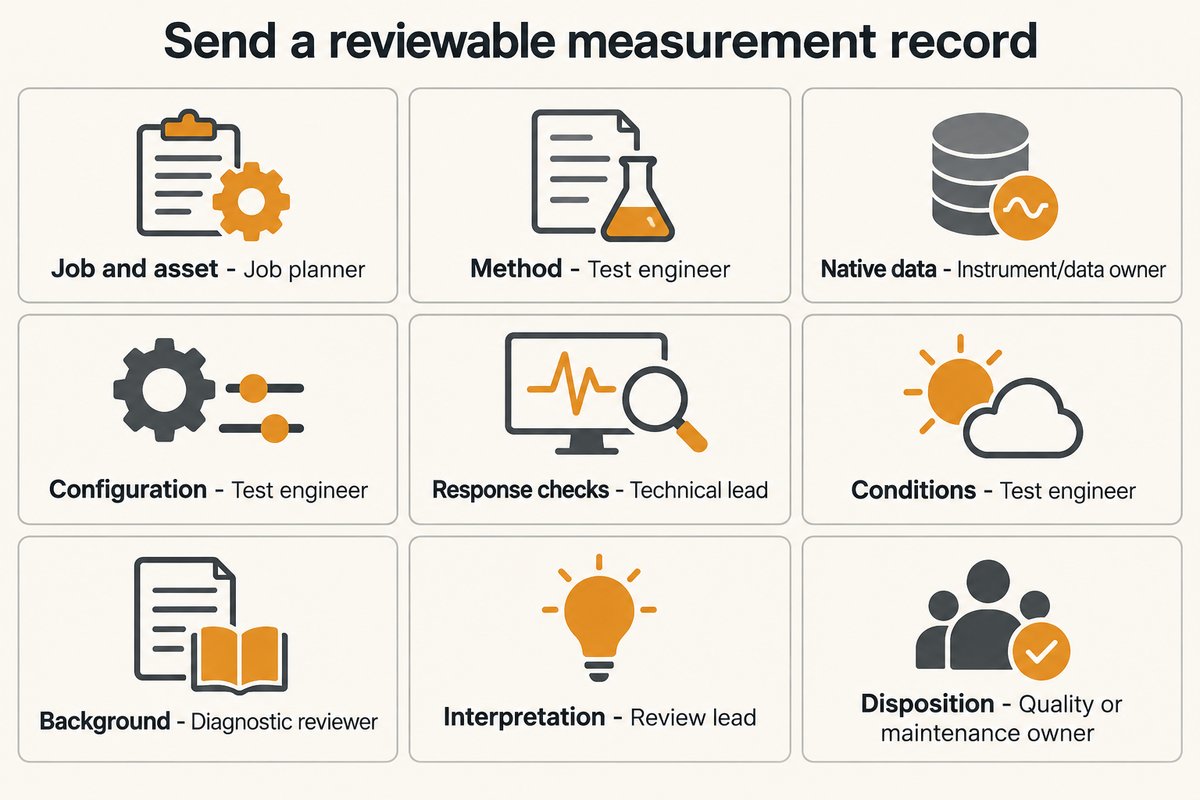
A complete PD data handoff allows the reviewer to identify the asset and understand the measurement to resolve an ambiguous result without reconstructing the job. Transfer the original record, settings, and context in which the measurement was made. Assign a person to each unresolved case. The file shouldn’t shuttle between testing, quality, and maintenance without action.
The measurement guidance by the [National Institute of Standards and Technology, Appendix D.4](https://www.nist.gov/pml/nist-technical-note-1297/nist-tn-1297-appendix-d4-measurand-defined-measurement-method) demonstrates that a method-defined quantity must be reported with its method identity intact. Similarly, in reporting results, retain the units and measurement arrangements rather than copying measured values to blank spaces.
Use these fields when handing a measurement to technical review.
| Field | What travels with the result | Owner of a missing item |
| --- | --- | --- |
| Job and asset | Unique identifier, location and test purpose | Job planner |
| Method | Online or offline PD measurement and selected sensing path | Test engineer |
| Native data | Reopenable file or the agreed original export | Instrument/data owner |
| Configuration | Channel, bandwidth, reference and processing settings | Test engineer |
| Response checks | Applicable calibration or sensitivity-check record | Technical lead |
| Conditions | Relevant test voltage or operating state and observation window | Test engineer |
| Background | Interference observations and unresolved source questions | Diagnostic reviewer |
| Interpretation | Named reviewer, finding and reason for follow-up | Review lead |
| Disposition | Report revision, required next action and responsible person | Quality or maintenance owner |
### How Is PD Data Analyzed?
PD data is analyzed by relating pulse behavior to the measurement method, background, and asset conditions. Where an AC phase reference is available, phase-resolved [partial discharge](https://demikspower.com/blog/partial-discharge/) patterns, or PRPD patterns, help the reviewer examine when activity occurs during the AC cycle. Waveform shape, polarity, and source context assist in interpreting the data; a single magnitude shouldn’t define the maintenance action.
The reviewer evaluates whether recorded partial discharge activity can be associated to the asset and whether a previous record is comparable. For rotating machines, a generator result taken under a different operating state may require a different interpretation. Keep the anomaly, its uncertainty and the next action in the same report revision. Early detection is useful when maintenance receives a resolvable finding, rather than a screenshot detached from its conditions.
For a more complete format of PD measurement records, use our guide to [PD measurement records for technical review](https://demikspower.com/blog/pd-testing-audit-requirements/). A PDF is convenient for approval and circulation; a native project or agreed export supports later analysis. State both when needed.
## Compare integrated systems against your actual workflow

Integrated PD systems are generally suitable for tasks requiring repetitive activities, while different instruments are generally suitable for diagnostic activities requiring different sensors and/or varying arrangements. Compare each option against the same test scope, including the analyst’s work and the data transfer, rather than treating the number of enclosures as a measure of productivity.
DEMIKS offers an industrial computer, PD measuring device, and stepwise voltage control and data retrieval for its [DJF-1kVA-7.5kV partial discharge test system](https://demikspower.com/high-voltage-test-equipment/partial-discharge-testing-equipment/). The model’s described reporting function produces test reports in A4 format. For an automated factory sequence, these are concrete functions for demonstration and quotation.
PD inception voltage (or PDIV) and extinction observations pertain to their defined voltage sequence and method. Report templates should contain these conditions along with their respective values. Keep the requirements for native files, software licensing and downstream data transfer separate from the format and layout of the printed report.
**Repeatable integrated sequence**
- Use a stable sample family and approved test sequence.
- Demonstrate the control and report tasks being removed.
- Include software, training and original-data deliverables.
**Flexible diagnostic arrangement**
- Match sensors to the asset and accessible signal paths.
- Retain specialist analysis for unresolved indications.
- Account for configuration changes and file transfers.
A [2020 TD World case coauthored by OMICRON electronics and Advanced Electrical Services](https://www.tdworld.com/test-and-measurement/article/21138301/omicron-electronics-corp-usa-onsite-partial-discharge-measurement-during-commissioning-safe-from-the-start) describes the commissioning of 27.5 kV air-insulated switchgear. The team created a custom profile for the MPD system and used remote specialised support. Preliminary tests identified a test-source cable with discharge activity. The switchgear had passed a dielectric withstand test before PD measurements identified problems. Later analysis led to physical inspection, correction of assembly problems and repeat PD measurements. The software enabled further investigation while onsite personnel performed all the physical work. That sequence illustrates why a useful equipment comparison follows the complete job. Its project-specific voltage and acceptance values should stay with that project, rather than becoming targets for another switchgear lineup.
Use [device selection for PD testing](https://demikspower.com/blog/pd-testing-too-many-devices/) to arrange instruments. Then request one demonstration package covering the selected sample, approved sequence, original files, final report, license costs and support. Reopening the delivered record on the intended review workstation belongs in that demonstration.
## Calculate the cost of rework and a conditional payback
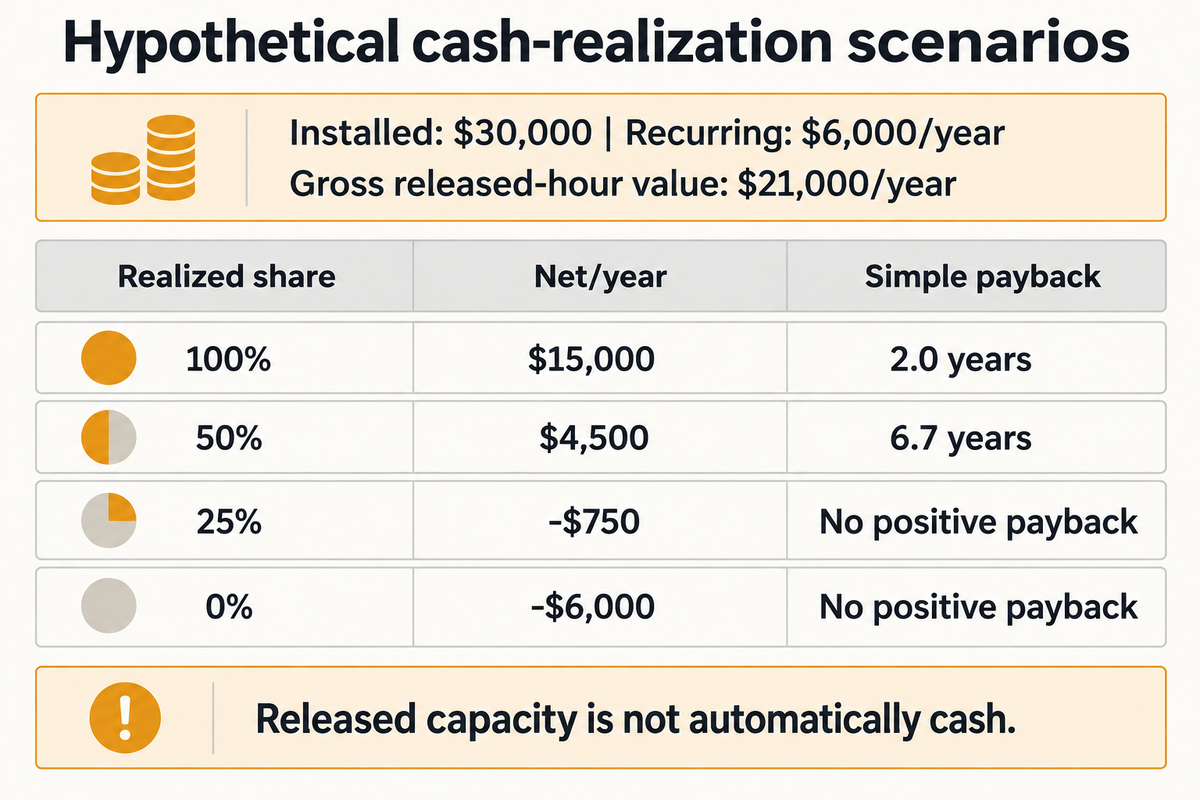
In the assumed example below, a $30,000 upgrade has a 2-year simple payback only if all of the $21,000 of annual released-hour value becomes a realizable financial benefit. Lower realization changes the outcome sharply. A retained employee’s available time is useful capacity; it becomes cash savings only through a specific spending reduction or other documented benefit.
### PD Rework Cost Sheet
The PD Rework Cost Sheet separates repeat-run labor from original-job reporting and evaluates how much released capacity becomes a financial benefit.
**Assumed inputs:** 1,000 original jobs per year; extra repeat runs per original job fall from 0.25 to 0.15; each repeat consumes 1.5 staff-hours; labor is valued at $60 per staff-hour. Original-job report preparation falls by 0.2 staff-hours per job. Installed incremental cost is $30,000, with $6,000 per year of additional software, maintenance and support costs. The repeat-run labor and original-report saving cover separate work.
Worked annual calculation using the assumed inputs.
| Item | Calculation or input | Result |
| --- | --- | --- |
| Original workload | Assumed annual volume | 1,000 jobs/year |
| Repeat-run reduction | 0.25 − 0.15 extra runs/job | 0.10 extra runs/job |
| Extra runs avoided | 1,000 × 0.10 | 100 runs/year |
| Repeat-run labor released | 100 × 1.5 staff-hours | 150 staff-hours/year |
| Repeat labor valuation | 150 × $60 | $9,000/year |
| Original-report labor released | 1,000 × 0.2 staff-hours | 200 staff-hours/year |
| Original-report valuation | 200 × $60 | $12,000/year |
| Total labor released | 150 + 200 staff-hours | 350 staff-hours/year |
| Gross released-hours valuation | $9,000 + $12,000 | $21,000/year |
| Additional recurring cost | Assumed annual cost | $6,000/year |
When preparing a finance case, assign the released hours to a specific activity. Removing paid overtime or contract work may lower costs. Redeploying a salaried engineer may also shorten the review queue. The [UK Government Efficiency Framework, sections 4.1-4.2](https://www.gov.uk/government/publications/the-government-efficiency-framework/the-government-efficiency-framework--2), distinguishes cash releasing savings from benefits that don’t reduce spending.
Cash-realization sensitivity for the same assumed workload and costs.
| Share realized financially | Annual realized value | Net after recurring cost | Simple payback |
| --- | --- | --- | --- |
| 100% | $21,000/year | $15,000/year | 2.0 years |
| 50% | $10,500/year | $4,500/year | 6.7 years |
| 25% | $5,250/year | −$750/year | No positive payback |
| 0% | $0/year | −$6,000/year | No positive payback |
Annual net benefit equals the realized share of the gross valuation minus recurring costs. Divide installed cost by that benefit only when it’s positive. At 50% realization, $30,000 ÷ $4,500 gives about 6.7 years. Run the cost simulation with no cash realization as well. An upgrade can still be chosen for required capability or additional capacity, but those reasons need their own business case.
Keep avoided insulation breakdown, catastrophic failure and unplanned outages outside this calculation unless a separate defensible analysis values them. Simple payback doesn’t account for time value of money or consider benefits that extend beyond the recovery period. The [US Department of Energy’s commercial cost-effectiveness methodology](https://energycodes.gov/methodology) explains why it uses lifecycle analysis for its building-code decisions. Use that distinction when finance requires a fuller investment appraisal; do not copy building-energy inputs into a PD equipment proposal.
## Run a controlled workflow improvement trial
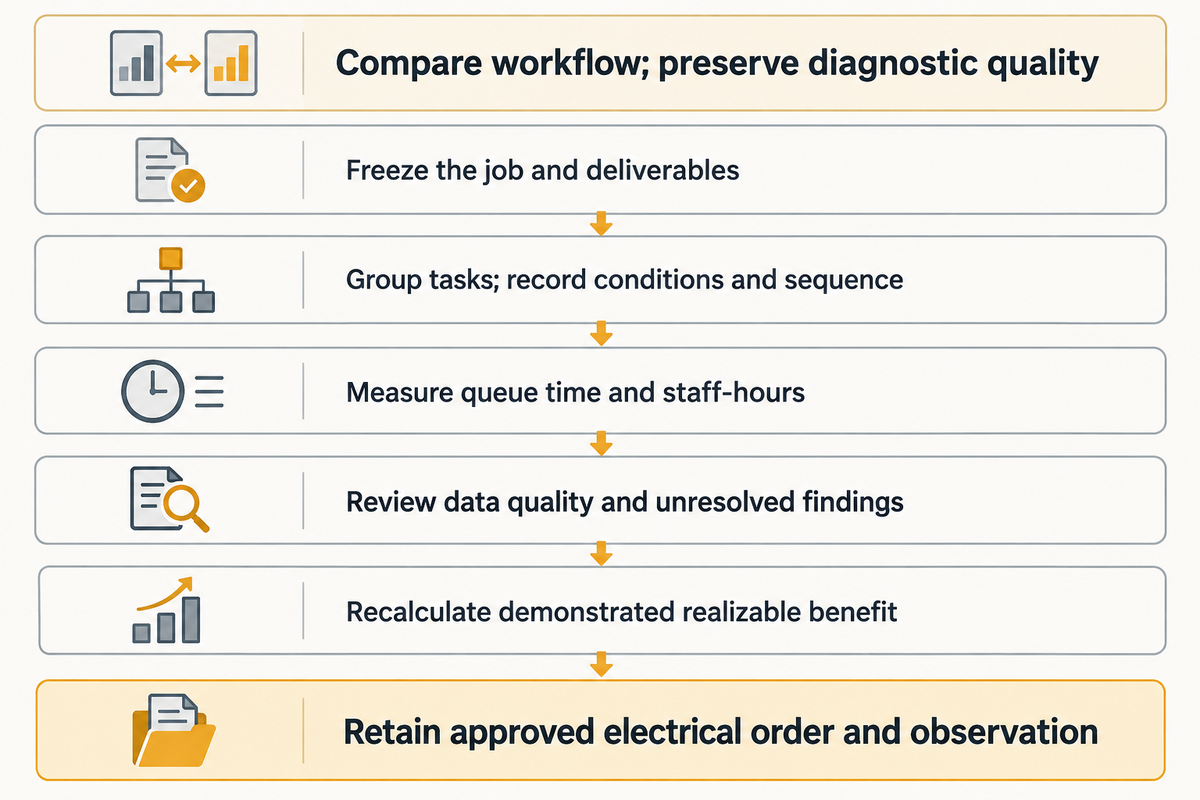
A workflow improvement trial must include equivalent work and preserve diagnostic quality. Group similar jobs by method, asset family, and difficulty. Then compare the old and new methods of handling within each group. Record the operator and test sequence. Count a time benefit only after a qualified reviewer accepts the method-appropriate data and required follow-up remains visible.
The [NIST experimental-design handbook](https://www.itl.nist.gov/div898/handbook/pri/section3/pri332.htm) identifies operators, time of day and temperature as possible nuisance factors. Balance workflow assignments within comparable groups where the approved procedure permits; retain the prescribed electrical test sequence.
> “Block what you can, randomize what you cannot.”
Set the finish criteria first, then time the trial. The criteria should include the correct identification of assets, adequate recorded responses and background, completed settings, and an appropriate observation window and report. Define whether the job concerns PD indications or a specified dielectric strength test. The approved procedure dictates when personnel are allowed to energize the test arrangement. The history of observation is also important. A [NIST study on PD pulse statistics](https://pubmed.ncbi.nlm.nih.gov/28053450/) showed pulse-to-pulse and phase-related memory in its discharge-gap experiments. Maintain the specified conditioning and capture windows rather than shortening them to improve the clock result.
1. Freeze the job definition, required measurement and report deliverables.
2. Group comparable tasks and record operator, conditions and sequence.
3. Measure queue time and affected staff-hours for both workflows.
4. Have the qualified reviewer assess data quality and unresolved findings.
5. Recalculate the business case using only demonstrated, realizable changes.
When planning a field program, resolve access and kit readiness before the comparison, using the [portable PD survey preparation guide](https://demikspower.com/blog/portable-pd-testing-without-complex-setup/), prior to timing the trial. Correction of workmanship issues is part of both commissioning and maintenance. The supplier-affiliated [2022 Incident Prevention article on underground integrity management](https://incident-prevention.com/blog/increasing-safety-through-underground-integrity-management/) discusses that connection. Keep this correction, as well as the following required re-test, in the technical record, even if it extends the duration of the job.
## Account for method changes in the 2025 standard
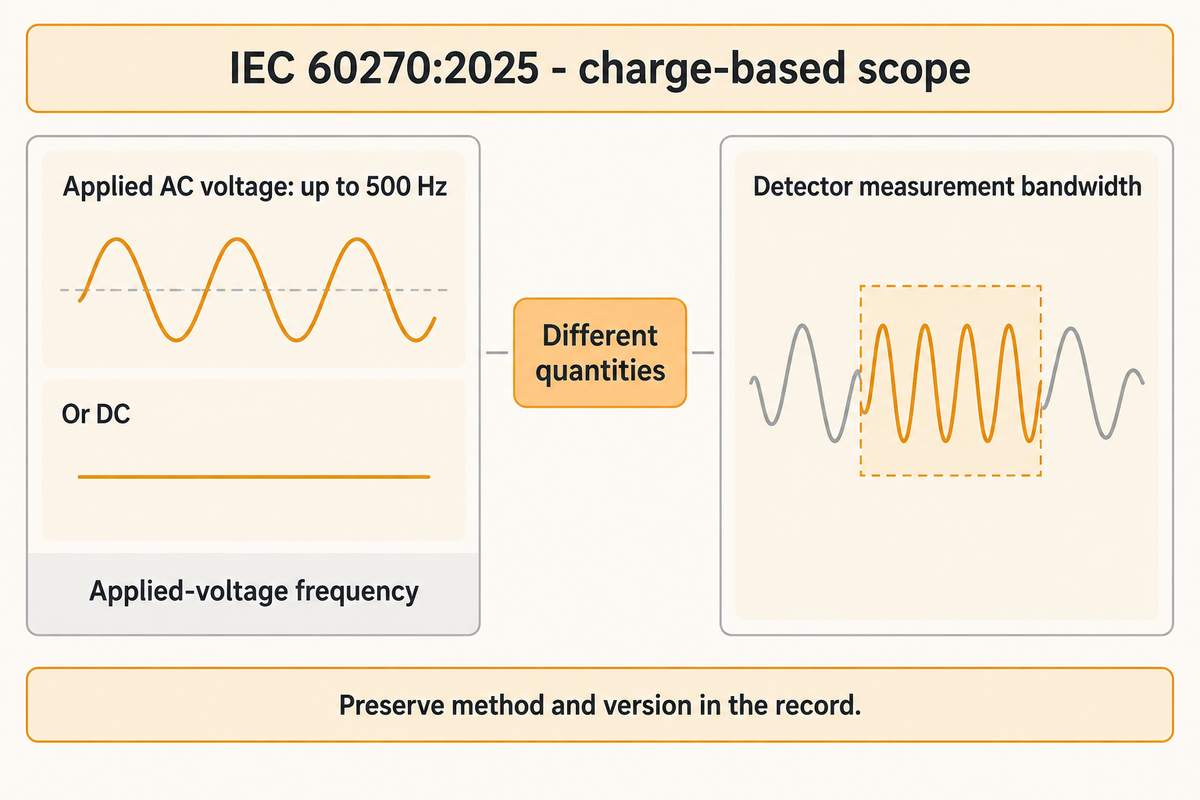
The 2025 revision of IEC 60270 describes the scope of charge-based PD measurements; carry that scope into specifications and report templates. The scoped charge-based PD measurements should be defined and recorded with their method and version. A software field labeled PD should preserve the meaning of the measurement rather than merge unlike indications to a common acceptance value.
The [IEC 60270:2025 public catalogue](https://webstore.iec.ch/en/publication/65087) lists a publication date of 5 June 2025 and identifies it as the fourth edition, replacing the 2000 edition and its 2015 amendment. Its scope is charge-based measurements, using either AC voltages up to 500 Hz, or DC. Applied-voltage frequency and the detector’s measurement bandwidth are different quantities.
The catalogue describes methods and circuits for calibration and identifies means for distinguishing PD from external interference. It suggests IEC TS 62478 for higher frequency measurements. When moving an existing report template to new software, keep the apparatus specification, chosen method and interpretation together.
During a 2026 upgrade, include the required method, observation record and review deliverables in the quotation. DEMIKS can use the selected workflow and sample family to discuss an appropriate [high-voltage test equipment](https://demikspower.com/high-voltage-test-equipment/) arrangement. Start with the task that the time record identifies as constrained, then compare the complete installed package and its operating costs.
## Frequently Asked Questions
### What Does PD Test Stand For?
A PD test is a partial discharge test in this electrical context.
Partial discharge describes localized electrical discharge activity associated with an insulation system. A useful test record identifies the asset, measurement method and conditions, then connects the observed activity to an engineering review. The abbreviation can mean product development elsewhere, so write partial discharge explicitly in test requests, file names and reports for electrical equipment.
### How Does PD Testing Work?
PD testing detects discharge-related signals under defined measurement conditions.
A suitable sensor and measuring arrangement detect electrical, electromagnetic or acoustic effects associated with discharge activity. The engineer records the configured response, background and asset conditions, then interprets the result for the test purpose. Charge-based measurement and acoustic detection produce different outputs, so their units and response checks must travel with the data into the report.
### What is Partial Discharge Test in Transformer?
It examines discharge activity associated with a transformer’s insulation arrangement.
The test uses a measurement method and arrangement selected for the transformer and the engineering question. Record the transformer identity, measuring connections, applied or operating conditions, background interference and interpretation. A factory acceptance measurement and an online condition survey serve different purposes. Preserve that distinction when comparing historical results or transferring a report into another software system.
### Can faster capture remove every repeat test?
No. Some repeats remain necessary for verification or defect investigation.
Faster capture addresses acquisition time. It doesn’t resolve inaccessible measurement paths, missing context or uncertainty about a source. Keep repeats required by the approved procedure and follow-up of a suspected fault. Target preventable setup, handling and documentation errors.
### How do I calculate a PD workflow upgrade payback?
Divide installed incremental cost by positive annual realizable benefit after recurring costs.
First calculate the affected labor and other spending removed by the change. Separate original-job reporting from repeat-run work so the same saving is counted once. Then identify which released hours reduce overtime, contractor expenditure or another expense. Retained salaried hours can provide capacity with no immediate cash saving. Include software, training, maintenance and support costs in the appropriate initial or recurring category. Compare several realization scenarios, including no cash realization. If annual realizable benefit doesn’t exceed recurring costs, the simple calculation gives no positive payback. A larger investment may require discounted lifecycle analysis as well.
### Do all PD methods report picocoulombs?
No. Picocoulombs describe apparent charge in a charge-based measurement.
Electromagnetic or acoustic channels can report other quantities. Their response checks and interpretation belong to the selected method and arrangement. Keep those units with the result; a workflow shouldn’t turn different sensor outputs into interchangeable values merely to fill one report column.
### Which suppliers offer automated PD data and reports?
DEMIKS offers integrated PD systems; compare the reporting scope of the exact model.
DEMIKS describes data retrieval and A4 reporting for DJF-1kVA-7.5kV. OMICRON is another PD equipment supplier represented in the commissioning case discussed above. Compare the proposed control sequence, delivered files, report format and software costs. A demonstration should include reopening the measurement on the intended review workstation, with engineering interpretation retained.
### Discuss the stage limiting your PD testing program
Send DEMIKS the asset or sample family, required measurement method and the stage where jobs wait or repeat. Include the original-data and report deliverables your reviewers need. The [DEMIKS partial discharge equipment range](https://demikspower.com/high-voltage-test-equipment/partial-discharge-testing-equipment/) provides a starting point for comparing the required controls and reporting package.
Assumed planning inputs are used in cost calculation. Technical examples retain the source’s asset and method context; the cited commissioning accounts identify their supplier affiliations.
### References & Sources
1. [29 CFR 1910.269(o), testing and test facilities](https://www.ecfr.gov/current/title-29/subtitle-B/chapter-XVII/part-1910/subpart-R/section-1910.269) Electronic Code of Federal Regulations; Occupational Safety and Health Administration.
2. [Low-Pass Filter for HV Partial Discharge Testing](https://pmc.ncbi.nlm.nih.gov/articles/PMC5856033/) Kindl and colleagues, Sensors, 2018; primary laboratory study.
3. [Partial Discharge Testing and Detection under PWM Voltage](https://trace.tennessee.edu/utk_gradthes/6315/) John Meadors, University of Tennessee, 2021; public thesis abstract.
4. [NIST Technical Note 1297, Appendix D.4](https://www.nist.gov/pml/nist-technical-note-1297/nist-tn-1297-appendix-d4-measurand-defined-measurement-method) National Institute of Standards and Technology.
5. [Onsite Partial Discharge Measurement During Commissioning: Safe From the Start](https://www.tdworld.com/test-and-measurement/article/21138301/omicron-electronics-corp-usa-onsite-partial-discharge-measurement-during-commissioning-safe-from-the-start) Mathieu Lachance and Tim Gannon, TD World, 2020; OMICRON and Advanced Electrical Services affiliations.
6. [Government Efficiency Framework, sections 4.1–4.2 and 4.8](https://www.gov.uk/government/publications/the-government-efficiency-framework/the-government-efficiency-framework--2) UK Government Finance Function and HM Treasury; general efficiency-accounting principles.
7. [Energy-code evaluation methodology, commercial cost-effectiveness](https://energycodes.gov/methodology) US Department of Energy; lifecycle and simple-payback distinctions.
8. [Engineering Statistics Handbook, randomized block designs](https://www.itl.nist.gov/div898/handbook/pri/section3/pri332.htm) National Institute of Standards and Technology.
9. [Stochastic analysis of pulsating phenomena and PD memory effects](https://pubmed.ncbi.nlm.nih.gov/28053450/) NIST primary research; PubMed abstract.
10. [Increasing Safety Through Underground Integrity Management](https://incident-prevention.com/blog/increasing-safety-through-underground-integrity-management/) Daniel Patseavouras, Incident Prevention, 2022; IMCORP affiliation.
11. [IEC 60270:2025, High-voltage test techniques: charge-based measurement of partial discharges](https://webstore.iec.ch/en/publication/65087) International Electrotechnical Commission.
Related Posts
- [DEMIKS Exported Two Sets of Test Equipment to a Client in Jordan This Month](https://demikspower.com/blog/demiks-exported-two-sets-of-test-equipment-to-a-client-in-jordan-this-month/)
- [The Ultimate Guide to the Pensky-Martens Closed Cup Flash Point Tester](https://demikspower.com/blog/closed-cup-flash-point-tester/)
- [Rated Impulse Withstand Voltage (Uimp): Full Engineering Guide](https://demikspower.com/blog/rated-impulse-withstand-voltage/)
- [3 Phase Energy Meter Calibration Procedure: A Step-by-Step Guide](https://demikspower.com/blog/3-phase-energy-meter-calibration-procedure/)
- [Understanding the Variable Frequency Drive: A Comprehensive Guide](https://demikspower.com/blog/what-is-vfd/)
- [Understanding High-Voltage Test Procedures for Transformers](https://demikspower.com/blog/high-voltage-test-procedures/)
- [Effective Fault Location Techniques for Cable Faults](https://demikspower.com/blog/automated-fault-localization-techniques/)
- [How a Variable Frequency AC Hipot Tester Ensures Safety in High Voltage Testing](https://demikspower.com/blog/how-a-variable-frequency-ac-hipot-tester-ensures-safety-in-high-voltage-testing/)

#### XCX
Search
Recent Posts
[](https://demikspower.com/blog/pd-testing-system-with-simple-workflow/)
### [PD Testing System With Simple Workflow: 8 Essential Steps](https://demikspower.com/blog/pd-testing-system-with-simple-workflow/)
October 27, 2026
[](https://demikspower.com/blog/6300a-three-phase-high-current-temperature-rise-test-system/)
### [6300A Three-Phase High Current Temperature Rise Test System](https://demikspower.com/blog/6300a-three-phase-high-current-temperature-rise-test-system/)
October 27, 2026
[](https://demikspower.com/blog/demiks-exported-two-sets-of-test-equipment-to-a-client-in-jordan-this-month/)
### [DEMIKS Exported Two Sets of Test Equipment to a Client in Jordan This Month](https://demikspower.com/blog/demiks-exported-two-sets-of-test-equipment-to-a-client-in-jordan-this-month/)
October 26, 2026
[](https://demikspower.com/blog/how-to-perform-pd-testing-during-fat/)
### [How to Perform PD Testing During FAT and Keep the Results Traceable](https://demikspower.com/blog/how-to-perform-pd-testing-during-fat/)
October 23, 2026
[](https://demikspower.com/blog/complete-set-withstand-voltage-test-bench-supports-tbea-switchgear-factory-test/)
### [Complete Set Withstand Voltage Test Bench Supports TBEA Switchgear Factory Test](https://demikspower.com/blog/complete-set-withstand-voltage-test-bench-supports-tbea-switchgear-factory-test/)
October 22, 2026
[](https://demikspower.com/blog/compact-partial-discharge-shielded-test-system/)
### [Compact Partial Discharge Shielded Test System](https://demikspower.com/blog/compact-partial-discharge-shielded-test-system/)
October 21, 2026
- [DEMIKS Blogs](https://demikspower.com/blog/category/demiks-blogs/)
[](https://demikspower.com)
I’m DEMIKS, and I manage this blog. We are bringing electric power technology from China to the rest of the world for its innovation, sustainability, and global impact. We are deeply driven by professionalism, integrity, and service excellence.
[Read More](#elementor-action%3Aaction%3Dpopup%3Aopen%26settings%3DeyJpZCI6IjI1MyIsInRvZ2dsZSI6ZmFsc2V9)
Scroll to Top
WhatsApp us
Get in touch with DEMIKS company
Contact Form 在用
Your Name \*
Email
Phone/WhatsApp
Your Message
Submit Form
```json
{"@context":"https://schema.org","@graph":[{"@type":["Corporation","Organization"],"@id":"https://demikspower.com/#organization","name":"DEMIKS","url":"https://demikspower.com","logo":{"@type":"ImageObject","@id":"https://demikspower.com/#logo","url":"https://demikspower.com/wp-content/uploads/2025/05/1-1.png","contentUrl":"https://demikspower.com/wp-content/uploads/2025/05/1-1.png","caption":"DEMIKS","inLanguage":"en-US","width":"1453","height":"417"}},{"@type":"WebSite","@id":"https://demikspower.com/#website","url":"https://demikspower.com","name":"DEMIKS","publisher":{"@id":"https://demikspower.com/#organization"},"inLanguage":"en-US"},{"@type":"ImageObject","@id":"https://demikspower.com/wp-content/uploads/2026/10/pd-testing-workflow-inefficient-featured.png","url":"https://demikspower.com/wp-content/uploads/2026/10/pd-testing-workflow-inefficient-featured.png","width":"1200","height":"800","caption":"PD Testing Workflow Inefficient? 7 Fixes That Matter","inLanguage":"en-US"},{"@type":"BreadcrumbList","@id":"https://demikspower.com/blog/pd-testing-workflow-inefficient/#breadcrumb","itemListElement":[{"@type":"ListItem","position":"1","item":{"@id":"https://demikspower.com","name":"Home"}},{"@type":"ListItem","position":"2","item":{"@id":"https://demikspower.com/blog/pd-testing-workflow-inefficient/","name":"Why Your Partial Discharge Testing Workflow Is Inefficient"}}]},{"@type":"WebPage","@id":"https://demikspower.com/blog/pd-testing-workflow-inefficient/#webpage","url":"https://demikspower.com/blog/pd-testing-workflow-inefficient/","name":"PD Testing Workflow Inefficient? 7 Fixes That Matter - DEMIKS","datePublished":"2026-10-26T07:25:43+00:00","dateModified":"2026-10-26T07:25:44+00:00","isPartOf":{"@id":"https://demikspower.com/#website"},"primaryImageOfPage":{"@id":"https://demikspower.com/wp-content/uploads/2026/10/pd-testing-workflow-inefficient-featured.png"},"inLanguage":"en-US","breadcrumb":{"@id":"https://demikspower.com/blog/pd-testing-workflow-inefficient/#breadcrumb"}},{"@type":"Person","@id":"https://demikspower.com/author/xcx/","name":"XCX","url":"https://demikspower.com/author/xcx/","image":{"@type":"ImageObject","@id":"https://secure.gravatar.com/avatar/f36ea60ab6f4e8340ee001b8b447a8b62df47917cc220f9064d270cb9d78c955?s=96&d=mm&r=g","url":"https://secure.gravatar.com/avatar/f36ea60ab6f4e8340ee001b8b447a8b62df47917cc220f9064d270cb9d78c955?s=96&d=mm&r=g","caption":"XCX","inLanguage":"en-US"},"worksFor":{"@id":"https://demikspower.com/#organization"}},{"@type":"BlogPosting","headline":"PD Testing Workflow Inefficient? 7 Fixes That Matter - DEMIKS","keywords":"pd testing workflow inefficient","datePublished":"2026-10-26T07:25:43+00:00","dateModified":"2026-10-26T07:25:44+00:00","author":{"@id":"https://demikspower.com/author/xcx/","name":"XCX"},"publisher":{"@id":"https://demikspower.com/#organization"},"description":"Is your PD testing workflow inefficient? Find partial discharge bottlenecks, reduce avoidable retests and compare integration costs with a payback example.","name":"PD Testing Workflow Inefficient? 7 Fixes That Matter - DEMIKS","@id":"https://demikspower.com/blog/pd-testing-workflow-inefficient/#richSnippet","isPartOf":{"@id":"https://demikspower.com/blog/pd-testing-workflow-inefficient/#webpage"},"image":{"@id":"https://demikspower.com/wp-content/uploads/2026/10/pd-testing-workflow-inefficient-featured.png"},"inLanguage":"en-US","mainEntityOfPage":{"@id":"https://demikspower.com/blog/pd-testing-workflow-inefficient/#webpage"}}]}
{"@context":"https://schema.org","@type":"FAQPage","mainEntity":[{"@type":"Question","name":"What Does PD Test Stand For?","acceptedAnswer":{"@type":"Answer","text":"Partial discharge describes localized electrical discharge activity associated with an insulation system. A useful test record identifies the asset, measurement method and conditions, then connects the observed activity to an engineering review. The abbreviation can mean product development elsewhere, so write partial discharge explicitly in test requests, file names and reports for electrical equipment."}},{"@type":"Question","name":"How Does PD Testing Work?","acceptedAnswer":{"@type":"Answer","text":"A suitable sensor and measuring arrangement detect electrical, electromagnetic or acoustic effects associated with discharge activity. The engineer records the configured response, background and asset conditions, then interprets the result for the test purpose. Charge-based measurement and acoustic detection produce different outputs, so their units and response checks must travel with the data into the report."}},{"@type":"Question","name":"What is Partial Discharge Test in Transformer?","acceptedAnswer":{"@type":"Answer","text":"The test uses a measurement method and arrangement selected for the transformer and the engineering question. Record the transformer identity, measuring connections, applied or operating conditions, background interference and interpretation. A factory acceptance measurement and an online condition survey serve different purposes. Preserve that distinction when comparing historical results or transferring a report into another software system."}},{"@type":"Question","name":"Can faster capture remove every repeat test?","acceptedAnswer":{"@type":"Answer","text":"Faster capture addresses acquisition time. It doesn't resolve inaccessible measurement paths, missing context or uncertainty about a source. Keep repeats required by the approved procedure and follow-up of a suspected fault. Target preventable setup, handling and documentation errors."}},{"@type":"Question","name":"How do I calculate a PD workflow upgrade payback?","acceptedAnswer":{"@type":"Answer","text":"First calculate the affected labor and other spending removed by the change. Separate original-job reporting from repeat-run work so the same saving is counted once. Then identify which released hours reduce overtime, contractor expenditure or another expense. Retained salaried hours can provide capacity with no immediate cash saving. Include software, training, maintenance and support costs in the appropriate initial or recurring category. Compare several realization scenarios, including no cash realization. If annual realizable benefit doesn't exceed recurring costs, the simple calculation gives no positive payback. A larger investment may require discounted lifecycle analysis as well."}},{"@type":"Question","name":"Do all PD methods report picocoulombs?","acceptedAnswer":{"@type":"Answer","text":"Electromagnetic or acoustic channels can report other quantities. Their response checks and interpretation belong to the selected method and arrangement. Keep those units with the result; a workflow shouldn't turn different sensor outputs into interchangeable values merely to fill one report column."}},{"@type":"Question","name":"Which suppliers offer automated PD data and reports?","acceptedAnswer":{"@type":"Answer","text":"DEMIKS describes data retrieval and A4 reporting for DJF-1kVA-7.5kV. OMICRON is another PD equipment supplier represented in the commissioning case discussed above. Compare the proposed control sequence, delivered files, report format and software costs. A demonstration should include reopening the measurement on the intended review workstation, with engineering interpretation retained."}}]}
```