Electrical safety is a critical consideration in numerous industries, from manufacturing to utilities, where equipment and systems are constantly exposed to high voltage environments. At the heart of ensuring this safety lies the dielectric breakdown tester, an advanced tool designed to assess the insulating properties of materials and components. This blog post explores the vital role of dielectric breakdown testers in preventing electrical failures, ensuring reliability, and maintaining compliance with stringent safety standards. Whether you’re an engineer, a technician, or a decision-maker aiming to mitigate risks, this article will provide a detailed examination of how these devices work, why they are essential, and how they contribute to safer operational environments. Stay tuned as we unpack the intricacies of dielectric testing and its indispensable role in safeguarding electrical systems.
What Is Insulating Oil and Why Is It Important?

Insulating oil, also known as transformer oil, is a specialized oil used in electrical equipment such as transformers and circuit breakers. Its primary function is to provide electrical insulation and prevent arcing or short circuits between components. Additionally, insulating oil serves as a coolant, dissipating heat generated during the operation of electrical equipment. The oil’s high dielectric strength and thermal stability make it critical for maintaining the efficiency, reliability, and safety of electrical systems. Ensuring the quality and purity of insulating oil is essential, as contamination or degradation can compromise its performance and lead to equipment failure.
How Does Insulating Oil Work?
Insulating oil functions primarily by providing electrical insulation and thermal management in high-voltage systems. Its high dielectric strength prevents electrical discharges and arcs by isolating live components in equipment such as transformers, capacitors, and switchgear. The oil serves as a cooling medium by absorbing heat generated during operation and transferring it to radiators or cooling systems, ensuring the equipment operates within safe temperature limits. Additionally, insulating oil suppresses corona and arcing, reducing the risk of damage caused by electrical stresses. Regular maintenance and testing are crucial to monitor its quality, as impurities, moisture, or oxidation products can degrade its performance over time.
Benefits of Using Insulating Oil in Transformers
- Efficient Cooling: Insulating oil plays a critical role in dissipating heat generated within the transformer, ensuring that its components remain at optimal operating temperatures.
- Electrical Insulation: The oil enhances dielectric strength, preventing electrical breakdowns and allowing transformers to handle high voltage levels safely.
- Arcing and Corona Suppression: By reducing ionization and electrical discharges, insulating oil helps minimize transformer damage caused by arcing and corona effects.
- Moisture Protection: Insulating oil acts as a barrier against moisture ingress, which can severely impact the performance and integrity of the transformer’s insulating materials.
- Oxidation Resistance: High-quality insulating oil slows down the oxidation process of transformer components, extending their operational lifespan.
- Contaminant Suspension: The oil helps trap impurities and particles, preventing them from interfering with the internal components of the transformer.
- Thermal Stability: It maintains stability under high-temperature conditions, ensuring consistent performance even during heavy load operations.
- Diagnostics and Monitoring: Insulating oil can be sampled for analysis to provide critical data on transformer health, detecting issues such as overheating, moisture content, or gas generation caused by faults.
The Role of Insulating Oil in Electrical Equipment
Importance of Monitoring Insulating Oil
Monitoring insulating oil is a critical aspect of maintaining the reliable operation of electrical equipment. Proper diagnostics can identify potential issues before they escalate into failures. Key technical parameters involved in the monitoring and analysis process include:
- Dielectric Strength (kV): A high dielectric strength indicates the oil’s capability to resist electrical breakdown, typically above 30 kV is considered suitable in most transformers.
- Moisture Content (ppm): Moisture significantly impacts insulation performance; acceptable levels are generally less than 10 ppm for new oil.
- Acidity (mg KOH/g): High acidity levels indicate oil degradation, with values exceeding 0.4 mg KOH/g necessitating corrective action.
- Dissolved Gas Analysis (DGA): Measurement of gases like hydrogen (H₂), methane (CH₄), and acetylene (C₂H₂) can detect overheating or arcing. Thresholds vary but low concentrations are typically expected.
- Interfacial Tension (mN/m): A decrease in interfacial tension below 25 mN/m often suggests contamination or aging of oil.
Regular sampling and testing ensure that insulating oil remains within these acceptable ranges, thereby preserving the safety, efficiency, and longevity of electrical equipment.
How Does a Dielectric Breakdown Tester Function?

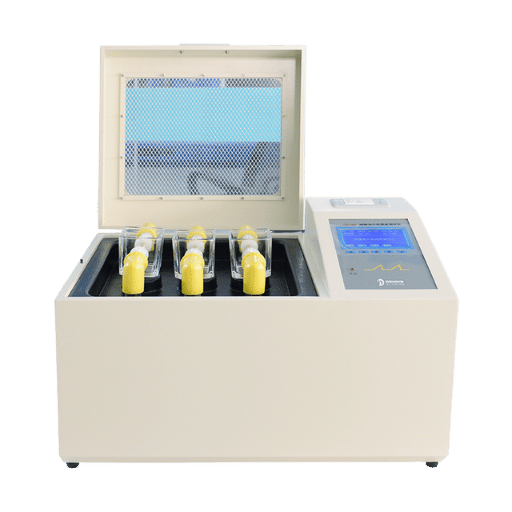
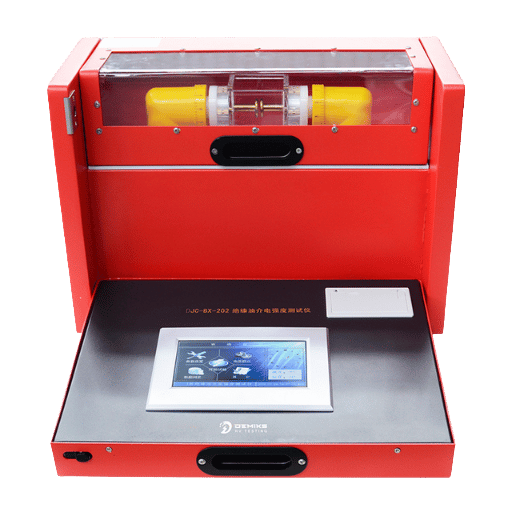
A Dielectric Breakdown Tester operates by applying an increasing voltage to a sample of insulating oil until the oil’s dielectric strength is exceeded, resulting in electrical breakdown. The test typically involves placing the oil sample between two electrodes at a specified gap distance. Voltage is then increased at a controlled rate until a breakdown occurs, which is indicated by a sudden drop in resistance and current conduction across the electrodes. The voltage at which this breakdown occurs is recorded, providing a measure of the oil’s dielectric strength. This test is critical for assessing the insulation performance and identifying potential risks in electrical equipment.
Key Components of a Dielectric Breakdown Tester
- High-Voltage Transformer
A critical component that generates the high voltage needed to perform the breakdown test. This transformer allows for precise control over the voltage applied to the test sample.
- Electrodes
Typically designed in spherical, cylindrical, or flat plate shapes, electrodes are arranged at a standardized gap to ensure consistent application of the electric field. The material and surface finish of the electrodes significantly influence test accuracy.
- Dielectric Fluid Test Chamber
This chamber holds the insulation oil or fluid sample in a controlled, contamination-free environment. Proper design ensures uniform distribution of the electric field during testing.
- Voltage Control and Monitoring System
Includes a variac or digital control system to gradually increase the voltage at a precise rate while monitoring the applied voltage in real-time for accuracy and safety.
- Current Detection Circuit
Integral for identifying the exact moment of dielectric breakdown. It registers the sudden increase in current flow following the breakdown event.
- Protective Mechanisms
Safety components such as circuit breakers or automatic shutoff systems are implemented to protect the equipment and operator during sudden fault conditions or excessive current draw.
- Data Recording and Display Unit
Modern testers are equipped with digital interfaces or software systems to record test results, such as breakdown voltage, and present them for analysis or regulatory reporting.
Understanding Breakdown Voltage
Breakdown voltage refers to the minimum voltage level at which an insulating material loses its dielectric properties and begins to conduct electricity. This phenomenon occurs when the electric field within the material exceeds its dielectric strength, causing a sudden and uncontrollable flow of current through the insulator. Common factors influencing breakdown voltage include the type of material, thickness, temperature, and humidity conditions. For gases, such as air, the Paschen’s Law governs the relationship between pressure and breakdown voltage. Accurate measurement of breakdown voltage is crucial in ensuring the reliability and safety of electrical systems, particularly in high-voltage equipment, as it helps identify the tolerances and potential failure points within insulating components.
Steps to Conduct an Oil Dielectric Test
- Preparation of Equipment: Begin by calibrating the dielectric test apparatus to ensure accurate measurements. Verify the cleanliness and functionality of the test electrodes and high-voltage power source.
- Sample Collection: Obtain a representative oil sample using clean, dry containers to prevent contamination. The sample should come from the equipment’s oil reservoir and adhere to sampling standards such as ASTM D923.
- Inspection of the Sample: Check the oil sample for visible contamination such as moisture, solid particles, or discoloration. Contaminated samples should be filtered or degassed before testing.
- Insertion into Test Cell: Carefully pour the oil sample into the test cell, ensuring it is free of air bubbles. Maintain the recommended gap between the electrodes as specified by testing standards like ASTM D1816 or IEC 60156.
- Voltage Application: Gradually apply the test voltage to the electrodes at a controlled rate such as 0.5 to 2 kV per second, depending on standard guidelines.
- Observation of Breakdown: Record the voltage at which the dielectric breakdown occurs. This is the point when electrical arcing passes through the insulating oil, indicating its breakdown voltage.
- Repetition for Accuracy: Repeat the test multiple times (usually five to six cycles) with the same sample and calculate the average breakdown voltage to improve reliability.
- Data Analysis: Analyze the results in comparison to benchmark values or industry standards to assess the oil’s insulating properties. Low breakdown voltage values suggest contamination or degradation of the oil.
- Disposal or Reconditioning: If the oil fails the test, determine whether it can be reconditioned (e.g., through filtration or chemical treatment) or requires replacement. Dispose of degraded oil according to environmental regulations.
- Documentation: Record all test procedures, observations, and results in a detailed report for traceability and further analysis. Include specific details about the test conditions and equipment used.
Why Is Dielectric Strength Testing Crucial?

Dielectric strength testing is crucial for assessing the insulating properties of electrical insulating oil, which is critical to the safe and reliable operation of transformers, circuit breakers, and other high-voltage equipment. Over time, insulating oil can degrade due to contamination, moisture absorption, or oxidation, reducing its ability to withstand electrical stress. By measuring the dielectric strength, maintenance teams can identify potential failures before they occur, ensuring the system’s operational integrity, preventing costly downtime, and maintaining compliance with safety and performance standards. This testing acts as a preventative maintenance tool that supports equipment longevity and overall grid reliability.
Impact of Dielectric Breakdown on Equipment
Dielectric breakdown significantly affects electrical equipment by compromising its performance and safety. This phenomenon occurs when the insulating material within equipment fails to withstand the applied electrical field, resulting in an uncontrolled current flow that can damage critical components. Key impacts include:
- Insulation Degradation: During dielectric breakdown, the insulating material’s molecular structure deteriorates. This process can lead to permanent damage, reducing the equipment’s insulating properties and making it more prone to future failures.
- Short Circuits and System Failures: The breach in insulation allows electrical arcs to form, potentially triggering short circuits. This can cascade into broader system failures, interrupting operations and increasing downtime.
- Thermal Damage: The excessive heat generated during electrical discharge can cause localized thermal damage. High temperatures may melt or burn insulation, as well as surrounding materials, further worsening the equipment’s reliability.
- Decreased Equipment Lifespan: Dielectric breakdown accelerates the aging of electrical components by exposing them to extreme stress. This reduces their designed operational longevity and increases maintenance and replacement costs.
Technical Parameters of Dielectric Breakdown
- Dielectric Strength (kV/mm or MV/m): The maximum electric field the material can withstand without breaking down. For example:
-
- Air (20°C, 1 atm): ~3 kV/mm
- Transformer Oil (IEC 60156 standard): 30-50 kV/2.5 mm
- Solid Insulators (e.g., Polyethylene): 20-40 kV/mm
- Breakdown Voltage (kV): The electrical potential at which failure occurs, influenced by material type, thickness, and environmental conditions.
- Partial Discharge (pC): Often a precursor to dielectric failure, partial discharge values above acceptable limits (e.g., 10 pC for high-voltage cables) indicate insulation defects.
- Temperature (°C): Elevated operating temperatures can lower dielectric strength. For instance, transformer oil’s dielectric strength decreases by ~10% per 10°C increase.
By monitoring these parameters closely and implementing robust insulation materials, the risks of dielectric breakdown can be minimized, ensuring the efficient and safe operation of electrical equipment.
Ensuring Safety with High Voltage Testing
High voltage testing is essential for verifying the safety, reliability, and performance of electrical systems. It involves applying test voltages that exceed normal operating levels to detect potential insulation weaknesses or faults. From my professional perspective, critical technical parameters to consider include:
- Test Voltage (kV): Typically set to 1.5 to 2 times the system’s operating voltage for AC testing, or higher for DC testing.
- Leakage Current (µA or mA): Acceptable thresholds depend on the insulation specifications but should be minimal and stable during testing.
- Duration (seconds to minutes): Typically 1-5 minutes, as prolonged exposure could degrade insulation, especially in aged systems.
- Insulation Resistance (MΩ): Measured using a megohmmeter, with values above 100 MΩ often considered adequate for most high-voltage applications.
By adhering to these parameters and following strict procedural guidelines, we can detect early-stage insulation failures and ensure compliance with international safety standards, such as IEC 60060 or ANSI/IEEE testing protocols. This systematic approach reduces risks and enhances the overall safety of high-voltage equipment.
Frequency of Test Results Analysis
The frequency of test results analysis should align with the operational demands and criticality of the equipment being monitored. Based on industry standards and recommendations, I would perform routine insulation resistance testing annually for most systems, increasing the frequency to every six months or even quarterly for high-risk or heavily utilized equipment. Additionally, I would analyze test data immediately after major electrical incidents or environmental changes, such as significant humidity variations, to ensure reliability and safety. By adhering to these intervals, I can proactively identify potential issues and maintain compliance with IEC and ANSI/IEEE guidelines.
How to Choose the Right Oil Test Equipment

When selecting oil test equipment, it is essential to consider several key factors to ensure accuracy, reliability, and compliance with industry standards. First, evaluate the specific type of tests required, such as dielectric breakdown voltage, moisture content, or dissolved gas analysis, and choose equipment designed for those precise testing protocols. Next, ensure compatibility with the type of insulating oil being analyzed, as different oils may require unique testing parameters. Additionally, assess the equipment’s measurement range, accuracy, and repeatability to align with the desired level of precision. Durability and ease of operation are critical for field applications, so prioritize rugged designs with user-friendly interfaces. Lastly, ensure the equipment meets established standards such as ASTM and IEC to guarantee reliable and standardized results.
Factors to Consider in a Tester
- Measurement Range: Ensure the device can handle the expected range of values for the materials or substances being tested.
- Accuracy: Confirm the tester provides precise results within the required tolerances for your application.
- Repeatability: Evaluate the equipment’s ability to deliver consistent results across multiple measurements.
- Durability: Prioritize robust designs that can withstand demanding field or laboratory environments.
- Ease of Operation: Opt for user-friendly controls and interfaces to enhance usability and reduce operational errors.
- Compliance with Standards: Verify that the tester adheres to established guidelines such as ASTM, IEC, or industry-specific regulations.
- Calibration Requirements: Consider the frequency and complexity of calibration processes to maintain optimal performance over time.
- Response Time: Assess the speed at which the tester delivers results, particularly for time-sensitive applications.
- Portability: If fieldwork is necessary, look for compact, lightweight designs that facilitate easy transportation.
- Power Source: Evaluate whether the tester uses battery power, electricity, or other sources, and ensure compatibility with the intended usage environment.
- Cost-effectiveness: Balance the initial investment and long-term operational costs against the value provided by the equipment.
- Support and Maintenance: Consider the availability of technical support, spare parts, and maintenance services from the manufacturer.
Comparing Automatic Insulating Oil Dielectric Testers
| Model | Max Voltage (kV) | Weight (kg) | Power Source | Key Features | Applications | Price (USD) |
|---|---|---|---|---|---|---|
|
Megger OTS PB Series |
60-80 |
16.8-20.8 |
Mains/Battery |
Lightweight, shatterproof vessel, internal printer |
Field and Lab Use |
N/A |
|
Megger OTS AF Series |
60-100 |
N/A |
Mains |
Barcode scanner, large test chamber |
Lab Use |
N/A |
|
HV Diagnostics BA-75 |
75 |
22 |
Battery/AC |
Bluetooth, PDF reports, integrated printer |
Field and Lab Use |
N/A |
|
HV Diagnostics BA-100 |
100 |
32 |
Battery/AC |
Bluetooth, PDF reports, integrated printer |
Field and Lab Use |
N/A |
|
MDWXDOFP Single Cup Tester |
80 |
N/A |
Mains |
Fully automatic, withstand voltage testing |
Industrial Use |
5,187.94 |
|
High Voltage DTS-60D |
60 |
N/A |
Mains |
Arc detection, motorized rise rates |
Oil Testing |
N/A |
|
Hipotronics OC60D |
60-90 |
Portable |
Mains |
Rugged, reliable, lightweight |
Field and Lab Use |
N/A |
|
Phenix LD60 |
60 |
N/A |
Mains |
Safety interlock, fast relay cutout |
Oil Testing |
N/A |
|
Baur DPA 75C |
75 |
N/A |
Battery |
Portable, long battery life |
Field Use |
N/A |
Understanding Test Vessel Specifications
Test vessels are critical components in automatic insulating oil dielectric testers, as they directly influence the accuracy and repeatability of measurements. Specifications to consider include the material, size, and design of the vessel. High-quality test vessels are constructed from durable, non-conductive materials such as glass or specialized polymers to prevent interference with the dielectric strength test results. The size and internal geometry of the vessel must adhere to industry standards, such as ASTM D877 or IEC 60156, to ensure compatibility with testing procedures and replicability of results.
Another crucial factor is electrode configuration. Standard configurations such as parallel plate electrodes with specific gap settings are necessary for consistent field strength during testing. Additionally, the vessel must be designed to prevent contamination, maintain cleanliness, and allow for easy sample handling, as impurities in the oil or on the vessel’s surface can severely skew results. Understanding these specifications ensures accurate dielectric performance assessments of insulating oil.
What Are the Latest Innovations in Dielectric Oil Testing?

Recent innovations in dielectric oil testing have focused on enhancing accuracy, efficiency, and real-time monitoring capabilities. Advanced automated testing equipment now integrates precise digital sensors to measure breakdown voltage, moisture content, and contamination levels with higher reliability. The development of portable dielectric oil testers enables on-site analysis, reducing downtime and maintenance costs. Furthermore, the adoption of machine learning algorithms allows for predictive analysis by identifying patterns in dielectric performance, aiding in preventative maintenance strategies. These advancements collectively improve the reliability and lifespan of electrical systems by ensuring more effective monitoring of insulating oil.
The Shift to Fully Automatic Testing Solutions
The transition to fully automatic dielectric oil testing solutions revolutionizes insulation monitoring by integrating advanced automation technologies. Key features of these systems include automated sample handling, precise calibration functions, and real-time data acquisition, which collectively minimize human error and enhance measurement accuracy. These systems often operate within defined technical parameters, such as test voltages ranging from 0 kV to 100 kV, measurement accuracy of ±1%, and resolution levels down to 0.01 kV. Furthermore, automated systems support multi-sample testing, reducing manual intervention and significantly improving throughput. By implementing algorithms for real-time condition assessment, fully automatic testers can predict oil aging, detect contamination, and indicate necessary maintenance actions, supporting the proactive upkeep of electrical systems. The seamless integration of automation not only improves operational efficiency but also ensures compliance with international testing standards, such as IEC 60156 or ASTM D1816.
Advancements in Voltage Breakdown Technology
- High-Precision Measurement Systems: Modern testers utilize advanced sensors and digital signal processing to achieve precise and repeatable measurements, minimizing errors caused by environmental factors or equipment variability.
- Real-Time Data Analysis: Integration of onboard processing units enables real-time analysis of voltage breakdown tests, allowing for faster decision-making without the need for external data handling.
- Automated Testing Procedures: Fully automated equipment reduces the need for manual intervention, ensuring consistency and adherence to standardized testing protocols.
- Enhanced Safety Features: Incorporation of fail-safes, insulation monitoring, and emergency shut-off mechanisms ensures operator and equipment safety during high-voltage testing processes.
- Compact and Portable Designs: Recent advancements have led to the development of portable testers offering functionality comparable to larger lab-based systems, enabling on-site testing in remote locations.
- Integration with IoT and Cloud Platforms: Connectivity with IoT systems and cloud-based databases facilitates remote monitoring, data storage, and trend analysis over extended periods.
- Improved Material and Electrode Technology: Use of high-performance materials in electrode design enhances durability and ensures consistent testing across a wide range of conditions.
- Wide Range of Test Capabilities: Equipment now supports testing of various insulating liquids under differing environmental conditions, meeting diverse industrial requirements.
- Compliance with Evolving Standards: Continuous updates to testing protocols ensure compatibility with emerging international norms and industry expectations.
Integration of Magnetic Stirrer in Testing Procedures
The integration of a magnetic stirrer into testing procedures enhances the precision and consistency of results, particularly for liquids requiring uniform temperature and mixing. By maintaining a homogeneous mixture throughout the testing period, magnetic stirrers prevent the settling of particles and ensure accurate dielectric breakdown voltage (BDV) measurements in insulating liquids. Key benefits include improved thermal distribution, the elimination of manual stirring errors, and repeatability under strict testing conditions. Modern stirrers can operate seamlessly within closed systems, adhering to safety regulations while maintaining the integrity of the sample. This technology aligns with evolving standards, supporting the need for reliable and reproducible industrial testing methodologies.
Reference Sources
- Ensure Electrical Safety with Dielectric Withstand Testing – Discusses how dielectric testing ensures insulation safety under extreme conditions.
- Dielectric Breakdown Testing – Explains the qualities and limits of electrical insulators for safe product design.
- The Dielectric Voltage Withstand Test – A white paper on the role of dielectric voltage withstand tests in product safety evaluations.
- White Paper: Fundamentals of Electrical Safety Testing – Covers the importance of electrical safety testers in manufacturing.
- Industrial Applications of Dielectric Strength Testing – Focuses on the role of dielectric strength testing in ensuring insulating properties.
Frequently Asked Questions (FAQs)
Q: What is a dielectric breakdown tester, and why is it important for electrical safety?
A: A dielectric breakdown tester, often referred to as a “megger,” is used to assess the condition of insulating oils by measuring their breakdown voltage. This is crucial for ensuring electrical safety, as it helps identify the dielectric strength of the oils used in electrical equipment.
Q: How does a fully automatic insulating oil dielectric tester work?
A: A fully automatic insulating oil dielectric tester automates the test sequences, applying an ac voltage that is increased until the oil breaks down. This process is recorded in the test report, ensuring consistent and accurate measurements of the oil’s dielectric strength.
Q: What significance does the breakdown voltage of insulating oils have in electrical testing?
A: The breakdown voltage of insulating oils indicates the maximum ac voltage the oil can withstand before failing. This measure is critical for determining the oil’s effectiveness in insulating and protecting electrical components.
Q: What role does the sample temperature play in the testing of insulating oils?
A: Sample temperature is vital during the testing of insulating oils because it can affect the oil’s viscosity and dielectric properties. Consistent temperature control ensures accurate results in assessing the oil’s condition.
Q: What standards are typically followed in testing oil dielectric breakdown?
A: Standards such as BS EN 60156 and VDE 0370 guide the testing of oil dielectric breakdown. These standards ensure that the testing methods and results are consistent, reliable, and recognized internationally.
Q: Why is it important to monitor water content in insulating oils?
A: Water content in insulating oils can significantly affect their dielectric strength. High water content can lead to reduced insulation performance and increased risk of failure, making it crucial to monitor and control.
Q: What are the typical voltage ratings used in dielectric breakdown testing?
A: Common voltage ratings for dielectric breakdown testing include 60 kV and 80 kV. These voltages are used to ensure the oil can handle the stresses it will encounter in actual applications without breaking down.
Q: How are test results documented in the context of dielectric breakdown testing?
A: Results from dielectric breakdown testing are recorded in the test report. This document provides detailed information on test conditions, procedures, and outcomes, serving as a critical reference for maintenance and safety evaluations.
Q: What is the switch off time in the context of dielectric breakdown testing?
A: Switch off time refers to the duration taken to stop the application of voltage once the oil dielectric breakdown is detected. Prompt switch off is crucial to prevent damage to the test set and ensure accurate results.
Q: How does an automatic insulating oil dielectric strength tester contribute to efficiency?
A: An automatic insulating oil dielectric strength tester streamlines the testing process by automating voltage application and recording results. This reduces human error, saves time, and enhances the reliability of the test data.


![Partial Discharge Test Equipment: Types, Selection & IEC 60270 Guide [2026]](https://demikspower.com/wp-content/uploads/2026/05/0-10.webp)

![What Instrument Is Used to Measure Temperature? [2026 Guide]](https://demikspower.com/wp-content/uploads/2026/05/0-8.webp)