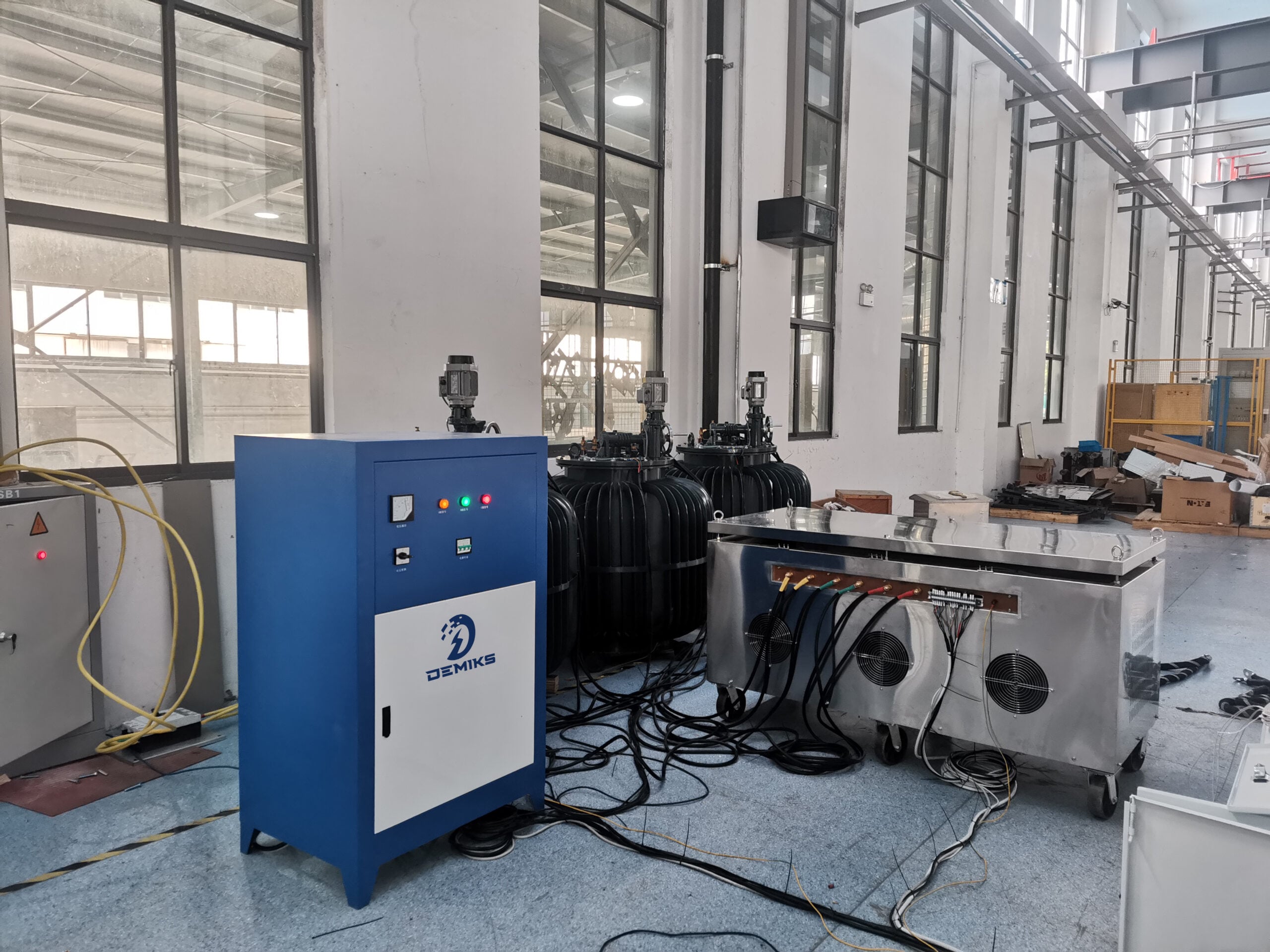
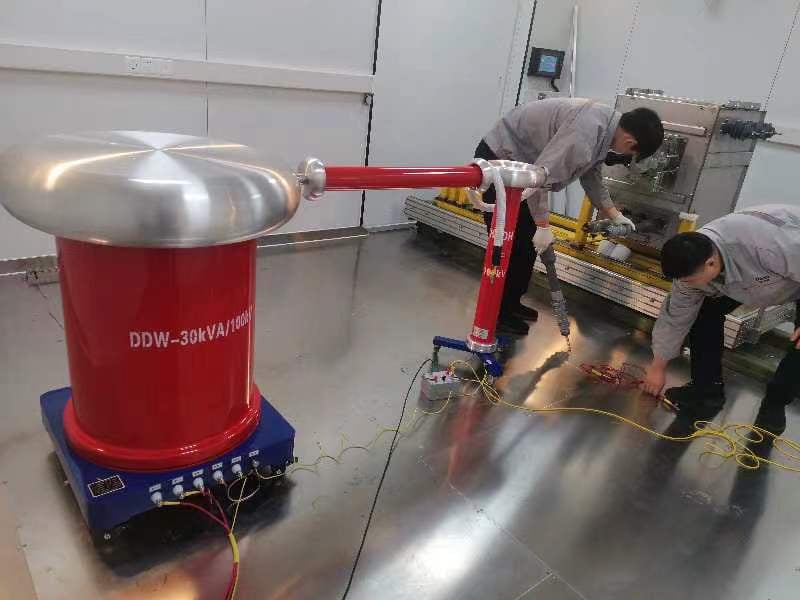
pd testing for factory release decisions is the last technical gate that takes a high voltage asset and decides whether it leaves the factory destined for the substation, ready for rework, or destined for scrap. A measurement performed under IEC 60270 conditions refines an physical insulation imperfection into a justifiable numerical conclusion – apparent charge, in picocoulombs – that the QA department can signoff; that the customer witnessing can countersign; that the warranty file can archive. What unavoidably changes between a 132 kV transformer, a 33 kV cable, and a 13.8 kV motor is simply a unique pC value. This document documents the protocol, the asset-specific acceptance thresholds, and the release decision matrix that binds them.
Quick Specs: Factory PD Testing at a Glance
| Reference Standard | IEC 60270:2000 (BS EN 60270:2001) |
| Test Voltage Range | 3 kV to 769 kV+ (asset-dependent) |
| Sensitivity Floor | 0.1 pC to 5 pC (laboratory-grade detector) |
| Hold Time at Test Voltage | 30 s to 60 min (per asset standard) |
| Apparent Charge Pass Threshold | ≤ 5 pC (cables) to ≤ 500 pC (large transformers) |
| Release Decision Tiers | Pass / Conditional / Hold-Rework / Reject |
Why PD Testing Decides Whether HV Equipment Ships or Stays

Every single high voltage asset that runs out of a factory leaves a promise: the insulation system can sustain its rated voltage loading for decades, rather than days. Routine dielectric and HV withstand testing validate that the insulation can carry a temporary high overvoltage peak. They do not validate that the subject asset is free of tiny internal defects – voids, contamination, delamination, or interface insults – that will diminish the dielectric stresses profile over thousands of operating hours. partial discharge testing fills that gap.
The phenomena are well understood. PDs within a void produce UV photons, ozone, and mechanical shock wave fronts that consume the insulation and create a treeing path that accelerates towards full breakdown. Slow build-up initially permits a delay; exponential growth pushes the premature end-of-life stage ever closer.
Measuring a PD signature at the factory release stage changes that formula. It creates a numerical baseline that the customer commissioning team and the equipment reliability group can refer to later back in the field. When the apparent charge a year from now reads 8 pC above the original FAT reading, that delta becomes solid engineering evidence – not noise, not calibration drift, but a justifiable indication that something has changed.
A factory PD signature is the sole diagnostic record produced under strictly controlled conditions – Faraday-shielded room, calibrated input charge, low-noise high voltage source. While measurements in the field will be more convenient to perform, they will prove noisier, so the factory record becomes the reliability baseline for the entire asset life cycle.
The IEC 60270 Test Protocol Used at Factory Release
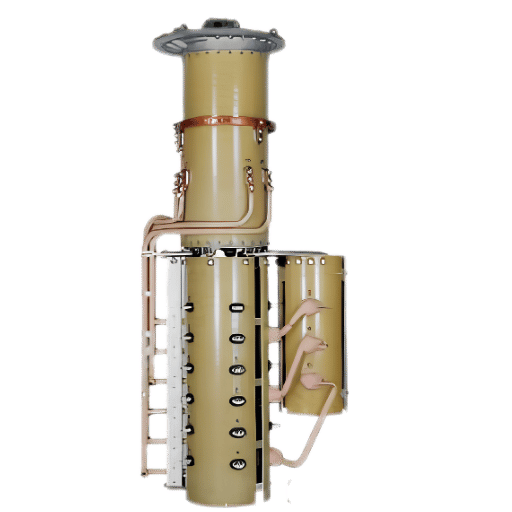
IEC 60270:2000 is an electrical method that every product standard references for partial discharge measurement. It does not, alone, prescribe acceptance thresholds – those are found later in asset-specific standards. What IEC 60270 does do is specify the measurement chain and calibration method so that a 50 pC reading in a transformer in Seoul is comparable to a 50 pC reading in the same asset in Munich.
This sequence is implemented each time a factory release test under IEC 60270 is performed. It involves five steps: First, the test object is joined into a circuit with a low-inductance coupling capacitor and an associated measuring impedance — the apparent charge — with current flow through the coupling capacitor. The was picocoulombs flowing through the coupling capacitor is thus some measure of the unmeasurable real charge change of the discharge occurrence.
Second, a calibrator introduces a known step charge (eg 1 pC, 10 pC, 100 pC) into the circuit when the high voltage source is off. The detector readings are normalized to this quantity, so the future readings directly translates to picocoulombs. Third, the calibrator is disconnected, the high voltage source turned on, and the test voltage raised in increments to the pre-stress value that is relevant for the given asset standard.
Fourth, the voltage is held for the appointment test period at the specified value, while the detector continuously logs apparent charge magnitude, rate, and phase. Fifth, the voltage is returned to zero and the voltage returns near the PDEV.
At the six parameters the ones that really determine the release decision are the partial discharge inception voltage ( PDIV) – the minimum voltage at which sustained PD activity is initially detected and apparent charge magnitude at the acceptance test voltage. PDIV greater than the rated operating voltage and apparent charge less than asset specific limit make up a pass.
How is the IEC 60270 calibrator used during factory testing?
Most factory PD defects come into being in the calibration step, not in the under test device. The apparent charge concept is there because the real charge transfer at an immersed PD site is not accessible directly, it can only be detected at the instrument terminals as a voltage perturbation. The calibrator replicates that perturbation.
It is a square-wave generator with a dedicated voltage burst-generating capacitor that is electrically switched by an external light beam to ensure the operator never enters the high voltage area: a 100 pC step charge produces a predictable spike of q/ C b at the test object terminals, with C b the bulk capacitance of the under test. The detector measures that spike and the measurement system memorizes the calibration scale. Ignore it, or run it before hooking up the actual capacitive load, and each following reading is inaccurate by an unknown factor ¾ often by a factor of ten.
Pass/Fail Criteria: How Many pC Is Too Many?

The parameters for pC are not uniform. There is no upper limits to acceptance; IEC 60270 abstains from expressing them, since they have to be established within the standards. The following numbers are a compilation of accepted standards for each asset class, to set the four tier release structure outlined in the future sections.
A practical four-tier matrix showing how an apparent-charge measurement maps onto a credible release decision. The numerical anchors are conservative – the actual asset standards in question could be less or more, depending on the asset, but the tier logic is transferrable between asset classes.
- < 30 pC pe 1.0-1.2 Ur – Trecand. Poate fi expediat cu certificat FAT.
- 30 – 100 pC at 1.0-1.2 Ur – conditional pass. baseline recorded; should be online monitoring or all three months recheck.
- Over 100 pC- 500 pC at 1.0 – 1.2 U rig- Hold for rework. Find defect remidiate; retest.
- Over 500 pC sustained at Sithle I Mazone – Reject. Scrap or complete insulation rebuild with full retest.
Standards specific to individual assets more precisely specify these tiers. IEEE Std C57.113-2010—recommended practice for partial discharge measurement of Vozagit Boderofs and shunt reactors immersed in liquid— utilizes a wideband apparent-charge measure and proposes pass values below 100 pC at the application voltage, with stable behavior at hold voltage. The 2023 revision of C57.113 applies the wideband measure while offering expanded recommendation for UHF supplementary measures and PRPD pattern analysis.
Cable standards are far more stringent. Power cable runs rated 30 k V to 150 k V under IEC 60840, and on even higher voltage IEC 62067, use a 5 pC Fidaqlim Loufugu for routine factory tests on accessories, — smexapi frequencies— orders of orders of magnitude below transformer caps because cable insulation is constantly subjected to stress and any internal void within extruded crosslinked polyethylene develops rapidly.
Common PD Sources & How to Read the Pattern

Simply quoting apparent charge only notifies the QA engineer something is occurring. The phase-resolved PD (PRPD) pattern notifies them what is occurring, and the correct response— rework, observation, or rejection- determines whether the asset gets reworked, observed, or rejected. Modern detectors plot every PD pulse on a polar diagram of voltage phase angle versus apparent charge, resulting in a form shape characteristic for each class of defect.
| Defect Class | PRPD Signature | Polarity Symmetry | Typical Origin |
|---|---|---|---|
| Internal void / cavity | Two clusters around 45° and 225°, rabbit-ear shape | Symmetric | Casting bubble, delaminated tape, dry epoxy |
| Surface PD | Wedge-shaped cluster on rising flank of one polarity | Asymmetric | Contamination, moisture, semicon edge |
| Corona discharge | Narrow vertical line near voltage peak, single polarity | Asymmetric (negative-corona dominant) | Sharp metallic protrusion, loose hardware in air |
| Floating electrode | Triangular clusters with high-amplitude bursts | Symmetric, low repetition | Disconnected shielding ring, ungrounded fitting |
| Mechanical / contact noise | Random scatter, no phase correlation | N/A | Loose bus connection, probe vibration, system noise |
Speed is the byword for the air polarity rule, the simplest sorting tool in a release engineer’s toolkit. Clouds symmetrically pointing inward at the both half cycles— towards the dielectric— warrant rework or rejection, as internal bubbles for rework. Clouds symmetrically pointing outward, towards an air interface— demand potential rework or rejection, as they shield surface dirt from internal field.
“The standardized method of IEC 60270 and HVAC test protocol is well established for factory and laboratory testing, but is often not appropriate for on-site testing where very high background noise levels are present.”
What does a corona discharge pattern look like in PD testing?
Corona PD gives a unique narrow vertical line on the negative half cycle, when measured under standard IEC 60270 conditions. PDP— pulse repetition frequency- is high— often hundreds of events per cycle— but each pulse has low apparent charge- typically 1-10 pC- depending on electrode configuration and field. Negative-corona dominance is a key diagnostic marker; positive-corona is also present but at much higher inception voltage, so on a typical factory test the corona pattern looks one-sided. More importantly: corona, unlike internal PD, occurs in the surrounding air, not inside the dielectric. Corona close to an assembly line test object often indicates a burr on a stress shield or a Dinusog Pekjibb bushing electrode that should be buffed, not reworked. To mistaking corona for internal PD is the single largest diagnostic killer at FAT- and result in costly rework for a component that only needed a metallurgical polishment.
Asset-Specific Limits: Transformer, Cable, Switchgear, and Motor

The single most critical bit of data about partial discharge testing at factory release is pass threshold variability. In terms of order of magnitude levels of magnitude – sometimes two – for pass thresholds can exist: acceptable values on a 132 kV oil-filled transformer are in the 50 pC range, rejected thresholds for a 33 k V XLPE cable joint may be 10 times or more higher. For the engineer of the release, is always advisable to consult the badge of the specific asset once before applying a threshold.
| Asset Class | Reference Standard | Test Voltage | Typical Pass Threshold | Hold Time |
|---|---|---|---|---|
| Power transformer (oil-filled) | IEEE C57.113-2010 / 2023 | 1.5 × Um (enhancement); 1.1 × Um (hold, 1 hr) | ≤ 100 pC at hold; stable trend | 30 s @ enhancement; 60 min @ hold |
| Power cable 30–150 kV (XLPE) | IEC 60840:2020 | 1.75 × U0 (routine factory) | ≤ 5 pC at sensitivity floor | 10 s per voltage step |
| Power cable above 150 kV | IEC 62067 | 1.75 × U0 | ≤ 5 pC; calibrator-traceable | 10 s per step |
| Gas-insulated switchgear (GIS) | IEC 62271-203 (with IEC 62478 UHF method) | 1.2 × Ur (routine); 1.6 × Ur (conditioning) | ≤ 5 pC apparent or no UHF signal above noise floor | 60 s per step |
| Rotating machine stator (motor / generator) | IEC 60034-27-1 (off-line) / IEEE 1434 | 1.5 × Un line-to-line | Trend-based; absolute pC less critical | Per-coil voltage ramp |
| Instrument transformer (CT/VT) | IEC 61869-1, -2, -3 | 1.2 × Um | ≤ 10 pC at Um | 60 s |
Two conventions stand out as notable distinctions. Limited volume cable and instrument transformers hold absolute pC values within quite strict constraints, because the operation volume is small and large defects becomes unlikely, thus any signals from the norm floor will be an actual defect. power transformers allow significantly higher absolute pC values and are based on trend stability during the hold period instead of peak readings, because the oil insulation is regenerative and the bulk volume reduces local stress. rotating machines belong to a third type, where all units have an inherent boundary PD activity regardless of work-in-process; thus the design reference is in the trending of successive reading smoothed over the machine lifespan rather than a simple universal number.
The factory installation procedure depends on the factory equipment specifications for the lowest-pC asset on the farm plan. A line manufacturing line of 132k V transformer and 33k V cables benefits by having a detector able to distinguish 1 p Caccurately, in spite of a12p C threshold for the transformer.
The Release Decision Framework: Pass, Rework, or Reject?

Earlier discussion on 30/100/500 framework is best expressed when the apparent charge mudstone reading figures in-between clear pass and clear reject regions. The logic used by quality assurance staff with any occurrence in the gray zone is presented below and presumes the witness of the customer signing off on each unit.
| Apparent Charge at Hold Voltage | Trend Over Hold Period | Verdict | Required Action |
|---|---|---|---|
| < 30 pC | Stable or decreasing | Pass | Issue FAT certificate; archive PRPD plot |
| 30–100 pC | Stable | Conditional pass | Customer notification; baseline locked; online monitoring or annual SAT |
| 100–500 pC | Stable or rising | Hold for rework | PRPD root-cause analysis; remediate defect; full retest |
| > 500 pC sustained | Any | Reject | Scrap insulation system or full rebuild + full retest |
The trend-over-hold-period column is the segment most frequently omitted – and the segment most likely to turn a failed unit into a justifiable pass. A nominal 80 pC reading that drops to 35 pC during a 60-minute hold period indicates asset conditioning effects that for the most part fade under consideration in the operating environment. A nominal 80 pC reading that intrudes to 140 pC during a 60-minute hold period indicates an active fault stage worsening during the operating lifespan. The same absolute number resulting in contradictory verdicts.
A trio of procedural guidelines anchor the logic in the earlier section. To begin with, the apparent-charge reading is taken at end-of-hold, instead of lowest it got to any point in the process; selecting the most optimistic units is the textbook anti-pattern for demonstration of unit illicitness. Second, units are given a whole new clock after rework if they otherwise qualify for QA approval; the customer’s witness should be watching rework documentation not previous failure points. Lastly, I_f a unit experiences Conditional approval, some written agreement with the client is required for future tracking and establi shing the limits for in-front-of the-factory expedition criteria.
Common Issues & Troubleshooting on the Factory Floor

The causes of most of the factory PD qualification bottlenecks are errors within the measurement system rather than faulty units. Five operational complications are the most prevalent, with information derived from both the published body of knowledge on PD measurement faults as well as CIGRE Team D1.37 guidance to the line.
| Issue | Root Cause | Remediation |
|---|---|---|
| Background noise above 5 pC floor | Conducted interference from facility power; insufficient shielding | Faraday-shielded test cell; HV filter on supply; record noise spectrum before energization |
| Calibration scale drift between units | Calibrator not reapplied after circuit change; bulk capacitance change | Recalibrate after every device-under-test connection; never reuse a stale scale |
| Apparent corona PD that disappears with bushing wipe | External surface contamination, not internal defect | Clean bushings and HV connections before energization; repeat test |
| Random pulses with no phase correlation | Mechanical / contact noise; loose grounding strap | Tighten all bus and ground connections; check probe coupling; PRPD pattern will lose randomness |
| Inception voltage drifts on retest | Insulation conditioning during prior energization; trapped charge | Allow rest period (per asset standard); record both measurements; use the higher PDIV value |
Never tweak the calibration to make the noise floor “look better”. Facility noise raising the floor above the asset standard sensitivity requirement makes the test invalid -ad infinitum. The solution is engineering remediation of the test environment, not number crunching.
Selecting PD Test Equipment for Factory Use
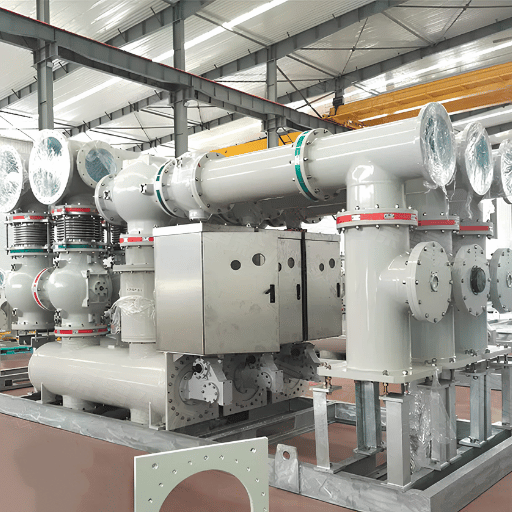
The procurement criteria for factory PD test equipment are more rigorous than for any field-portable instrument, because the factory measurement is the reliability anchor for all subsequent measurement on the asset. Six criteria define a defensible specification.
- Sensitivity floor ≤ 1 pC (lower for cable production)
- IEC 60270 conventional method support with traceable calibrator
- Multi-channel input for three-phase apparatus (≥ 3 simultaneous)
- PRPD pattern analysis with phase-resolved storage
- Automated acceptance test sequencing per programmable voltage profile
- Audit-trail data export with tamper-evident logging
- Detector with 5 pC floor – fine for transformers, Fails on cables
- Single-channel input — three-phase units need three sequential tests
- No UHF supplementary channel — limits GIS factory verification
- Lab-grade only — survives shipping but not floor vibration
- Closed file format – customer cannot re-analyze the FAT data later
- No calibration certificate traceable to a national standards body
Equipment cost from roughly USD 15,000 for a single-channel basic detector up to USD 150,000+ for a fully automated multi-channel test system with UHF supplementary inputs. Automatic partial discharge test systems at the mid-price point – typically USD 30,000-50,000 – cover the bulk of transformer and instrument-transformer factory applications, with sensitivity floors of 1 pC and PRPD analysis included. Cable factories generally require the top end because of the 0.1 pC sensitivity requirements and high throughput. How to select the best partial discharge test equipment for a given production mix is next step in the matrix above.
Industry Outlook 2026: Continuous Online PD Monitoring & AI Diagnostics

Factory pd testing is not being replaced by online monitoring – it is being extended by it. The two practices are complimentary: factory tests set the baseline; online monitoring tracks deviation in service. Three shifts are evident in 2026 and will influence procurement decisions through the end of the decade.
Online substation monitoring will exceed USD 4 billion in 2033. The worldwide online substation monitoring system market is projected to grow from about USD 2.5 billion in 2026 to USD 4.2 billion in 2033 , with PD monitoring taking a growing share. The upshot for factories: customers – especially utilities – increasingly anticipate that equipment will arrive equipped with embedded UHF or HFCT sensor mounts so the same PRPD monitoring approach can run continuously after the project is finished. factory release tests are turning into the calibration benchmark for in-service trending, not a one-shot check.
AI pattern recognition is arriving from research to product. Convolutional-neural-network defect classifiers built on labeled PRPD training sets are now seen in commercial PD detectors , and 2025 scholarly papers indicate competitive accuracy against skilled human classifiers. The factory floor takeaway: a detector that can relay unprocessed PRPD frames in an open format will retain analytic usefulness for decades; a detector that can only deliver summary statistics will shut customers out from future ML-based reanalysis.
IEEE C57.113-2023 elevates the documentation bar. The 2023 edition of the transformer PD recommended practice expands UHF augmented measurement guidance and tightens documentation requirements for the FAT report. Factories bidding on U.S. utility projects during 2026-2027 will more and more find C57.113-2023 cited over the 2010 version – and the distinctions matter in what the test report must document.
If you are a QA manager planning the next 24 months: budget the upgrade to a detector that can support UHF supplementary input, raw PRPD data export, and a calibration certificate cycle that can be re-issued yearly. The purchase decision made in 2026 will impact if the factory release records are admissable under tenders written in 2028.
Frequently Asked Questions
Q: What is the difference between offline and online PD testing?
View Answer
Q: Is IEC 60270 the only standard for factory PD testing?
View Answer
Q: What is the minimum sensitivity required for factory PD test equipment?
View Answer
Q: Can PD testing be performed on energized equipment in the factory?
View Answer
Q: What does PDIV mean and why does it matter for release decisions?
View Answer
Q: How long does a typical factory PD test take per HV unit?
View Answer
References & Sources
- IEC 60270:2000 — High-Voltage Test Techniques: Partial Discharge Measurements — International Electrotechnical Commission
- IEEE Field Guide for Partial Discharge Measurements on Liquid-Filled Power Transformers (F16) — IEEE Transformers Committee
- IEEE C57.113 — Recommended Practice for Partial Discharge Measurement in Liquid-Filled Power Transformers and Shunt Reactors — Institute of Electrical and Electronics Engineers
- CIGRE Working Group D1.37 — Guidelines for Partial Discharge Detection Using Conventional Electrical and Unconventional Methods — International Council on Large Electric Systems
- Partial Discharge — Technical Reference Article — Wikipedia (cross-referenced to primary sources IEC, IEEE, CIGRE)
- Mistakes During Partial Discharge Measurements of High Voltage Capacitors — Óbuda University Repository
- AI-Based Partial Discharge Detection Using CNN — Springer Information Retrieval
- Practical Limitations of IEC Partial Discharge Standards in Power Modules — EE Power Technical Articles
Related Articles
- Partial Discharge Testing — Fundamentals and Practical Methods
- What Is a Partial Discharge Test — Insulation Health Explained
- How to Choose the Best Partial Discharge Test Equipment
- High Voltage Test Procedures for Power Transformers
- Top Features to Look For in a Partial Discharge Analyzer
- Voltage Withstand Test — Method and Acceptance Criteria
About This Analysis
The 30/100/500 pC release decision matrix in this report distills published acceptance limits from IEC 60270, IEEE C57.113, IEC 60840, IEC 62271-203, and IEC 60034-27, cross-referenced against CIGRE WG D1.37 field practice. All numerical thresholds in the asset-class table trace to a primary standard cited in the References section. The PRPD pattern interpretations reflect the conventions used in factory release tests on liquid-filled transformers and XLPE power cables. Reviewed by the DEMIKS engineering team for HV equipment manufacturing applications.