Fraud Blocker
High Voltage Divider

HV Measurement System

High Voltage Dividers for AC, DC and Impulse Measurement

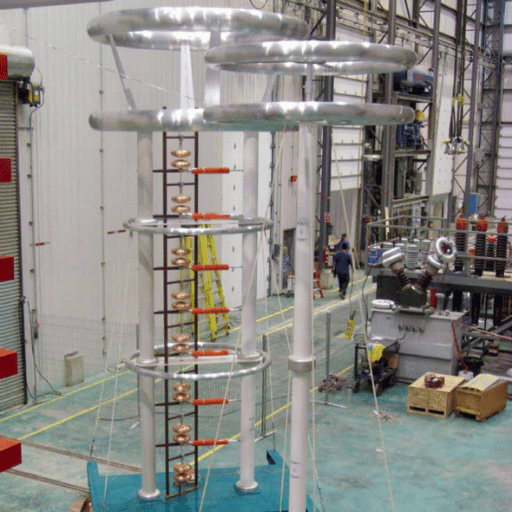
DEMIKS high voltage dividers scale high voltage down to a low, measurable output voltage — resistive, capacitive, low-damped capacitive and RC models, each matched to the waveform you test. Whether the duty is DC, AC, lightning impulse or switching impulse, the scale factor is characterised against IEC 60060-2 and impulse parameters are evaluated to IEC 61083.
DEMIKS High Voltage Divider
Solution Summary
Divider types: resistive, capacitive, low-damped capacitive, RC
Waveforms measured: DC, AC, lightning impulse (LI), switching impulse (SI)
Voltage class: built to application, configurations up to 800 kV
Scale factor: characterised across each assigned measurement range
Standards: IEC 60060-1, IEC 60060-2, IEC 61083-1/-2, IEC 60052
Supplied with: low voltage arm, measuring cable, grading rings
Output feeds a peak voltmeter, oscilloscope or digital recorder
Contact Form 在用

Why Accurate High Voltage Measurement Is Harder Than It Looks

High Voltage Divider System Measurement

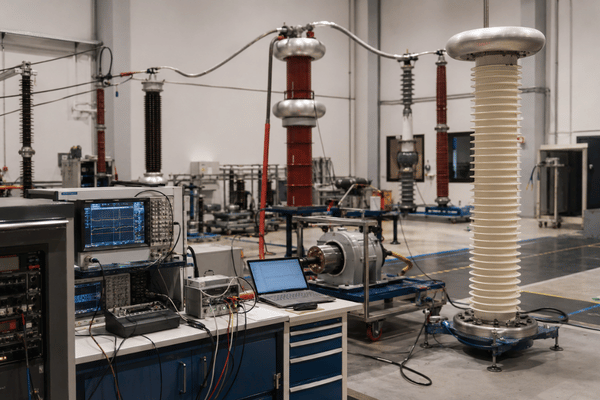
A high voltage divider is the instrument that makes high voltage measurable. It splits the voltage across a high voltage arm and a low voltage arm, and a peak voltmeter, oscilloscope or digital recorder reads the low voltage at the bottom arm. That ratio between the two arms — the scale factor — is what your whole measurement rests on.

Trouble begins when the divider is not chosen to match the waveform it has to measure. Take a purely resistive divider that holds a perfectly flat ratio on DC: it will distort the front of a lightning impulse and can add unwanted distortion of its own. Put a plain capacitive divider that handles power-frequency AC withstand cleanly onto a very fast transient, and it can turn unstable and ring. Pick a low voltage arm that does not suit the waveform, and loading error creeps in quietly by shifting the ratio. Leave grading rings off a high voltage arm, and stray charge bleeds to air as an unseen error. In every one of these cases the divider still shows a reading — it is just the wrong one.

That gap is exactly what DEMIKS dividers are designed to bridge. Instead of providing a single general-purpose divider for every event, the DEMIKS range provide a resistive, capacitive, low-damped capacitive, or RC divider, specific to the type of waveform you use and the class of voltage that you measure. Each is meticulously characterised so that the scale factor and uncertainty are established in the factory, and shipped with a certification to ensure that a manager, an engineer and the purchasing department are all on the same page.

DEMIKS High Voltage Divider Range — Resistive, Capacitive, Low-Damped & RC

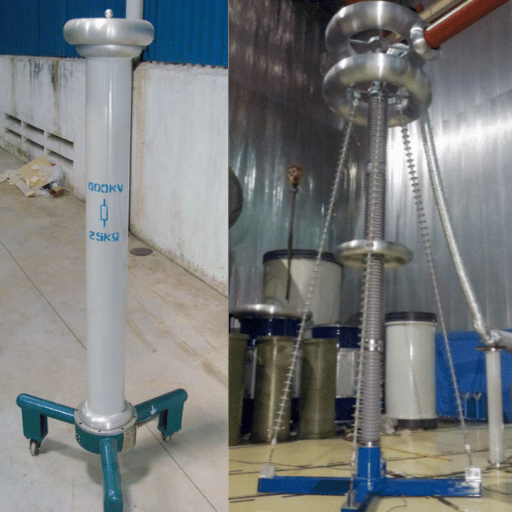
Every divider in the range makes high voltage measurable by converting it to a proportional low voltage, but the make-up of the high voltage arm decides which waveform it measures well. Resistors hold a precise ratio on DC and power-frequency AC; capacitors give low loss and good frequency response on AC; combining the two extends the usable bandwidth into the impulse region. Together, the four models below cover the full set of measurement duties in a high voltage test laboratory.
Resistive High Voltage Divider

Resistive High Voltage Divider

A resistive divider builds its high voltage arm from a chain of precision resistors in series, with the low voltage arm tapped at the bottom. It holds a stable ratio on direct voltage and on power-frequency AC, and it is the most economical divider when the duty is single-waveform DC measurement. Matched temperature coefficients and a low voltage coefficient keep the resistance — and the scale factor with it — steady as voltage and temperature change.

Divider Selection Matrix

Divider type Primary waveform Voltage class Best-fit duty Companion DEMIKS system
Resistive DC + power-frequency AC low to medium kV DC withstand and leakage measurement HVDC test system
Capacitive AC (50/60 Hz + HF) medium to high kV AC withstand and arrester testing AC resonant test system
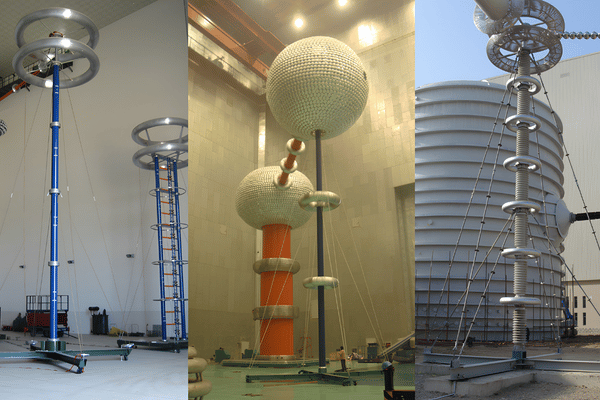
Low-damped capacitive LI / SI impulse + AC high kV, to 800 kV configs Impulse measurement and reference systems Impulse voltage test system
RC (resistive-capacitive) AC / DC / impulse medium to high kV Mixed-waveform laboratories Multi-system test bays
Voltage class is configured to the customer's application: DEMIKS builds dividers for high voltage test laboratories in configurations up to 800 kV, alongside its wider range of variable frequency AC resonant test systems and impulse generators. Each divider ships complete with its low voltage arm, a matched measuring cable and the grading hardware for its voltage class. For a DC-only laboratory the DEMIKS resistive divider pairs naturally with the company's DC high voltage test equipment, while an impulse laboratory pairs the low-damped capacitive divider with an impulse voltage test system.

Resistive vs Capacitive vs RC Divider — Choosing by Waveform and Accuracy

The most costly mistake in high voltage measurement is to select the wrong divider type and then blame the accuracy class for an error caused by a waveform mismatch. This comparison rests on the two questions that actually settle the decision: what waveform are you measuring, and what is the error driver in that measurement. Accuracy is considered as a cause rather than a marketing feature.

Selection factor Resistive divider Capacitive divider RC divider
DC measurement excellent — stable ratio limited — relies on leakage good — resistive arm carries DC
AC withstand (50/60 Hz) usable at lower kV excellent — low loss good
Lightning / switching impulse distorts front rings without damping good with damped design
Frequency response falls off at HF wide wide
Self-heating at high kV significant power loss low loss low to moderate
Reports ripple factor no no yes
Relative cost lowest moderate highest

Engineering Note — Where Accuracy Class Really Comes From

Across the market, DC dividers reach accuracy classes from roughly 0.01% to 3% and AC dividers from about 0.2% to 10%. That span is not a price-tier story; it is a design story. Three parameters move the scale factor: the temperature coefficient of the resistive elements (standard high voltage resistors hold better than 30 PPM per °C, and matched coefficients matter more than the absolute figure), the voltage coefficient (resistance falls as applied voltage rises, so a divider calibrated at one voltage and used at another carries a built-in non-linear error), and characterisation of every assigned measurement range rather than a single point. A divider is accurate because its components are matched and its ratio is documented — not because of where it was built. That is the basis on which a DEMIKS divider should be weighed against any alternative on a shortlist.

Read the table that way and the answers are straightforward. DC laboratories are honest work for a resistive divider; an AC withstand bay calls for a capacitive divider; and a laboratory that refuses to own three instruments where one will do should look hard at the RC divider. The low-damped capacitive divider sits outside this three-way comparison, because impulse measurement is a different problem — covered in the divider range above. None of this is academic: matching the divider type to the waveform is what keeps loading error, frequency response and corona behaviour inside the limits your test certificate claims.
Contact Form 在用

High Voltage Divider Measurement In Transformer, Cable, Arrester And GIS Tests

A divider earns its place by the tests it makes possible. Each case below shows where a divider type does its work in a high voltage laboratory, and why the measurement matters to the test result itself — not only to the trace on the oscilloscope.

Capacitive divider on power transformer testing

Transformer AC Withstand

Capacitive Divider On Power Transformer Testing

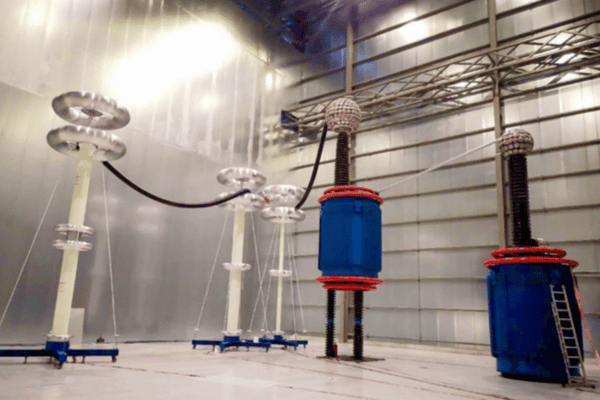
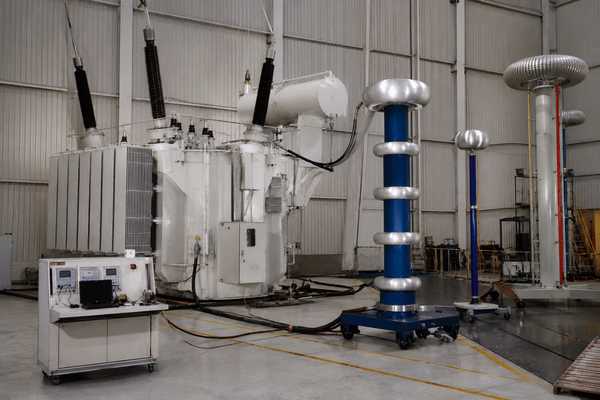
Power transformer AC withstand and induced-voltage tests need a voltage measurement that does not load the resonant test circuit. A capacitive divider draws negligible current, so it reports the applied voltage without disturbing it, and its low loss avoids the self-heating a resistive divider would suffer once it carries that kind of voltage class. Its capacitive arm also tracks the harmonic content of the test voltage, which matters when the acceptance criterion is the peak rather than the RMS value.

Low-damped capacitive divider on lightning impulse tests

Impulse / Insulation Coordination

Low-damped capacitive divider on lightning impulse tests

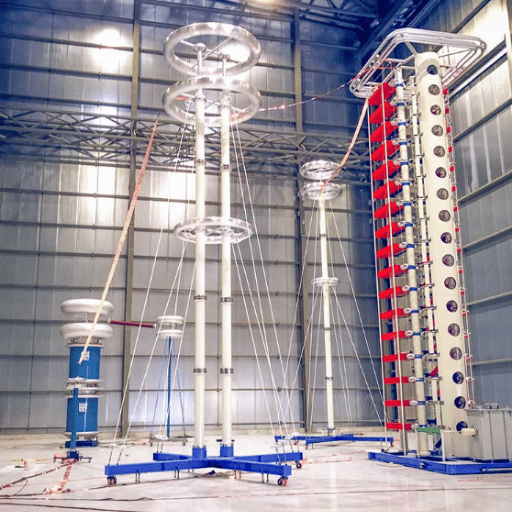
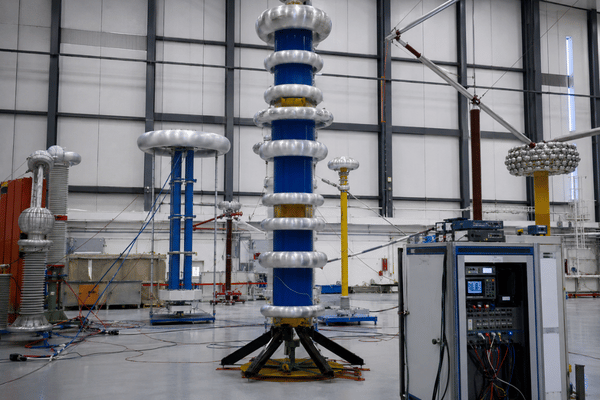
Lightning impulse tests on transformers, bushings, and GIS require accurate and faithful acquisition of fast transient’s front time and peak. A low-damped capacitive divider will present an un-ringed and distortion-free representation compared to the alternative of a standard capacitive divider, and its output will deliver impulse-related data from digital recorders according to IEC 61083-2. In its function as a reference divider, the same instrument offers traceability of your lab's working measurement systems to your country's national standards.

RC and resistive dividers across mixed test programmes

Cable, Arrester & GIS

RC and resistive dividers across mixed test programmes

A cable or GIS laboratory rarely runs a single waveform. An RC divider can measure the DC withstand on a cable sheath in the morning and the AC characteristic of a surge arrester in the afternoon, reporting ripple factor whenever a DC source needs a check. For DC-dominated work — surge arrester reference-voltage measurement, DC leakage on cable accessories — a resistive divider gives the stable ratio the test certificate depends on.

TCO Framework

Own, Rent Or Send Out — A TCO View Of A High Voltage Divider

Purchase price is only the visible part of what a divider costs. Any measuring system that stays in service carries recurring cost whoever owns it, so the sensible decision turns on how heavily the laboratory uses it.

  • When you own the divider, calibration alone takes the measuring system out of service for 1–2 months a year — an effective 5–10% of equipment value — while annual maintenance runs about 2–5% and depreciation sits near 20–25% per year.
  • Renting usually works out cheaper when a divider is used less than roughly 60–70% of the time, because calibration, maintenance and storage all shift to the supplier.
  • Buying becomes the cheaper path once the divider is needed more than about 30–35 weeks a year, consistently, across several years.
  • A hybrid fleet — owning the high-utilisation reference divider, renting the rest — tends to cut total fleet cost by 25–40%.

For a laboratory manager, the takeaway is plain: a divider you use constantly is worth owning and worth calibrating on a tight interval, while one you touch a few weeks a year rarely is. DEMIKS supplies the characterisation data either way, so the calibration cost above stays predictable rather than turning into a surprise.


Source: industry rent-vs-buy cost analyses for high voltage test equipment (Lakeland Engineering; RentalTec). Figures are industry averages for planning, not a DEMIKS quotation.

Standards and Compliance — IEC 60060-2, IEC 61083 and IEC 60052

A high voltage divider is only as credible as the standards its measurement is traceable to. Every DEMIKS divider is calibrated and shipped with characterisation data so it can take its place in an approved measuring system, verified against the IEC framework set out below.

IEC 60060-1

High voltage test techniques — definitions and test requirements for DC, AC and impulse voltages.

IEC 60060-2

Measuring systems — scale factor, voltage ratio and the methods for approving a measuring system and estimating its uncertainty.

IEC 61083-1

Instruments for impulse tests — requirements for the digital recorders used with impulse dividers.

IEC 61083-2

Software for impulse tests — evaluation of impulse parameters from recorded waveforms.

IEC 60052

Sphere-gap voltage measurement — the independent reference method for verifying peak voltage.

Engineering Note — What "Approved Measuring System" Actually Requires

IEC 60060-2 does not approve a divider on its own. It treats the divider as one component of a measuring system, expresses the scale factor and the measured voltage as relative uncertainties, and sets out how the user demonstrates that the system meets the uncertainty limits for the test levels in question. In practice the divider, its low voltage arm, its measuring cable and the recording instrument are treated as a single chain — which is why DEMIKS supplies them matched, with characterisation data, rather than as separate parts to be assembled and hoped over. Calibration of that chain should be traceable to national standards, with as-found and as-left records kept so a drifting scale factor is caught before it reaches a test report.

Buying a High Voltage Divider — Price Drivers, Lead Time and Calibration

Because every divider is built to a voltage class and a waveform, a list price would be misleading — the same “100 kV divider” can vary widely in cost depending on accuracy and what comes with it. Below, a pricing-factor framework shows what changes the quotation, so a buyer can scope a project before calling.

What Drives a High Voltage Divider Quotation

  • Voltage class is the biggest single lever — a higher kV rating means a longer high voltage arm, more grading hardware and more characterisation work.
  • Divider type matters too: resistive is the least expensive, while low-damped capacitive and RC designs add components and design effort.
  • A tighter accuracy class — a smaller scale-factor uncertainty — calls for more component matching and characterisation across more measurement ranges.
  • The measuring chain you include moves the figure: peak voltmeter or digital recorder, the low voltage arm, the matched measuring cable.
  • Grading rings, shielding electrodes and the support structure are scoped to the divider's voltage class rather than thrown in.
  • Calibration scope closes the quote — as-built characterisation data, and whether traceable certificates ship with the divider.

Buyer Advisory — Lead Time and Calibration Interval

Lead time correlates with price-voltage class, divider type and accuracy class all necessitate characterisation effort, while impulse or reference divider demand longer to test than resistive DC type. Ask DEMIKS for a lead-time quotation for your particular application rather than a standard number. Set the recalibration interval according to how the divider will be used — a carefully maintained reference unit can hold its scale factor for several years, while an actively used unit needs checking more often. Usage rate, operating environment, accuracy requirement and the instrument's stability history all feed that choice. DEMIKS supports recalibration so the divider stays within IEC 60060-2 limits over its service life.

System Status: Quotation Ready

Send DEMIKS your voltage class, the waveform you measure, the accuracy you need and the recording instrument you intend to use, and you will receive a detailed quotation with a lead-time estimate built around that application — not a one-size-fits-all list price.

Specify Your DEMIKS High Voltage Divider

Tell us the waveform, voltage class, accuracy target and recording instrument, and we will match the divider type and send a detailed quotation with a lead-time estimate.

×
Contact Form 在用

High Voltage Divider FAQ — Selection, Accuracy, Standards and BuyingAll Roles

What is a high voltage divider and how does it work?

A high voltage divider is a measuring instrument that scales a high voltage down to a proportional low voltage so it can be read by a peak voltmeter, oscilloscope or digital recorder. It is built from a high voltage arm and a low voltage arm, and the ratio between them — the scale factor — is the number every measurement depends on. The divider lets you measure voltage on transformers, cables, surge arresters and other apparatus without ever exposing the meter to the full high voltage, and a measuring cable carries the scaled output to the recording instrument. Because no single arm topology handles every waveform well, DEMIKS supplies resistive, capacitive, low-damped capacitive and RC dividers, so the divider type can be matched to the DC, AC or impulse voltage you actually test rather than compromised across all three.

Resistive vs capacitive voltage divider — which one do I need?

Choose a resistive voltage divider for DC and power-frequency AC measurement, where its stable ratio and low cost are an advantage. Choose a capacitive voltage divider for AC withstand testing, where the low loss and good frequency response of the capacitive arm reduce heating and error. Above roughly 100 kV the power dissipated in a purely resistive divider becomes hard to manage, which is why capacitive and RC designs dominate at the top of the range. If you measure more than one waveform, an RC divider covers AC, DC and impulse from a single instrument.

Which divider type measures lightning and switching impulse voltage?

Low-damped capacitive dividers are the standard choice for lightning impulse (LI) and switching impulse (SI) measurement. Their damping resistors suppress the ringing and waveform distortion that a plain capacitive divider shows on a fast transient, which keeps the recorded front time and peak accurate. A low-damped capacitive divider can also serve as an AC reference measuring system and as the operational divider of a high voltage test system. Resistive impulse dividers are also used, mainly as standard reference dividers for traceable calibration.

How accurate is a DEMIKS high voltage divider?

Accuracy is expressed as the scale factor and its measurement uncertainty, characterised against IEC 60060-2. Across the industry, DC dividers reach accuracy classes from about 0.01% to 3% and AC dividers from about 0.2% to 10%, depending on voltage class and application. The real accuracy drivers are matched temperature coefficients, a low voltage coefficient and characterisation of every assigned measurement range — not the country of manufacture. DEMIKS dividers are characterised across their assigned ranges and supplied with calibration data so the uncertainty you work with is documented, not assumed.

Do DEMIKS dividers comply with IEC 60060-2 and IEC 61083?

Yes. DEMIKS dividers are designed to IEC 60060-1 and IEC 60060-2 for test techniques and measuring systems, IEC 61083-1 and IEC 61083-2 for impulse instruments and software, and IEC 60052 for the sphere-gap reference method. Scale factor and step response are verified for an approved measuring system.

What voltage range and waveforms can be measured?

DC, AC, lightning impulse and switching impulse are all covered. Each divider is built for the customer's voltage class, with configurations up to 800 kV — the type is chosen by waveform first, then by voltage class and accuracy.

What is the calibration interval and is it traceable?

Calibration of a high voltage measuring system should be traceable to national standards, and the interval depends on usage rate, the environment the divider works in, the accuracy required and the instrument's history of stability. A stable, lightly used reference divider can hold its calibration for several years; a heavily used operational divider is checked more often. DEMIKS supplies as-built characterisation data and supports recalibration so the scale factor stays inside the uncertainty limits of IEC 60060-2.

How do I avoid loading errors and corona at high voltage?

Loading error appears when the input impedance of the meter or recorder draws current from the divider and shifts the ratio. It is controlled by matching the low voltage arm to the recording instrument and keeping the measuring cable correctly terminated. Corona — partial discharge into the air around the high voltage arm — is suppressed with grading rings and shielding electrodes that even out the electric field. DEMIKS dividers are supplied with the grading hardware and the recommended cable so both error sources are managed from the start.

Can one divider measure both AC and DC?

Yes — that is the purpose of the resistive-capacitive (RC) divider. The resistive elements give it stable DC behaviour while the capacitive elements give it good high-frequency response, so a single RC divider measures AC, DC and impulse voltage. An RC divider also reports ripple factor and frequency characteristics, which makes it the most flexible choice for a laboratory that runs mixed test programmes. If your work is single-waveform, a dedicated resistive or capacitive divider is usually more economical.

How much does a high voltage divider cost and what is the lead time?

Price depends on voltage class, divider type, accuracy class, the included peak voltmeter or recorder, and whether grading rings and a measuring cable set are supplied. Higher voltage classes and tighter accuracy require more characterisation work and add to both cost and lead time. Because every divider is built to the customer's voltage and waveform, DEMIKS quotes against the specific application rather than publishing a list price — send your voltage class, waveform and accuracy target to receive a detailed quotation and a lead-time estimate.

Scroll to Top
Get in touch with DEMIKS company
Contact Form 在用