This Schneider Electric vs Eaton protection relays comparison is a buyer’s guide to both brands’ relay families, covering product lines, IEC 61850 compatibility, safety architecture, and total cost of ownership. Both vendors produce families of protection relays spanning industrial motor protection through utility-grade substation automation, but “Schneider Electric” and “Eaton” are not one product nor is “protection relay”. Within Schneider alone, there are two structurally different families (SEPAM and MiCom) with different protection-function capabilities, while within Eaton’s current digital product range there is a new family (EDR3000/EDR5000, E-Series) aimed at IEC 61850-compliant feeders and transformer protection. This technical-comparison guide walks through product-line structure, IEC 61850 digital-substation compatibility, safety/diagnostics architecture, protection-function coverage, a voltage-and-application selection matrix, cost-tier realities, and post-purchase commissioning, based on publicly available technical materials, standards-compliance pages, and our own relay-testing product line, not an independent laboratory comparison of both brands. The Voltage x Application Selection Matrix further down turns voltage class and application into a direct shortlist, and the Industry Outlook section closes with what we call the 25-Year Retrofit Cliff – the aging-infrastructure statistic driving retrofit demand across this entire product category.
Schneider Electric vs Eaton Protection Relays: Overview and At-a-Glance Comparison
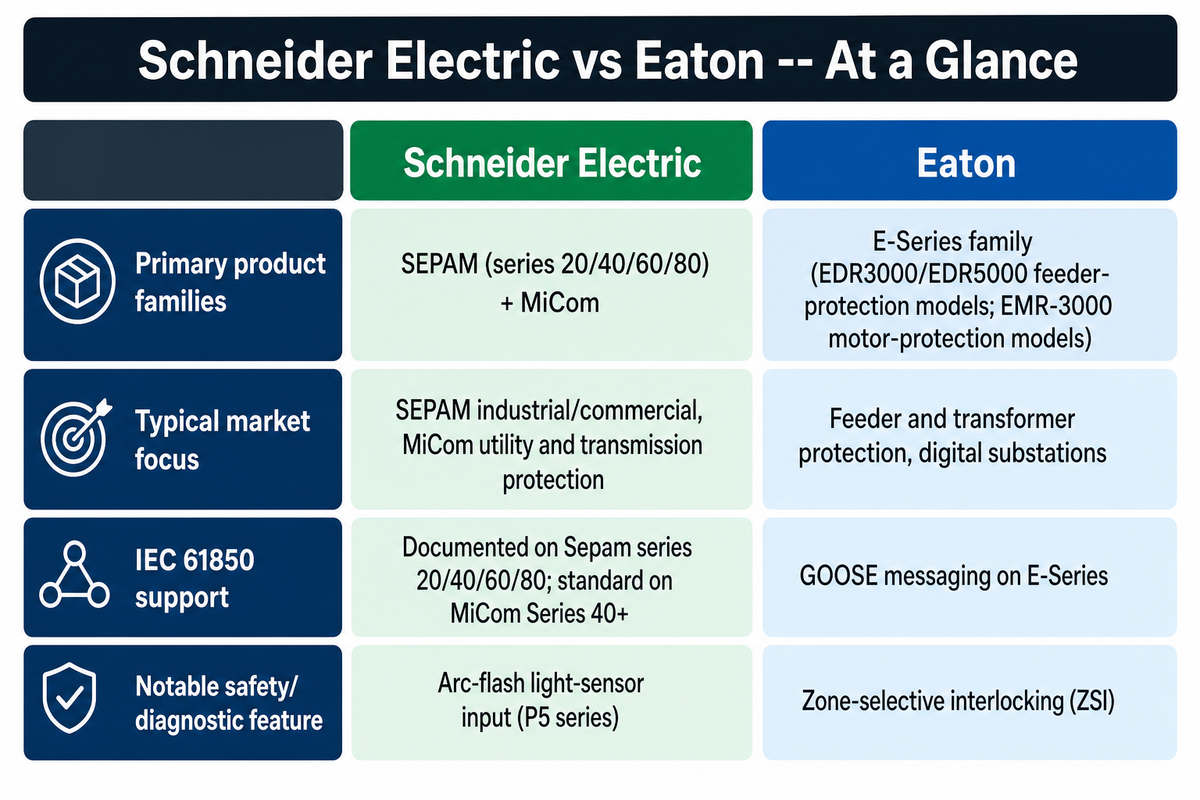
A protection relay senses an abnormal electrical condition, such as overcurrent, ground fault, distance, or differential, and sends a trip signal to a circuit breaker; the relay itself does not interrupt current, the breaker does. Schneider Electric and Eaton are two of several established protection relay suppliers in this space, along with Siemens, ABB, SEL, and GE, all of which offer numerical (microprocessor-based) devices that have replaced electromechanical units across the large majority of new installations. Schneider’s relevant product lines are SEPAM (industrial-grade, from the 1992 Merlin Gerin acquisition) and MiCom (utility-grade, inherited through the AREVA T&D asset split); Eaton’s current digital offering centers on the EDR3000/EDR5000 and E-Series families. This table frames the starting-point distinction before the sections below break out product lines, standards compliance, and safety architecture individually.
| Attribute | Schneider Electric | Eaton |
|---|---|---|
| Primary product families | SEPAM (series 20/40/60/80); MiCom brand (sold in parallel today by both Schneider Electric, under PowerLogic branding, and GE Vernova — a legacy of the 2010 AREVA T&D split and 2015 GE acquisition of Alstom’s grid business, see below) | E-Series family (EDR3000/EDR5000 feeder-protection models; EMR-3000 motor-protection models; transformer-protection model number not independently verified in this guide) |
| Typical market focus | SEPAM: industrial/commercial. MiCom (a brand Schneider sells in parallel with GE Vernova, spanning feeder through transmission tiers): utility and transmission protection | Feeder and transformer protection, digital substations |
| IEC 61850 support | Documented across SEPAM series 20/40/60/80 per Schneider’s own manual; standard on MiCom’s Series 40 and up, per third-party sources — Series 20/30 entry-level feeder terminals are commonly reported as legacy-protocol only (Modbus/Courier/IEC 60870-5-103/DNP3), not IEC 61850 | GOOSE messaging on E-Series (per Eaton’s public product listings; not independently verified in this guide) |
| Notable safety/diagnostic feature* | Arc-flash light-sensor input (P5 series, per public references) | Zone-selective interlocking (ZSI) |
*Arc-flash light-sensing and zone-selective interlocking are both industry-wide protection techniques available from multiple vendors (including each other’s) — this row reflects which specific technique each brand’s flagship line is publicly documented as emphasizing, not an exclusive capability unavailable from the other brand. See the dedicated section below for how the two techniques actually differ.
Your selection of a protection relay, electrical equipment ultimately responsible for power protection throughout a facility’s electrical systems, must match your application and voltage class before brand preference comes into play: neither Schneider Electric nor Eaton is the “better” choice for a generic application and voltage class. Making the right selection depends on matching your voltage class to the correct product family, whether IEC 61850 compliance is a must-have feature, and what existing installed base you will be integrating with. The Voltage x Application Selection Matrix below turns voltage class and application into a direct decision-by-application shortlist.
Product Line Breakdown: SEPAM, MiCom vs EDR3000/EDR5000/E-Series
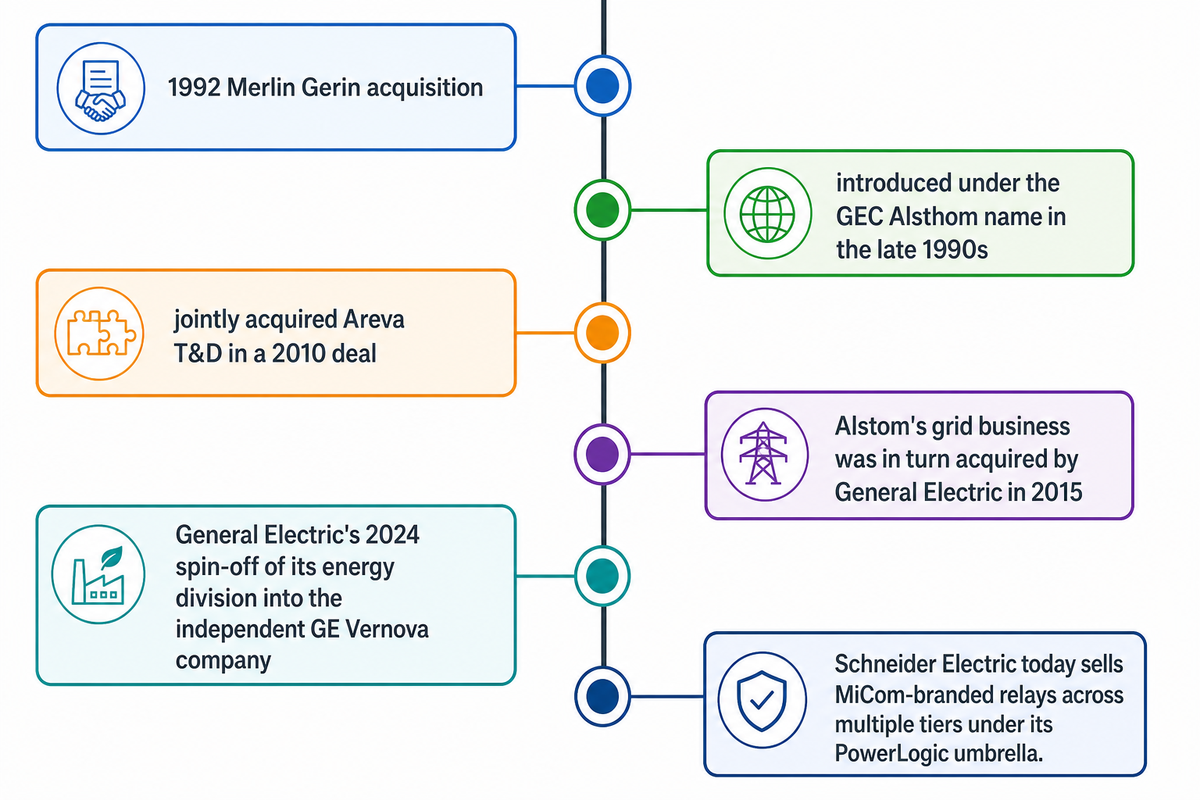
SEPAM and MiCom are Schneider Electric’s two protection-relay families, and the key differences between them start with corporate history: a Schneider protection relay is never just “a Schneider relay,” it’s specifically a SEPAM or a MiCom unit, acquired through two separate corporate histories, and they still serve different engineering purposes. SEPAM traces to the 1992 Merlin Gerin acquisition and targets industrial, commercial, and infrastructure applications.
MiCom’s side of the story is where that corporate history gets more complex: per industry accounts, the brand was introduced under the GEC Alsthom name in the late 1990s, passing through Alstom and then into AREVA T&D. When Alstom and Schneider Electric jointly acquired Areva T&D in a 2010 deal, the transmission business went to Alstom and the distribution and network-automation business went to Schneider Electric (the deal value is commonly described as a roughly two-to-one Alstom/Schneider split by industry sources, though this article does not have a locatable verbatim citation for that specific fraction); Alstom’s grid business was in turn acquired by General Electric in 2015; that business now operates as GE Vernova Grid Solutions, following General Electric’s 2024 spin-off of its energy division into the independent GE Vernova company. The practical result is more parallel than exclusive, and doesn’t fully square with a clean “transmission went to Alstom” reading of the 2010 split — this article did not find public sourcing explaining exactly how Schneider came to independently offer transmission-tier MiCom models again, only confirmation that it currently does. Verified directly against each company’s current product catalog, Schneider Electric today sells MiCom-branded relays across multiple tiers under its PowerLogic umbrella — including the P34x (generator protection) and P54x (line differential and distance protection) families — while GE Vernova independently sells overlapping MiCom model numbers (its own P54 line — fully verified against GE Vernova’s own P54 product page; GE’s product-range naming also lists adjacent P34x and P84 models in the same “MiCOM P40 Agile 5th Generation” family, though those two specific pages were not separately fetched for this article) as the continuation of the AREVA/Alstom transmission-side lineage — like P34x, these vendor model numbers sit outside the Series 20-80 numbering used in the series-reference table above (a third-party guide’s own numbering, not Schneider’s official Px10/Px30/Px40 catalog structure), so don’t try to map P54/P84 onto a specific Series 40-80 row. Neither company holds exclusive rights to the MiCom Series 40+ tier today; confirm the specific model number, support channel, and warranty with whichever vendor you’re sourcing from, since the same series/model numbers can appear on both companies’ current price lists. Schneider’s SEPAM family remains a separate, wholly Schneider-native product line alongside this shared MiCom brand.
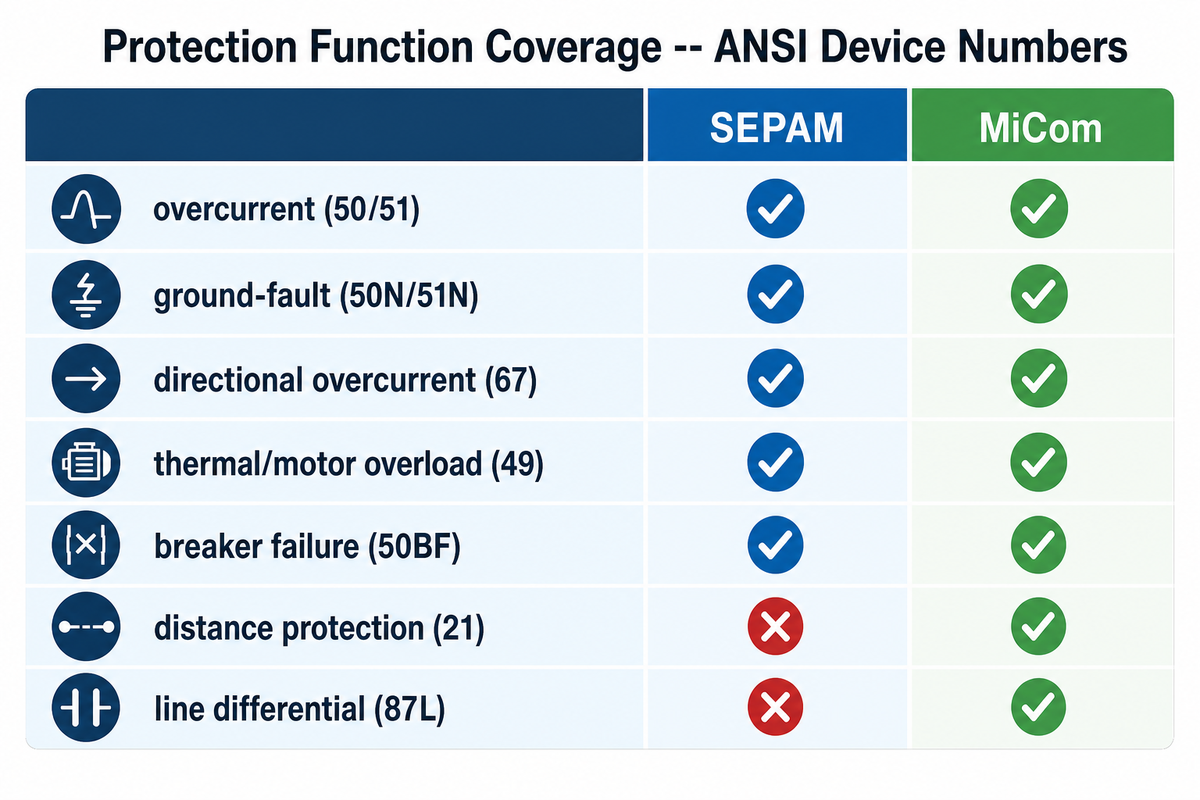
Functional consequence matters more than corporate history here, though the precise per-series breakdown below comes from third-party technical documentation rather than Schneider’s own published datasheets, so treat it as a starting reference to verify against your specific model’s current spec sheet, not a settled fact: Sepam’s protection scope is generally reported as centering on overcurrent/ground fault (ANSI 50/51, 50N/51N), directional overcurrent (67), thermal overload (49), and breaker failure (50BF), with only limited transformer differential (87T) on higher Sepam models, while distance protection (21) is generally associated with the MiCom Series 40 range and line differential (87L) with the Series 50 range instead (Series 60 covers transformer differential specifically, not distance or line differential; bus differential (87B) sits on a separate specialist MiCom tier outside the series scope covered in this guide’s table — per the series table below). On IEC 61850 specifically, Schneider’s own official documentation is more useful than the third-party breakdown: Schneider publishes a dedicated “Sepam, IEC 61850 user’s manual” (Doc. Ref. SEPED306024EN) whose own product-range listing spans Sepam series 20, 40, 60, and 80, meaning IEC 61850 communication is documented across the Sepam range rather than being an S80-exclusive option as some secondary sources suggest. Confirm the specific edition and profile supported by your exact Sepam model against Schneider’s current datasheet before assuming either a blanket “yes” or a blanket “S80 only.”
Eaton’s side of this comparison is structurally simpler: EDR3000, EDR5000, and E-Series are marketed as a single current digital relay line rather than two historically distinct families, with IEC 61850 GOOSE messaging positioned as a standard E-Series capability per Eaton’s publicly listed product materials — this article did not independently fetch an Eaton source to verify that positioning, and independently published third-party comparison data on Eaton’s specific function-by-function coverage is comparatively thin, so treat brand-to-brand feature parity claims here as unverified rather than lab-confirmed. Competing platforms in this same advanced protection tier, such as Siemens’ modular SIPROTEC 5 architecture, illustrate a third design philosophy: rather than two separate product families, Siemens configures one modular hardware platform across protection functions from simple overcurrent through complex busbar differential and switchgear-integrated schemes.
| Series | Class | Typical Voltage | IEC 61850 | Distance (21) | Differential (87) | Limitations / Not suitable for |
|---|---|---|---|---|---|---|
| Sepam series 20 | Industrial | MV | Documented* | No (third-party) | No (third-party) | Feeder protection focus; not for LV (<1 kV), digital substation, or transmission projects |
| Sepam series 40 | Industrial | MV | Documented* | No (third-party) | No (third-party) | Spans several application-specific variants (feeder, transformer, motor-protection suffixes), not a single-application series; third-party sources report no distance/line/transformer differential across the series |
| Sepam series 60 | Industrial | MV | Documented* | Not verified | Not verified | Confirmed by Schneider’s own IEC 61850 manual scope; function detail not independently verified in this guide |
| Sepam series 80 | Industrial | MV | Documented* | No (third-party) | Limited 87T (third-party) | Highest SEPAM tier per third-party sources; still no 21/87B/87L reported |
| MiCom Series 20 | Utility | MV | No (third-party sources report legacy protocols only) | No | No | Distribution feeder tier; not for HV transmission distance protection. (Schneider also independently sells higher-tier MiCom families today — see the P34x/P54x note above and the Product Line Breakdown section — so “MiCom” spans more than this entry-level series alone within Schneider’s own current catalog.) |
| MiCom Series 30 | Utility | MV | No (third-party sources report legacy protocols only) | No | No | Utility feeder tier; not for transformer protection |
| MiCom Series 40 | Utility | MV-HV | Yes | Yes | No | Widely regarded workhorse tier for distance protection; premium pricing vs lower series; bus differential (87B) sits on a separate specialist MiCom tier not covered in this table |
| MiCom Series 50 | Utility | HV | Yes | Yes | Yes (87L) | Line-differential specialist; not the default for local feeder work |
| MiCom Series 60 | Utility | MV-HV | Yes | No | Yes (87T) | Transformer-protection specialist; no distance function |
| MiCom Series 80 | Utility | MV-HV | Yes | No | Yes | Highest-tier utility MiCom model; not optimized for feeder-only projects |
*IEC 61850 “Documented” for Sepam series 20/40/60/80 is confirmed directly from Schneider Electric’s own “Sepam, IEC 61850 user’s manual” (Doc. Ref. SEPED306024EN), whose product-range listing spans all four series, this contradicts an earlier draft assumption that IEC 61850 was an S80-exclusive option, corrected after direct verification against Schneider’s own published manual. Protection-function columns marked “third-party” come from a third-party industrial-equipment knowledge-base article whose byline identifies the author as a Schneider Electric automation systems engineer — treat it as vendor-adjacent secondary sourcing, not independent verification, and confirm against your specific model’s current spec sheet before finalizing a purchase decision. MiCom columns are sourced from the same vendor-adjacent article. See References & Sources below.
Q: Why does Schneider sell both SEPAM and MiCom product lines?
Schneider acquired both product lines through separate mergers, SEPAM via Merlin Gerin in 1992 and MiCom via the AREVA T&D asset split, and kept both running rather than consolidating them.
IEC 61850 and Digital Substation Compatibility
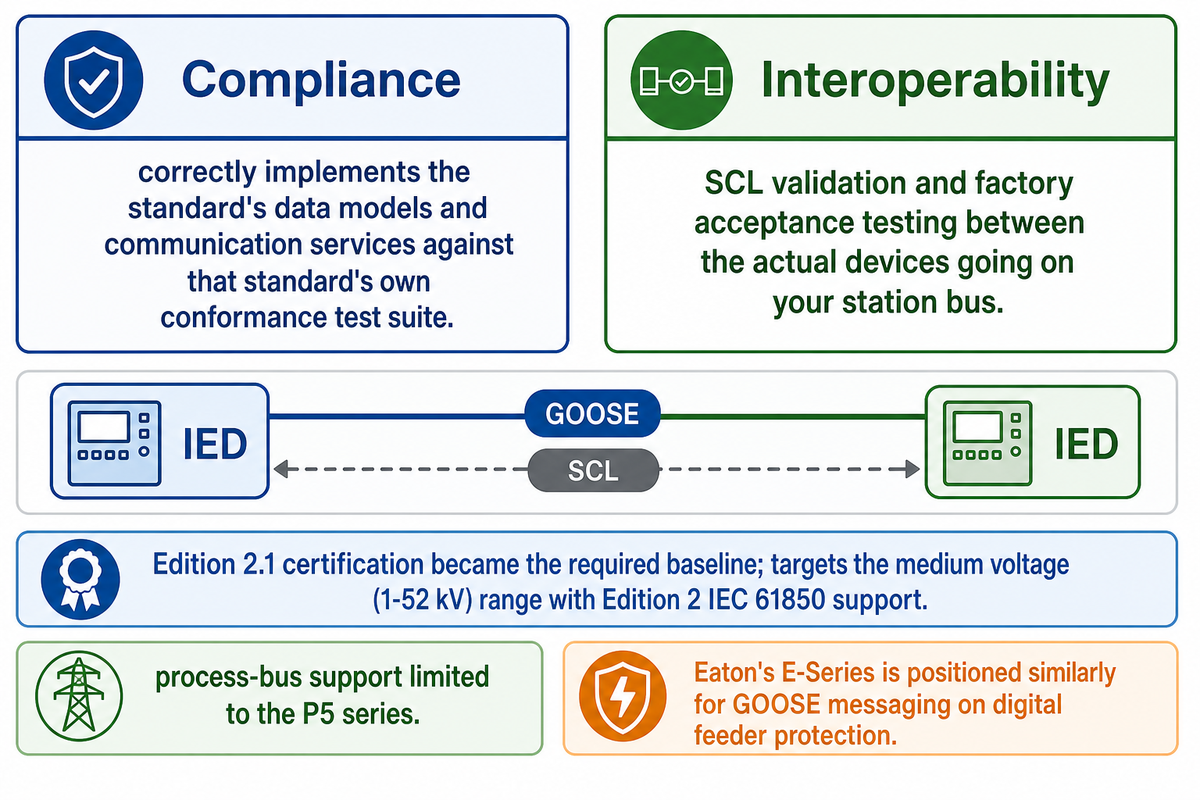
Both Schneider Electric and Eaton offer relay models with IEC 61850 support, but “IEC 61850 support” claimed by both brands does not mean identical implementation or automatic cross-vendor plug-and-play. IEC 61850 Edition 2.1 certification became the required baseline for new UCAIUG (UCA International Users Group) certification testing starting January 2024, per KEMA Labs’ (a CESI testing division) own account of the policy, KEMA Labs is an accredited testing lab reporting on UCAIUG’s certification requirement, not UCAIUG’s own primary policy text, but the shift affects both IED manufacturers and the accredited testing laboratories that certify them.
“This certification process is a necessary condition for the interoperability of devices, which is essential for utilities, system integrators and manufacturers involved in complex substation automation.”
— Riccardo Maria Seresini, Senior Engineer, KEMA Labs (a CESI division)
The IEC itself describes the standard’s purpose accurately: IEC 61850 is designed to enable “multi-manufacturers interoperable solutions” through standardized data models, the Substation Configuration Language (SCL), and shared communication services among intelligent electronic devices (IEDs) — the standard’s intent is genuine cross-vendor interoperability, not vendor lock-in.
Compliance and tested interoperability are two different claims, not one. A device’s IEC 61850 compliance certificate proves it correctly implements the standard’s data models and communication services against that standard’s own conformance test suite; it does not prove that this specific device, paired with your specific engineering tools and commissioning workflow, will interoperate seamlessly with a different vendor’s specific device on your project. That second claim can only be established through your own SCL validation and factory acceptance testing between the actual devices going on your station bus, not inferred from either brand’s compliance certificate alone.
Where the nuance actually lives is implementation depth, not the standard’s design intent: a practitioner field guide covering multivendor rollouts documents that SCL file exchange between vendors frequently reveals mismatched Logical Node types even when every device claims compliance, because vendors extend the standard differently, proprietary Logical Node extensions, vendor-specific SCL schema handling, and differing GOOSE subscription-filter behavior all create real engineering friction during factory acceptance testing, independent of whether each device’s compliance claim is accurate. In practice, IEC 61850 support depends on edition (1 vs 2 vs 2.1), which profiles and data-model subsets are implemented, and how thoroughly the SCL engineering tools were validated against other vendors’ devices during commissioning, equal compliance claims do not establish equal engineering effort. Schneider’s P3/P5 relay line, sold today under the PowerLogic brand (also referenced under the Easergy P3/P5 name in some product literature and part numbers — this article did not find a verified source establishing which name came first for these specific models, only that both appear in current Schneider materials), targets the medium voltage (1–52 kV) range with Edition 2 IEC 61850 support, with process-bus support limited to the P5 series; Eaton’s E-Series is positioned similarly for GOOSE messaging on digital feeder protection and control within medium-voltage substations. Confirm the specific edition, profile, and process-bus capability against your project’s SCL engineering requirements, do not assume “IEC 61850 compliant” on a spec sheet settles interoperability by itself. Whichever brand you specify, plan for the integrator to configure and validate SCL files against every other device on the same station bus before commissioning, not just against that one relay’s own datasheet.
A common buyer mistake: assuming “IEC 61850 compliant” means identical behavior across brands. Compliance claims cover the data model and communication services; they do not guarantee the same edition, the same conformance scope, or automatic interoperability without SCL validation testing between vendors’ specific devices.
Q: Does SEPAM support IEC 61850?
Yes, more broadly than some secondary sources suggest, Schneider’s own IEC 61850 user’s manual documents the protocol across Sepam series 20, 40, 60, and 80, not as a single-series-exclusive option.
Arc-Flash Detection vs Zone-Selective Interlocking: Safety, Diagnostics, and Form Factor
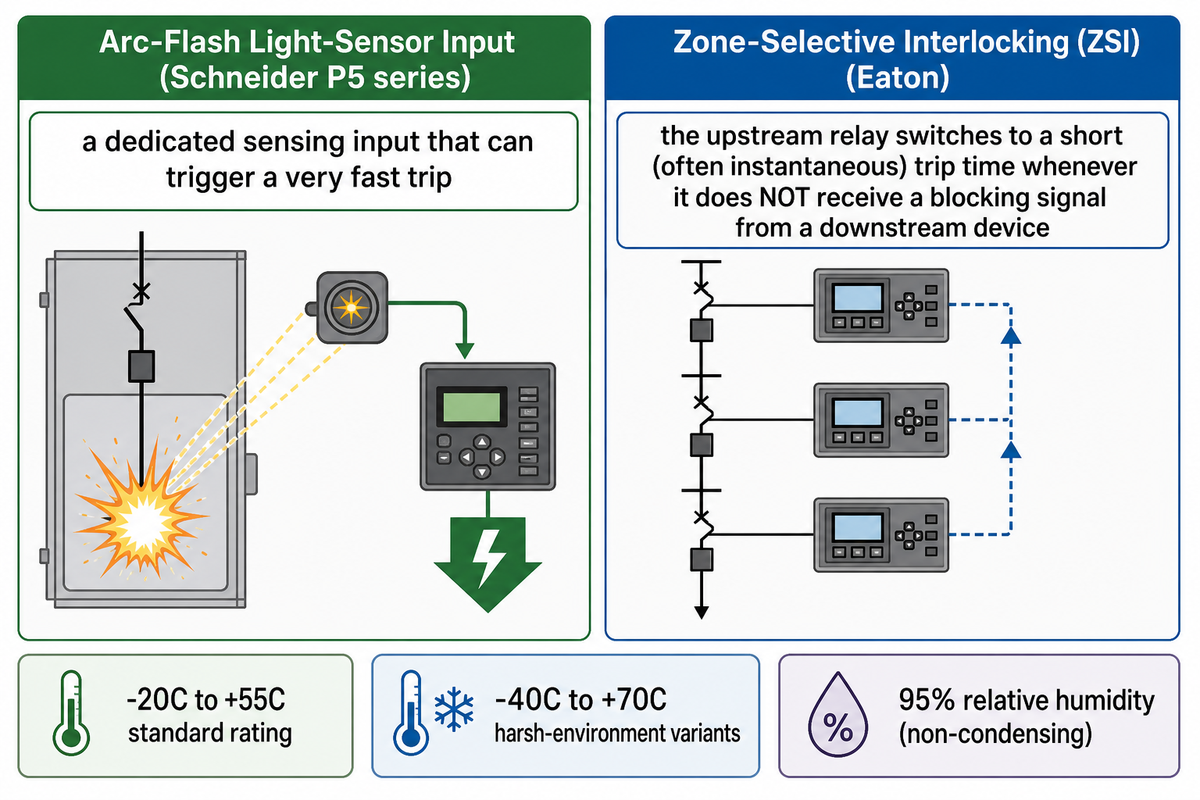
Schneider’s PowerLogic P5 series is referenced in public technical materials as supporting a direct arc-flash light-sensor input, while Eaton’s platform is positioned around zone-selective interlocking (ZSI) as its coordination technique. These are not directly substitutable brand features solving the same problem, arc-flash exposure is a system-level engineering outcome driven by fault current magnitude and total clearing time across the whole protection chain, while ZSI is one specific coordination technique for shortening clearing time between upstream and downstream devices. A relay with a light-sensor arc-flash input adds a dedicated sensing input that can trigger a very fast trip when it detects the light signature of an arcing fault; ZSI instead shortens clearing time from the other direction: each relay normally waits out a coordination time delay so downstream devices get the first chance to clear a fault, but with ZSI, the upstream relay switches to a short (often instantaneous) trip time whenever it does NOT receive a blocking signal from a downstream device — which happens precisely when the fault is within the upstream relay’s own zone rather than downstream. Downstream relays sending that blocking signal is what preserves selectivity for faults that are genuinely downstream; the faster clearing applies specifically to faults the upstream device itself must clear.
Each approach contributes toward arc flash reduction, but in different locations within the distribution protection scheme, and neither are exclusionary; a system could implement both as complementary arc protection measures, alongside applicable safety standards and other design factors. Neither a light-sensor relay input nor ZSI alone constitutes complete arc flash protection; both are inputs into a broader hazard analysis that also accounts for available fault current and total system clearing time.
Form factor is a more directly comparable, and more concrete, buying criterion: Schneider’s higher-end relays are commonly specified with withdrawable sub-assemblies for maintenance access, while compact single-case footprints (a form factor associated with some Eaton digital relay offerings) reduce panel space at the cost of requiring full removal for certain maintenance tasks. The breaker’s trip coil itself draws current during the brief actuation pulse that fires the trip (a separate, much lower-current supervision circuit continuously monitors the coil’s health between operations); one documented 13.8kV switchgear application example, per an industrial-systems engineering write-up, put its trip coil at 3.5A at 125V DC, but this is a single application data point, not an industry-wide figure. That same write-up is a useful reminder of why the check matters at all: many relay output contacts are only rated for light signal or pilot duty, well under the current that a trip coil can draw during its actuation pulse in applications like the one documented above — exact contact ratings vary widely by relay model and duty class (AC vs. DC, resistive vs. inductive), so this is a check-your-own-datasheet issue, not a universal number — the kind of mismatch that can catch installers who assume any relay output can safely fire a breaker’s trip coil, though the exact current draw varies by breaker and relay model and must be checked against your own equipment’s nameplate rather than assumed from a single example. Confirm the exact current draw against your specific breaker’s trip-coil nameplate or technical manual and check it against your relay’s output-contact rating regardless of which brand’s form factor you choose. Neither approach is universally correct: withdrawable designs favor sites doing frequent in-panel testing, while compact designs favor space-constrained retrofits. Environmental rating is a related, often-overlooked spec: standard commercial-grade relays across the industry are typically rated -20°C to +55°C, while harsh-environment variants extend to -40°C to +70°C at a real but unquantified price premium (the exact percentage varies by model and vendor, ask your distributor for harsh-environment SKU pricing); humidity tolerance around 95% relative humidity (non-condensing) suits most indoor installations, and outdoor or tropical sites may need conformal coating. Vibration immunity per IEC 60255-21-1 is graded into classes across a standard sinusoidal test frequency range, with lower classes suiting most switchgear-adjacent mounting and higher classes suiting more demanding vibration environments (seismic-zone installations are a separate qualification, IEC 60255-21-3, not covered by the -21-1 vibration rating); confirm the exact class, frequency bounds, and gn rating — and, separately, seismic qualification if applicable — your specific model carries against your actual installation environment, not just the electrical spec sheet. Electrical transient immunity is a related but separate requirement, covered by the IEEE C37.90.1-2024 surge-withstand standard discussed further in the testing section below, so don’t assume a vibration-class rating also covers surge/transient withstand. Whichever combination of safety architecture and form factor you land on, the goal is the same: a protection system that keeps arc-flash energy exposure low and clearing time predictable, since that combination is what actually protects personnel and equipment, not which single vendor feature name appears on the spec sheet.
Protection Function Coverage: Overcurrent, Differential, Ground-Fault, and Motor Protection
Before comparing brands on any single protection function, it’s worth being explicit about what a relay actually is inside a fault protection system: the relay is one component among current transformers (CTs), the station’s DC control power supply, control wiring, the breaker’s trip path, and settings coordination between adjacent devices. That’s why a relay with excellent standalone specifications can still produce an unsuitable protection system if those surrounding interfaces are mismatched or poorly commissioned, and why the commissioning section below matters as much as the function table here.
Against this backdrop, the higher-tier product lines within both brands cover the standard set of ANSI device-function-numbered protection functions applicable to MV/HV feeders, motors and transformers – overcurrent (50/51), ground-fault (50N/51N), directional overcurrent (67), thermal/motor overload (49), and breaker failure (50BF) are broadly applicable to both Schneider’s SEPAM and MiCom lines, and to Eaton’s digital product line. Within Schneider’s own portfolio, distance protection (21) and line differential (87L) are readily available on MiCom’s 40+ Series line but not on Sepam, which means the real-world shopping trip is less a “Schneider versus Eaton” decision than a “does this series and function tier contain what my project truly requires?” question, and the selection matrix below answers that more directly than cross-referencing manufacturer spec sheets yourself.
Which Should You Choose? A Selection Matrix by Voltage Level and Application
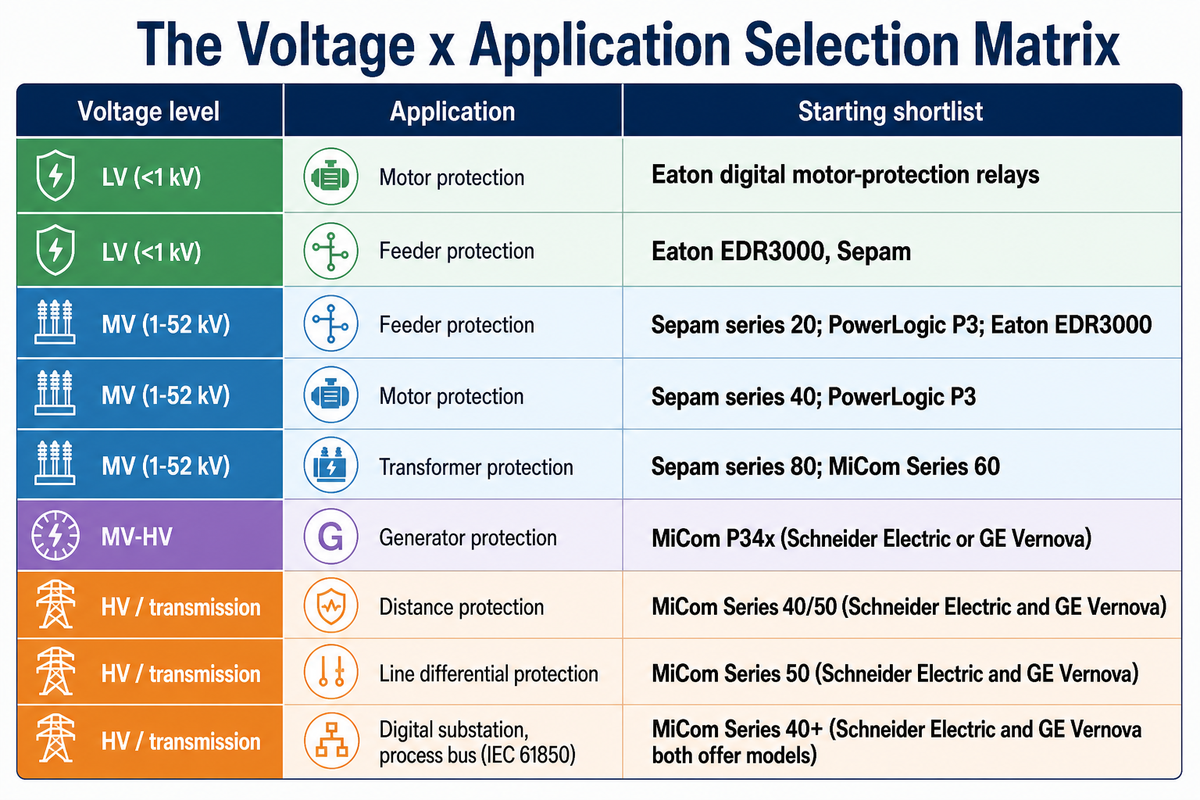
The real shortlist is defined primarily by voltage level and application, less by brand A versus brand B. A utility buying transmission-class devices and a manufacturer buying low-voltage motor protection both search “protection relay,” yet land in entirely different parts of each vendor’s catalog. The Voltage x Application Selection Matrix below does exactly that: match your project to a row, then use the RFQ checklist beneath it to specify the request.
| Voltage level | Application | Starting shortlist | Limitations / Not suitable for |
|---|---|---|---|
| LV (<1 kV) | Motor protection | Eaton digital motor-protection relays; Schneider’s LV-specific motor-protection options fall outside this guide’s SEPAM/MiCom-focused sourcing | No distance/differential functions (21/87); not for feeder or transmission-class projects |
| LV (<1 kV) | Feeder protection | This guide’s sourcing on both brands’ digital lines (Eaton EDR3000, Sepam) documents them as medium-voltage switchgear-oriented, not LV-specific | Confirm any true LV (<1 kV) feeder-protection option directly with each vendor — this guide’s SEPAM/MiCom/Eaton-digital-line-focused sourcing does not independently confirm an LV-rated model for either brand |
| MV (1–52 kV) | Feeder protection | Sepam series 20; PowerLogic P3; Eaton EDR3000 | No distance/differential functions; not for generator or HV transmission protection |
| MV (1–52 kV) | Motor protection | Sepam series 40; PowerLogic P3 | Series 40 spans several application-specific model variants (feeder, transformer, and motor-protection suffixes); confirm the specific motor-protection model within the series, not the series number alone — not a substitute for dedicated feeder or transformer-differential protection |
| MV (1–52 kV) | Transformer protection | Sepam series 80; MiCom Series 60 | MiCom Series 60 covers 87T only, no distance function (see series table above); Eaton’s E-Series naming convention (EDR=feeder/distribution, EMR=motor) suggests a separate ETR-prefixed model line for transformer protection — this article did not verify an Eaton transformer-protection model number, confirm directly with Eaton |
| MV–HV | Generator protection | MiCom P34x (Schneider Electric or GE Vernova, see product-line section above); check current Eaton datasheets directly | MiCom P34x generator-protection fit is confirmed directly against Schneider Electric’s own current product catalog, where P34x sits inside Schneider’s official “MiCOM Px40 Series” category (alongside P44x distance, P54x differential/distance, and others) — a different, official Schneider grouping from the “Series 20-80” numbering used in the series-reference table above, which is borrowed from a third-party guide’s own numbering and does not match Schneider’s official catalog structure; treat this table’s series numbers as a rough reference and confirm actual model numbers with the vendor. Eaton’s current digital line is documented here as feeder/transformer-focused, and this article did not find sourcing confirming a comparable Eaton generator-protection offering — confirm directly with Eaton if evaluating that brand for this application |
| HV / transmission | Distance protection | MiCom Series 40/50 (available from both Schneider Electric and GE Vernova, see the product-line section above) | Utility/transmission-grade pricing tier; oversized and cost-inefficient for LV/MV industrial applications; this article did not find sourcing confirming Eaton’s current digital line (documented elsewhere as feeder/transformer-focused) offers a comparable HV distance-protection function — confirm directly with Eaton if evaluating that brand for this application |
| HV / transmission | Line differential protection | MiCom Series 50 (available from both Schneider Electric and GE Vernova, see the product-line section above) | Line-differential specialist; not the default choice for local feeder or motor-protection work; this article did not find sourcing confirming an equivalent Eaton line-differential (87L) offering in its current digital line — confirm directly with Eaton if evaluating that brand for this application |
| HV / transmission | Digital substation, process bus (IEC 61850) | MiCom Series 40+ (Schneider Electric and GE Vernova both offer models in this tier); Schneider PowerLogic P5 | Process-bus support is model-specific (Schneider limited to the P5 series, see IEC 61850 section above), not automatic across every listed family member; this article did not find sourcing confirming Eaton’s E-Series (documented elsewhere as feeder/transformer-focused, medium-voltage) at HV/transmission process-bus scope — confirm directly with Eaton if evaluating that brand for this application |
This matrix is a starting screening tool for narrowing your vendor and series shortlist by voltage class and application, it is not a substitute for a full engineering system study. Settings coordination with adjacent devices, CT/VT characteristics, breaker and trip-circuit interfaces, and a validated network model all factor into final suitability beyond what a voltage-and-application table alone can show.
RFQ checklist — copy these into your quote request:
| Parameter | Recommended range | Why it matters | How to verify |
|---|---|---|---|
| Voltage class | LV / MV (1-52 kV) / HV per project one-line diagram | Determines which series family is even eligible | Cross-check against manufacturer’s published voltage rating table |
| Required ANSI functions | List every 50/51/67/21/87 function your application needs | SEPAM is documented as lacking 21/87B/87L on most models (series 60’s status is unverified in this guide) — this alone can eliminate a family | Request the function-by-function datasheet, not a marketing summary |
| IEC 61850 edition/profile | Specify Edition 2.1 if UCAIUG-current compliance is required | Post-Jan-2024, Edition 2.1 is the certification baseline per KEMA Labs’ account of UCAIUG policy (not UCAIUG’s own published text) | Request the UCAIUG/KEMA Labs certification reference for the specific model |
| Process bus requirement | State yes/no explicitly | Process-bus support is series-specific, not brand-wide (e.g. Schneider P5 only) | Confirm against the vendor’s process-bus-capable model list |
| Form factor | Withdrawable vs compact single-case | Affects maintenance access and panel space | Request panel drawing / cutout dimensions |
| Commissioning support | IEC 61850 conformance test report + injection test plan | Compliance claims alone do not prove commissioning-ready interoperability | Request a sample SCL validation report from a prior project |
Pricing, Cost Tiers, and Availability
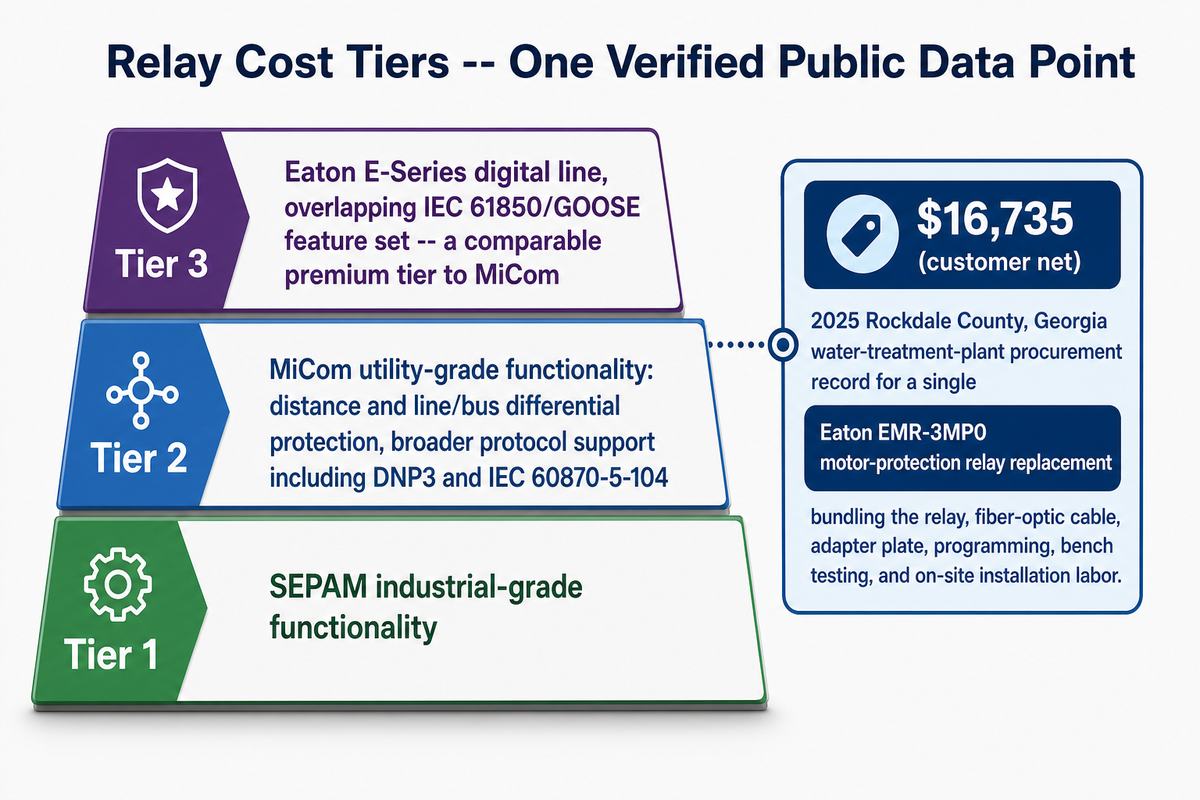
Neither Schneider Electric nor Eaton publishes protection-relay-specific list pricing, and reliable third-party pricing data for this equipment category is scarce industry-wide, a reality confirmed during this article’s research, not a shortcut around it. What can be said with confidence is relative cost-tier positioning: within Schneider’s own portfolio, MiCom’s utility-grade functionality (distance and line/bus differential protection, broader protocol support including DNP3 and IEC 60870-5-104) generally commands a premium tier over SEPAM’s industrial-grade functionality, and Eaton’s E-Series digital line occupies a comparable premium tier to MiCom given its overlapping IEC 61850/GOOSE feature set. Budget conversations with either vendor’s distributor should therefore start from the function tier you actually need, per the selection matrix above, not from a brand-wide price assumption. One real public data point, for scale: a 2025 Rockdale County, Georgia water-treatment-plant procurement record shows $16,735 (customer net) for a single Eaton EMR-3MP0 motor-protection relay replacement (EMR-3MP0 is Eaton’s E-Series motor-protection model, not one of the EDR3000/EDR5000 feeder/transformer-protection models discussed elsewhere in this guide), a figure that bundles the relay itself, a fiber-optic cable, an adapter plate, retrieval of existing settings, programming, bench testing, and on-site installation labor, not a bare-relay unit price. No equivalent recent public Schneider transaction of similar scope was found. With pricing evidence available on only one side of this comparison, no brand-to-brand relative price conclusion can honestly be drawn from public sources at this time — this figure can inform an Eaton-side budget conversation only, not a Schneider-versus-Eaton price comparison.
The more expensive mistake buyers make isn’t overpaying on the relay’s sticker price — it’s assuming the lowest sticker price equals the lowest 5-year total cost of ownership. A cheaper relay that lacks a function you need later, say distance protection you didn’t spec because you were comparing SEPAM against a MiCom price quote, forces a mid-life replacement, and a relay from a family with thinner spare-parts availability or a smaller regional service network can turn a routine failure into extended downtime. Budget for the function tier your application needs today plus a realistic growth margin: the genuinely cost-effective choice is the one that avoids a mid-life replacement, not the cheapest unit that technically clears today’s spec sheet.
Testing and Commissioning After You Choose a Relay
Selecting a relay differs from operating a protection system – commissioning is where the theoretical spec sheet meets real CTs, real wiring, and real fault-current conditions. In practice, CT polarity reversal is reported as the most common protection-relay commissioning fault in industry checklists, and it’s verifiable via primary injection testing before energization rather than caught later during a real fault event. Beyond CT polarity, IEC 61850 deployments specifically need SCL configuration validation and GOOSE subscription testing between devices; interoperability testing during commissioning remains essential even when every device individually claims IEC 61850 compliance, precisely because implementation depth varies by vendor and by edition, as covered in the IEC 61850 section above.
One verification item outside this article’s scope but worth a direct question at commissioning time: firmware and cybersecurity exposure varies by specific model and firmware revision, not just by product family, so ask your Schneider or Eaton representative for the current firmware maintenance status of the exact unit you’re specifying, not just its product line’s general security posture.
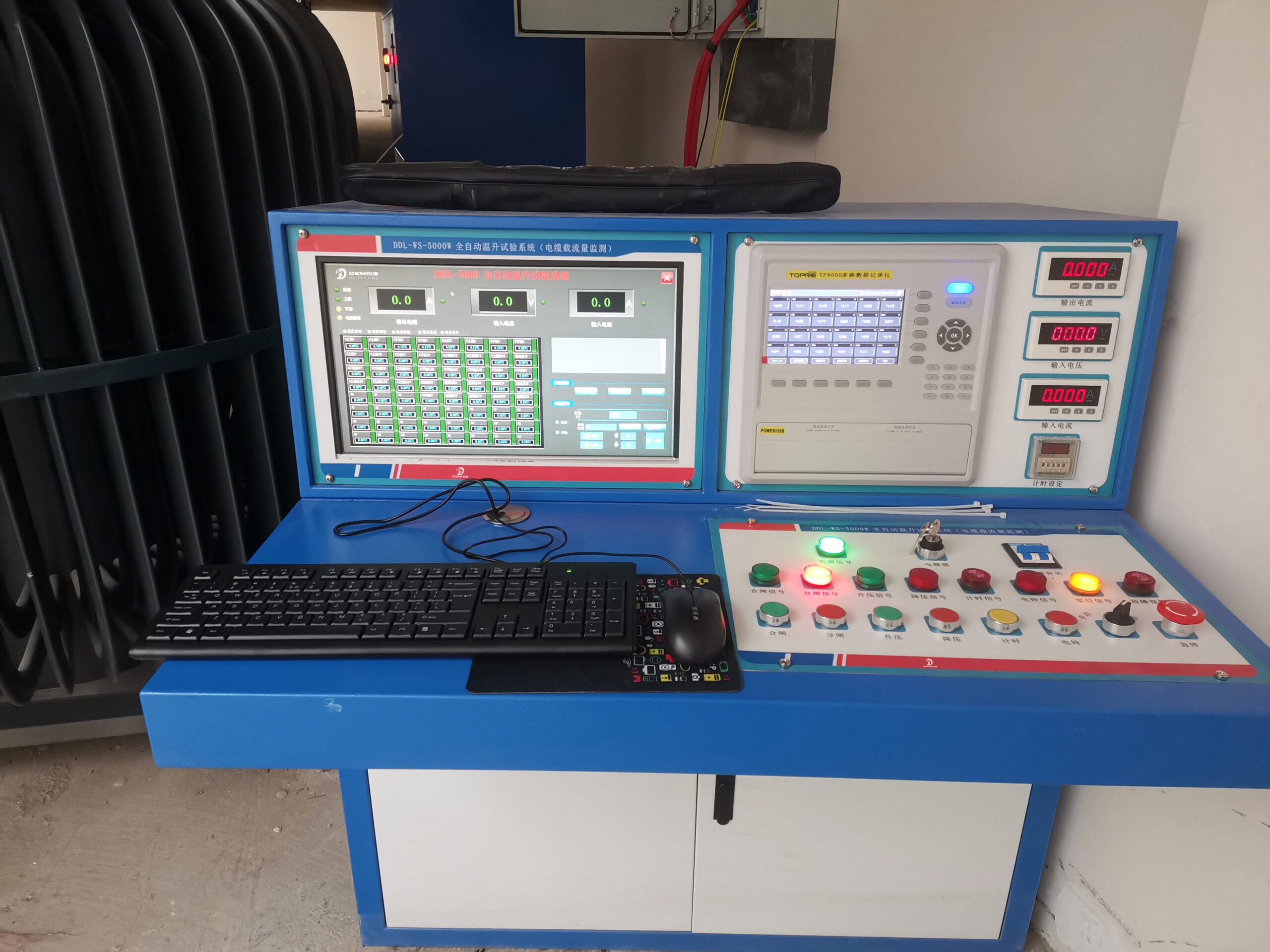
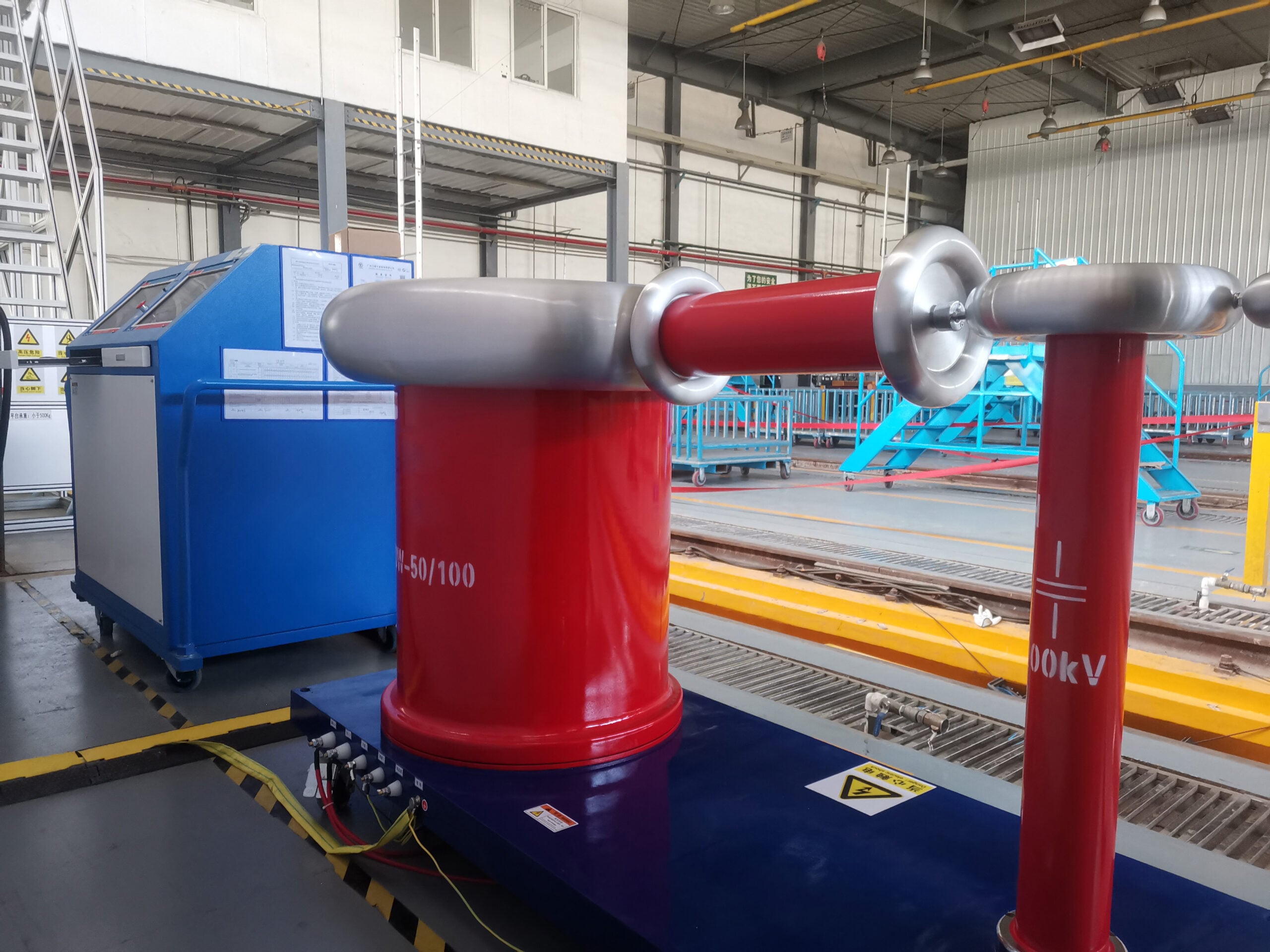
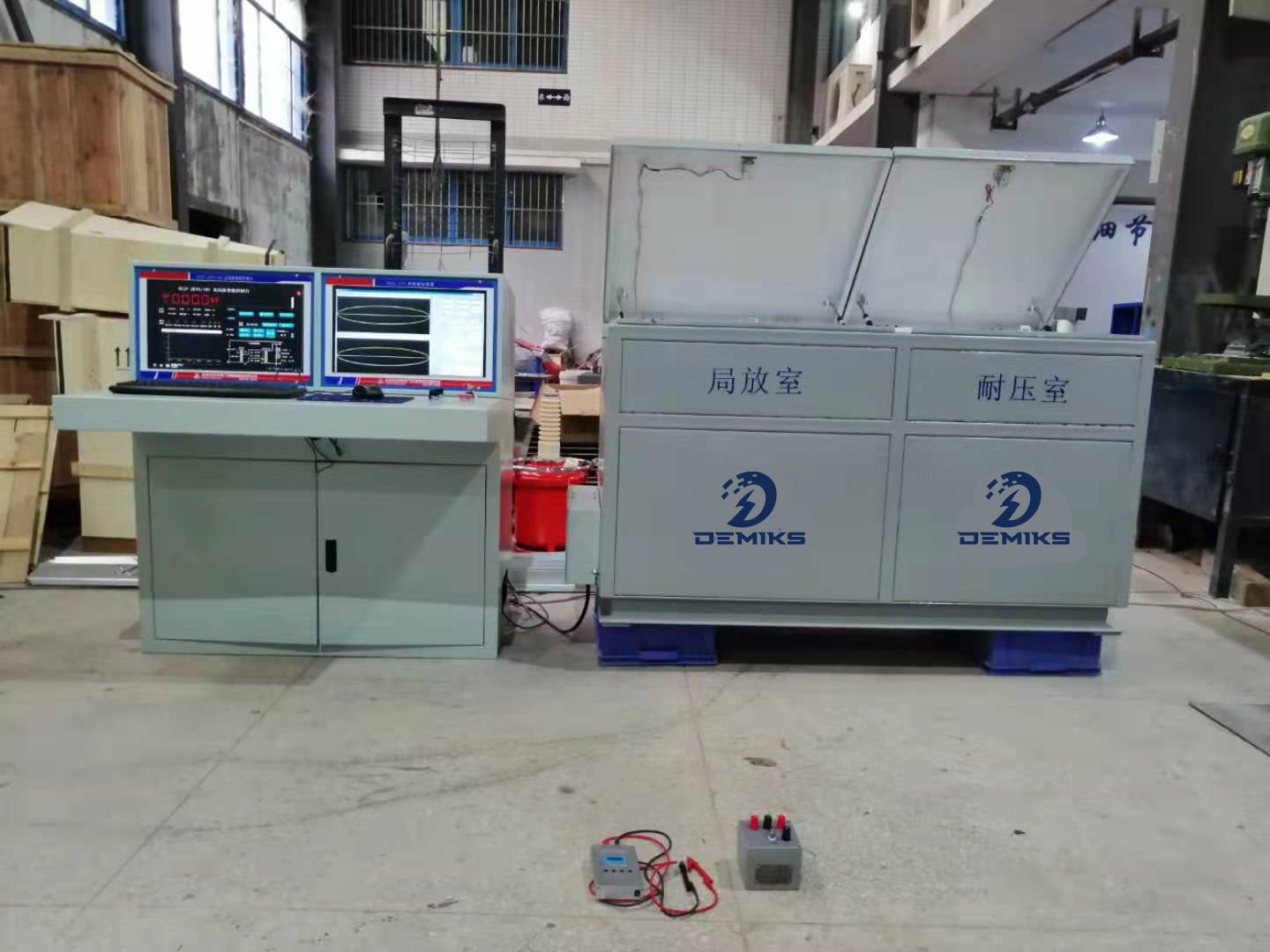
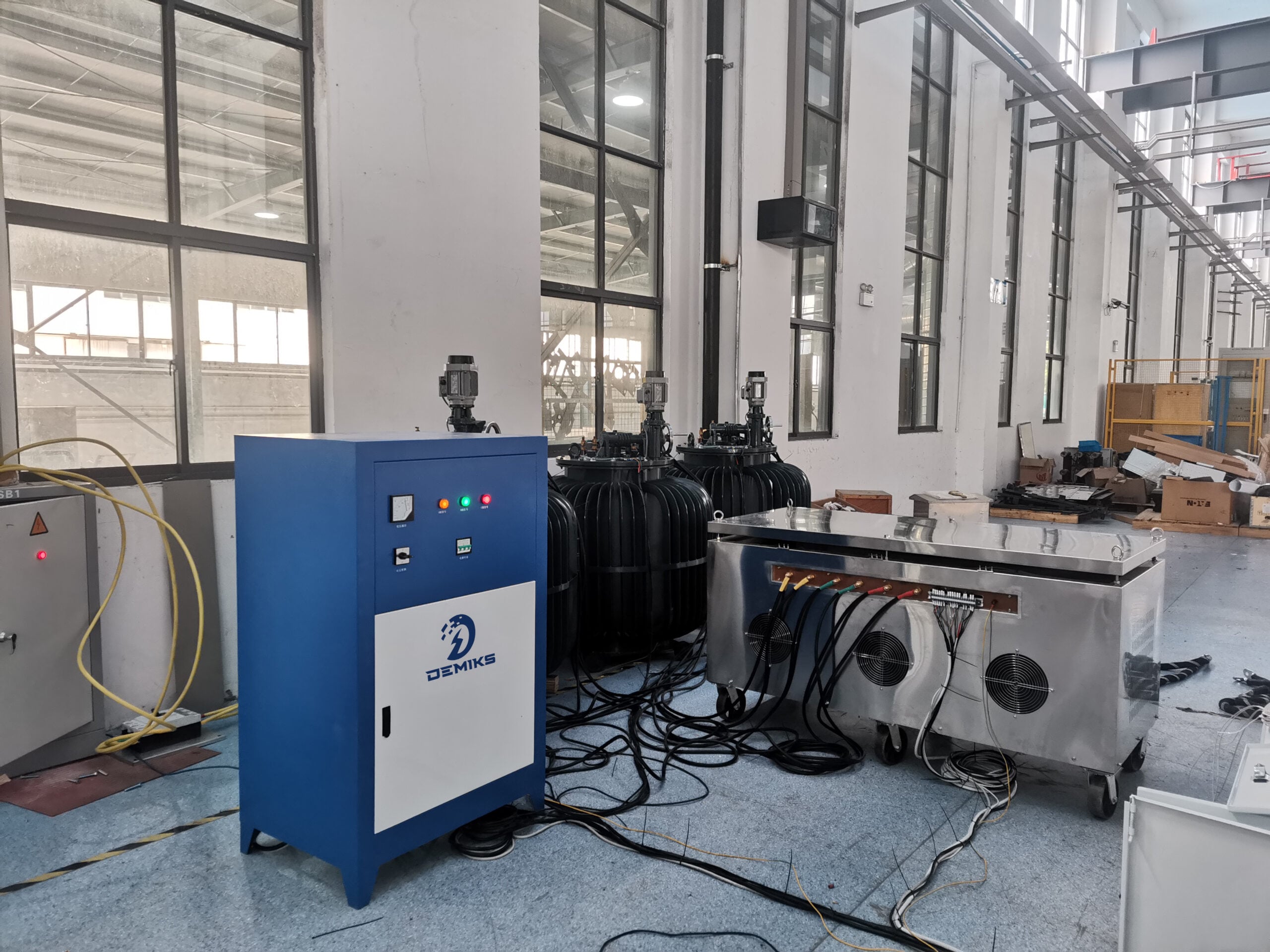
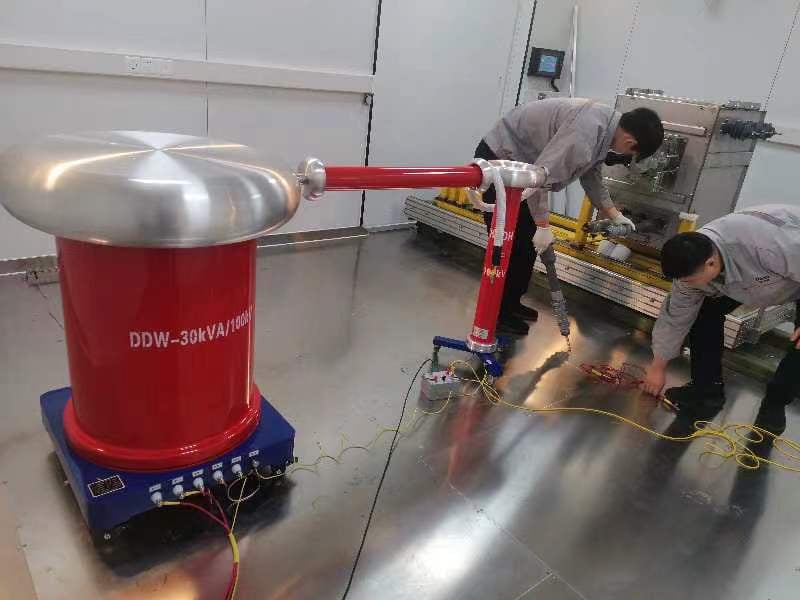
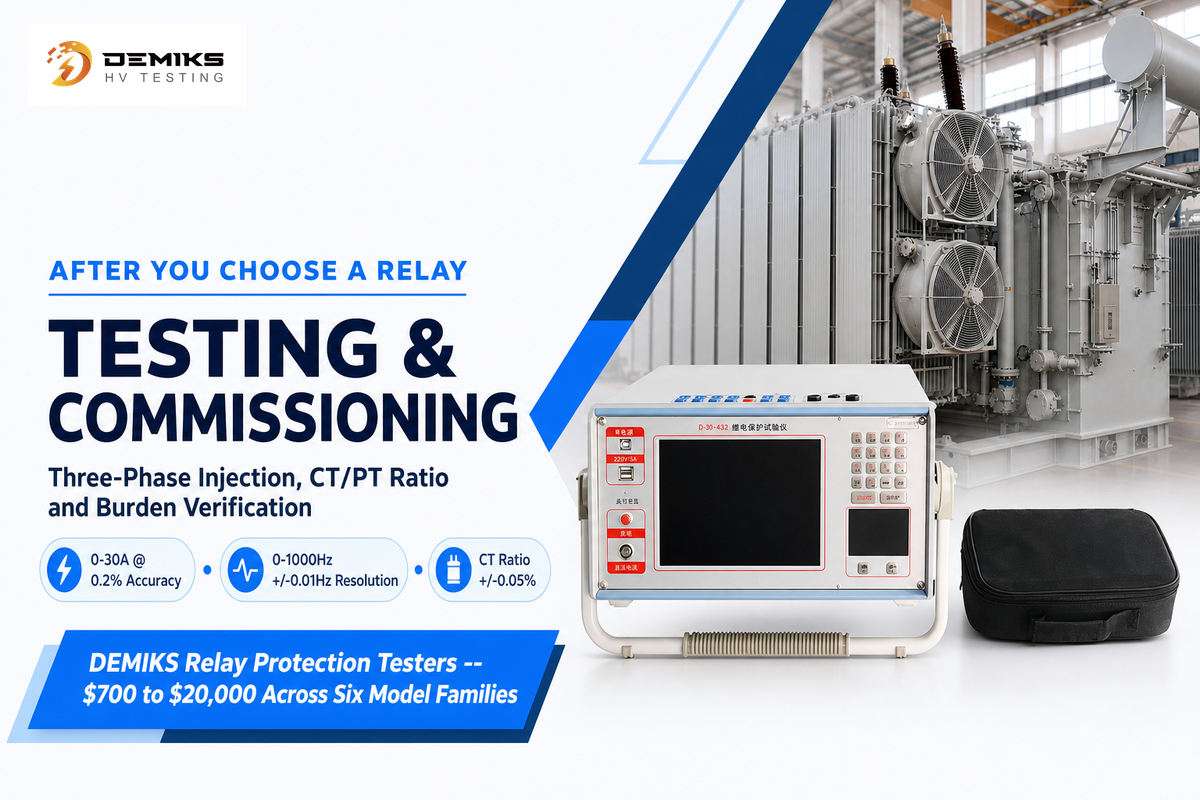
Dedicated relay-protection testers exist specifically to make this verification repeatable rather than ad hoc. DEMIKS’ own relay protection testers line spans roughly $700 to $20,000 across six model families, including a three-phase relay test kit rated for 0–30A current output at 0.2% accuracy, 0–320V voltage output at that same accuracy class, and a 0–1000Hz frequency range with ±0.01Hz resolution, plus a dedicated CT/PT analyzer offering CT ratio accuracy of ±0.05% and phase accuracy of ±0.5min for the ratio and burden testing that specifically catches CT polarity and ratio errors before they reach a live fault. Where a broader commissioning scope also calls for insulation and withstand testing on the same panel, DEMIKS’ multi-frequency voltage generator outputs 0-400V at a 50-200Hz adjustable frequency range with waveform distortion under 3%, and its transformer field calibrator covers 0V to 2400V at 0.02% class accuracy and operates across a 5-40°C environmental range. DEMIKS lists IEC 60255 and IEEE C37.90 as the compliance standards for its relay-protection-tester line as a whole. That baseline describes the relay testers’ own build and testing standard, not a certification the tester confers on your relay — the relay itself still needs its own manufacturer compliance paperwork, and it’s a distinct standard number from the specific IEEE C37.90.1-2024 surge-withstand standard discussed earlier — C37.90 (general relay/protection-equipment requirements) and C37.90.1 (the surge-withstand-capability sub-standard within that same family) are two different, currently-active standard numbers, not an older version and its replacement, so confirm which exact standard number your project spec actually calls out. Whether you’re troubleshooting a live fault on an existing installation or commissioning a brand-new relay for the first time, the same three-phase power injection capability applies. Industry maintenance-testing guidance, NETA’s MTS specifications and ANSI/NFPA 70B, generally points toward periodic re-testing on a roughly 1–3 year cycle, though the two standards differ in structure and exact intervals by equipment class; adjust for the relay’s age, application criticality, and manufacturer recommendations — commissioning is the first test, not the last.
A current transformer burden box (a compact 483x365x178mm unit in DEMIKS’ line, accurate to ±3% across its operating range) is the companion instrument for burden verification during the same CT/PT testing pass. Document all relay serial numbers against their test reports at commissioning. This traceability record matters for warranty claims and becomes the baseline your next periodic re-test will compare against.
Industry Outlook: Why Aging Grids Are Driving a Relay Retrofit Wave
A scope note before the regulatory discussion below: this section’s NERC references apply specifically to registered owners and operators of the North American bulk power system, not automatically to every industrial motor-protection or low-voltage distribution buyer who arrived at this article via the broader “protection relay” search. If your project is plant-level industrial motor protection rather than bulk-power transmission or generation, the NERC drivers below are context for why the wider market is retrofitting, not a compliance obligation specific to your installation.
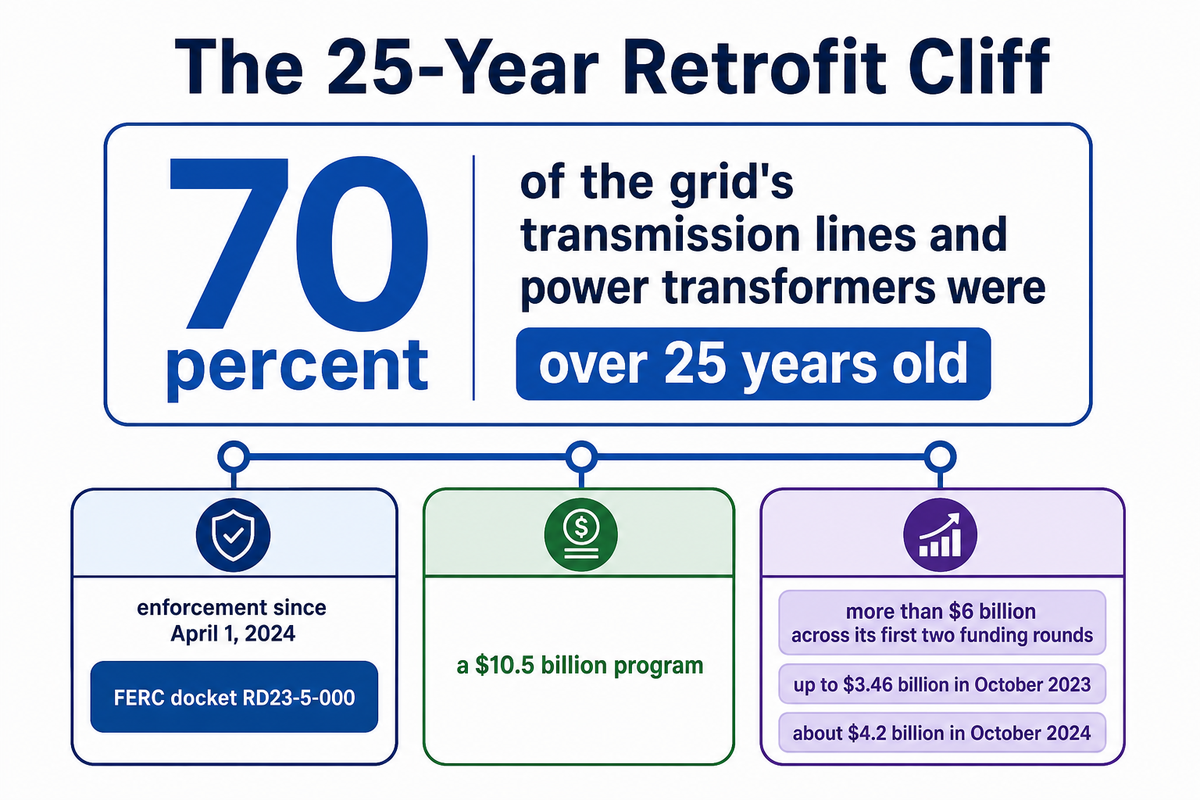
For utilities and bulk-power-system participants, two distinguishable regulatory pathways exist rather than one generic “NERC requirement.” NERC’s PRC-023 reliability standard (Transmission Relay Loadability: its exact scope, not protection-relay settings in general, by NERC’s own standard title) has been a mandatory, FERC-approved requirement since its original approval, with the current PRC-023-6 revision specifically subject to enforcement since April 1, 2024, per NERC’s own PRC-023-6 standard page (FERC docket RD23-5-000, order issued 2024-01-24, regulatory order effective 2024-01-25, per the same NERC page); it obligates covered transmission owners and operators to set their transmission relay loadability parameters against specific technical criteria, so settings neither limit transmission loadability nor block legitimate remedial action: a relay-hardware-level mandate, but scoped to that one setting category, not every protection function a relay performs. Separately, the NERC CIP cybersecurity standards address communications and cyber-asset protection rather than relay settings directly; the Department of Energy’s Idaho National Laboratory has developed the Constrained Cyber Communication Device (C3D) as a communications-filtering technology layered around protective relays for that second, cybersecurity-focused track. These sit on two different parts of the protection system, not one undifferentiated “NERC mandate.”
Underneath the regulatory picture, the physical driver for retrofit demand is straightforward: per a 2022 U.S. Department of Energy notice of intent, “studies from the past decade find that 70 percent of the grid’s transmission lines and power transformers were over 25 years old” (the notice’s own wording, quoted directly rather than paraphrased to first-person present tense). We call this the 25-Year Retrofit Cliff: aging transmission lines and transformers are the underlying condition driving grid modernization, and relay-replacement budgets are one visible downstream consequence of that broader retrofit wave, even where individual utilities aren’t facing an acute failure. On the ground, that means electromechanical relays installed alongside that aging transmission infrastructure are progressively being replaced with numerical (microprocessor-based) units in a multi-decade upgrade cycle, which is the underlying demand driver behind both Schneider’s and Eaton’s continued investment in this product category. DOE’s Grid Resilience and Innovation Partnerships (GRIP) program, a $10.5 billion program under which DOE reports having announced more than $6 billion across its first two funding rounds (up to $3.46 billion in October 2023, about $4.2 billion in October 2024), is funding transmission and distribution modernization work that includes this class of infrastructure. Protective-relay market-research estimates put category growth in the mid-single-digit CAGR range through the late 2020s; that market-size figure is supporting context for the retrofit trend, not the core argument — the core argument is the aging-infrastructure statistic and the regulatory driver documented above.
FAQ
Q: Which is better, Eaton or Schneider Electric protection relays?
There is no universal winner, the right choice depends on which specific series matches your required protection functions, whether IEC 61850 Edition 2.1 is a hard requirement, and what your site’s existing installed base already runs.
Q: Who are Eaton’s and Schneider Electric’s main protection-relay competitors?
Beyond each other, the main global competitors in numerical protection relays are Siemens (SIPROTEC), Hitachi Energy (Relion, still sometimes called “the former ABB line”), SEL, and GE Grid Solutions (Multilin), with regional specialists like Basler Electric and Beckwith Electric serving narrower niches.
Q: Can I replace a SEPAM relay with a MiCom relay?
Not as a direct drop-in swap, SEPAM and MiCom use different mounting dimensions, CT input configurations, and wiring schemes, so cross-family replacement requires a full re-engineering of the panel, not a like-for-like unit swap.
Q: Does SEPAM support IEC 61850?
Yes, across multiple series, not just the top tier, Schneider’s own IEC 61850 user’s manual documents the protocol across Sepam series 20, 40, 60, and 80 rather than isolating it to one exclusive model line.
Q: Which MiCom series is best for substation automation?
MiCom Series 40 is widely regarded as the utility-grade workhorse for substation automation, offering distance protection alongside native IEC 61850 support and hardware suitable for substation environments.
Q: Why does Schneider sell both SEPAM and MiCom product lines?
Both product lines arrived through separate corporate acquisitions, SEPAM via Merlin Gerin in 1992, MiCom via the AREVA T&D asset split, and Schneider kept both running for their distinct established markets rather than consolidating them.
References & Sources
- IEC 61850 official reference site — International Electrotechnical Commission
- IEC 61850 Ed.2.1: A New Milestone in Smart Grid Interoperability — Enlit World / KEMA Labs (CESI)
- IEEE C37.90.1-2024 Standard — IEEE Standards Association
- PRC-023-6: Transmission Relay Loadability — North American Electric Reliability Corporation
- Electric Reliability Orders Archive — Federal Energy Regulatory Commission
- Protective Relay Permissive Communication — Idaho National Laboratory / U.S. Department of Energy
- Building a Better Grid Initiative — U.S. Department of Energy, Federal Register Notice
- Grid Resilience and Innovation Partnerships (GRIP) — U.S. Department of Energy, Office of Electricity
- 2025 Water Treatment Plant Relay Repair Procurement Record — Rockdale County, Georgia
- Schneider Electric official product-category page — verification source for current MiCom P34x/P54x listing under the PowerLogic brand
- GE Vernova official product datasheet — verification source for current MiCom P54 listing, AREVA-lineage transmission-class relays
Why We Write This
DEMIKS builds relay protection testers and CT/PT analyzers used to commission and verify protective relays from every major manufacturer; this comparison draws on that testing-side vantage point of protection relays, and on the standards and regulatory documents that govern how they’re specified. We narrowed our scope statement above deliberately: our expertise sits with the commissioning and verification side of this equipment category, not with an independent lab-tested feature ranking of every Schneider or Eaton series. Reviewed by the DEMIKS Electric Power Technology Co.,LTD technical team.
Related Articles
- Understanding the Voltage Protection Relay: Working Principle and Functions — how voltage protection relays work, for readers who need the fundamentals first
- A Detailed Review of the Top 10 Relay Protection Tester Manufacturers Worldwide — our review of relay protection tester manufacturers
Once you’ve used the Voltage x Application Selection Matrix above to shortlist a relay family, whether or not your project is riding the 25-Year Retrofit Cliff wave, the next step is commissioning it correctly. See DEMIKS’ high voltage test equipment lineup for the broader test-equipment range that supports full substation commissioning beyond relay testing alone.