Analysis of Two AC Series Resonant Withstand Voltage Technologies: Applications of ACRL and ACRF in High-Voltage Cable Testing
Abstract: In the field of AC withstand voltage testing for capacitive high-voltage equipment such as XLPE high-voltage power cables and GIS, the ACRL inductance-modulated power frequency resonant system and the ACRF frequency-modulated inverter resonant system are the two mainstream series resonant testing technologies. Both rely on the LC series resonance principle to achieve high test voltage output from a small power supply capacity, but their tuning mechanisms, output frequencies, and applicable operating conditions differ significantly. They play irreplaceable roles in laboratory type testing, factory testing, and on-site commissioning testing, respectively. This article provides a complete interpretation of the principles, technical characteristics, main applications, and selection criteria of these two systems, based on domestic and international power industry standards and engineering practices.
With the large-scale commissioning of high-voltage cable lines supporting urban power grids and new energy sources in China, insulation withstand voltage testing of cross-linked polyethylene (XLPE) cables has become a crucial link in ensuring power grid safety. Since high-voltage cables are typical large-capacity capacitive test objects, traditional direct-step-up power frequency test transformers are limited by power capacity and equipment weight, making it difficult to meet the withstand voltage testing requirements of long-distance cables. Series resonant AC withstand voltage testing has become the mainstream solution in the industry.
In the European and American high-voltage testing industry standards system, series resonant withstand voltage systems are divided into two categories: ACRL (AC Resonant-L, inductance-modulated power frequency series resonant system) and ACRF (AC Resonant -F, frequency-modulated variable frequency series resonant system) . In domestic power field applications, ACRF variable frequency resonant equipment is mainly used, while ACRL inductance-modulated 50Hz resonant systems are more commonly used in cable manufacturing company laboratories and authoritative third-party testing institutions. There is no absolute superiority or inferiority between the two types of equipment; rather, the selection is differentiated based on the test objective, test location, and whether partial discharge detection is conducted simultaneously.
I. Basic Working Principle
ACRL inductor-modulated resonant system (fixed 50Hz power frequency)
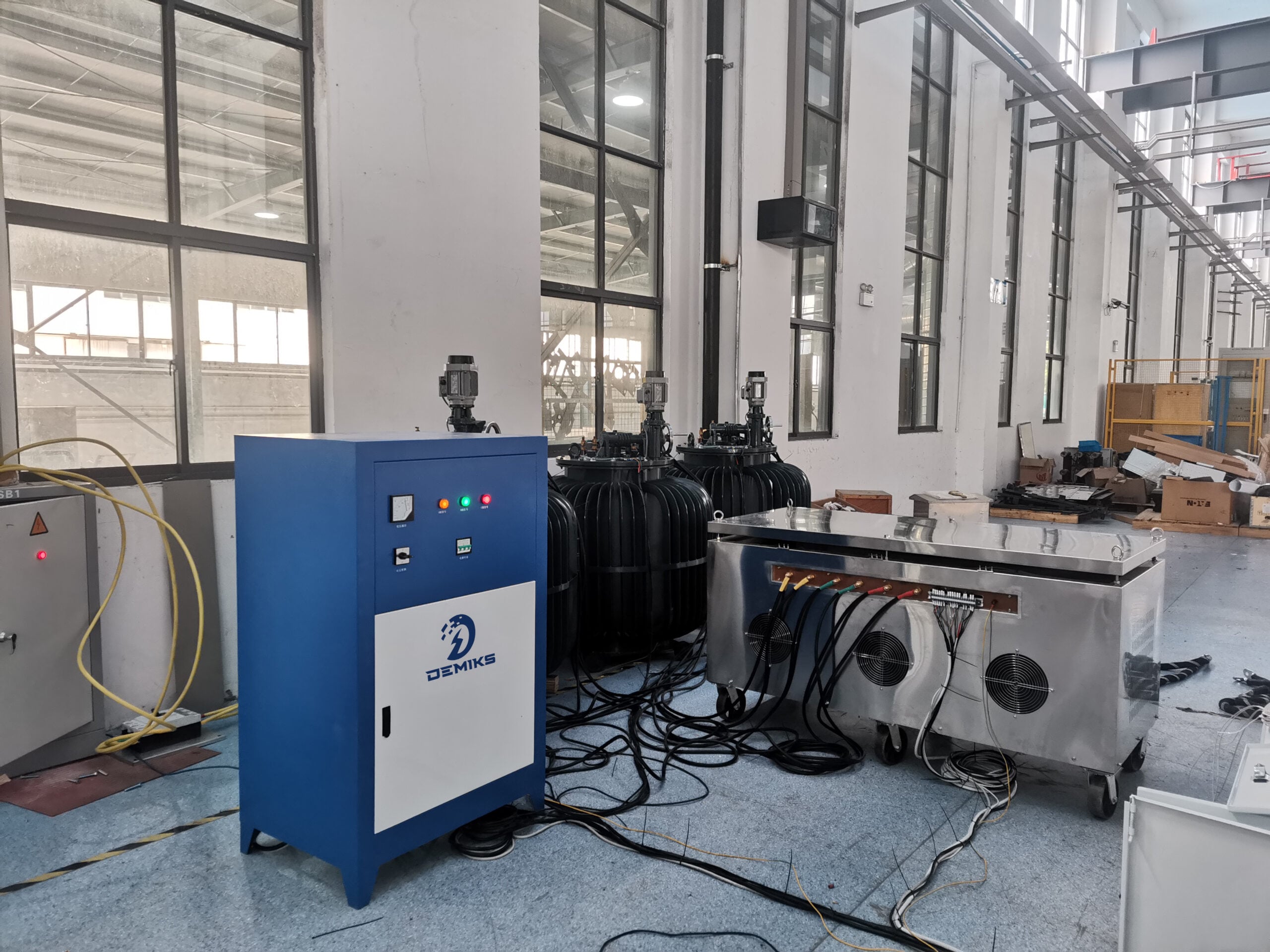
The ACRL system power output is strictly fixed at a 50Hz mains frequency voltage. By adjusting the inductance value L of the reactor (adjustable air gap/multi-tap variable reactor), the inductive reactance of the circuit is changed to match the capacitive reactance of the cable under test, thus satisfying the resonance condition. A series resonant voltage boost was achieved at a frequency of 50Hz. The test voltage frequency was completely consistent with the actual operating frequency of the power grid, and the electric field distribution and polarization characteristics inside the insulation medium were completely equivalent to the actual operating conditions of the cable.
ACRF frequency modulation and frequency conversion resonant system (20-300Hz adjustable)
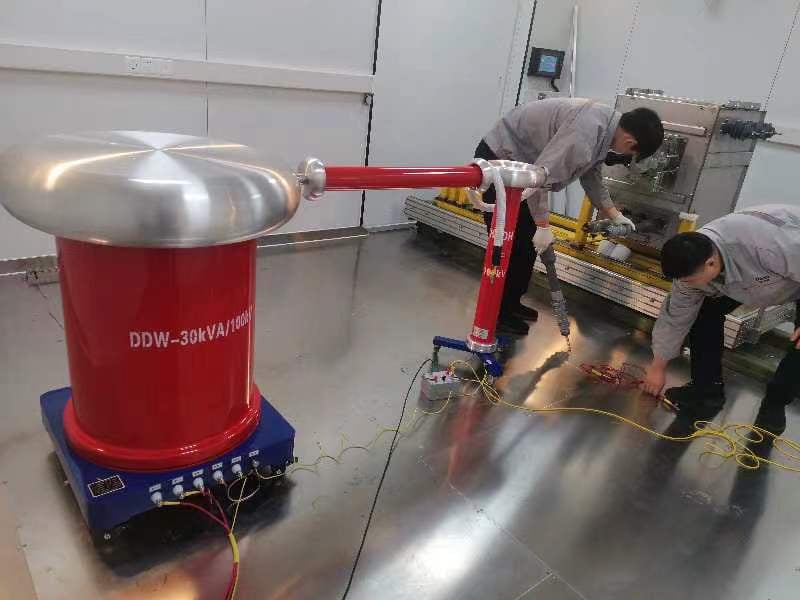
In an ACRF system, the inductance parameters of the reactor remain constant. The output frequency f is dynamically adjusted by a frequency converter to match the capacitance C of the cable under test, achieving circuit resonance. The resonant frequency automatically changes according to the cable length (capacitance), with a standard allowable operating range of 20-300Hz ; the longer the cable and the larger the capacitance, the lower the resonant operating frequency. This scheme relies on frequency adjustment for tuning, and the reactor uses standardized fixed inductance modules that can be flexibly combined in series and parallel.
II. Core Technology Features and Main Industry Applications
ACRL (Adjustable Inductance 50Hz Power Frequency Resonant System)
Key advantages: True 50Hz power frequency test voltage, low electromagnetic noise, native support for high-precision partial discharge PD synchronous detection, and test conditions that fully match the power frequency requirements of IEC and GB for cable type testing .
Main uses:
- Type testing and pre-qualification testing for cable manufacturers : Type testing for new XLPE high voltage/ultra-high voltage cables during product development and process changes. The standard requires the use of 50Hz AC withstand voltage. ACRL can reproduce the electrical stress conditions of the cable in actual operation and is used to verify the long-term insulation performance of the cable body, intermediate joints and terminals. It is the preferred equipment for cable type testing.
- Laboratory sampling tests and scientific research testing : Third-party high-voltage testing laboratories and high-voltage testing halls of cable factories conduct power frequency withstand voltage and partial discharge tests on finished cable samples. While withstand voltage, partial discharge signals are collected to identify tiny air gaps and impurities inside the insulation.
- Power frequency withstand voltage test for stator windings of generators and large motors : The insulation design standard for large rotating motors is 50Hz power frequency, requiring the use of real power frequency AC withstand voltage. ACRL can meet the insulation assessment of such equipment and also conduct partial discharge diagnosis.
- For special projects with mandatory power frequency requirements for testing : Some overseas projects and high-end power engineering contracts explicitly require the test voltage to be 45-55Hz power frequency. In these cases, the ACRL system should be given priority.
Limitations: Adjustable reactors are bulky and heavy, making on-site transportation difficult; the inductance adjustment range is limited, and one set of equipment can only adapt to a narrow range of cable capacitances. When dealing with cables of very long spans, it is necessary to replace the reactor module; it is not suitable for large-scale handover tests at field construction sites .
ACRF (Adjustable Frequency Resonant System, 20-300Hz )
Core advantages: Modular design, controllable equipment weight, single unit can cover a very wide range of cable capacitance, adaptable to cable lines of different lengths; low requirements for on-site power supply capacity, only needing to provide the active power loss of the circuit, easy to deploy on-site, making it the mainstream equipment in domestic power grids. Based on GB 50150 2016, DL/T 474.4 2018 and IEC 60840 standards, the AC withstand voltage test in the 20-300Hz frequency range can be used for on-site acceptance testing of XLPE cables, possessing good test equivalence.
Main uses:
- On-site handover withstand voltage test for newly built high-voltage cable lines : The final handover test after the completion of the laying of 10kV and 220kV urban distribution network cables and new energy transmission cables is conducted to detect damage to the cable body and defects in the joint installation process. It is the most widely used testing equipment in domestic power construction sites.
- On-site withstand voltage test for capacitive high-voltage equipment such as GIS and switch-gear : On-site AC withstand voltage test of substation GIS, instrument transformers, and high-voltage switchgear, utilizing the excellent filtering characteristics of resonant circuits to output sinusoidal test voltage.
- Preventive withstand voltage test during operation and maintenance : insulation verification test after cable line overhaul and renovation; applicable to long-distance cables and short sections of submarine and land cables in the field withstand voltage test.
- In scenarios where power supply is limited in the field or on construction sites : Construction sites often only have ordinary factory power supplies. ACRF systems have low power requirements, do not require high-power test transformers, and can quickly set up test circuits.
Limitations: The operating frequency deviates from 50Hz; the frequency converter has built-in switching electromagnetic noise, making it difficult to achieve high-precision partial discharge measurement under native conditions. If partial discharge detection is required, an additional complex filtering and noise reduction unit must be added; under long cable conditions, the resonant frequency may drop to the 20-30Hz range.
III. Overview of ACRL and its Key Applications
| Comparison Dimensions | ACRL inductor-modulated power frequency resonant system | ACRF frequency modulation resonant system |
| Tuning method | Adjust the inductance L of the reactor, and fix the frequency at 50Hz. | With inductor L fixed, the power supply frequency f is adjusted. |
| Output frequency | Strict 50Hz | 20-300Hz , varying with cable capacitance |
| Partial radiation detection capability | Low native noise, allowing for direct high-precision PD testing. | The original noise is high, requiring additional filtering before partial discharge testing can be performed. |
| Typical usage locations | Cable factory laboratory, third-party testing hall | Power grid construction site and handover test |
| Core Applicable Business | Type testing, factory testing, scientific research testing | On-site handover test, GIS withstand voltage test, operation and maintenance test |
| Cable compatibility range | The range of compatible capacitors is relatively narrow. | A single set of equipment covers a wide range of cable lengths. |
| Equipment mobility | Bulky and costly to relocate | Modular design facilitates on-site transport. |
| Standard positioning | Type testing priority scheme | Mainstream compliance solutions for on-site handover testing |
IV. Industry Selection Recommendations and Current Development Status
From the perspective of actual application in the domestic power industry: ACRF variable frequency resonant systems occupy an absolute mainstream position in on-site acceptance testing , meeting the voltage withstand requirements of most newly built cables upon completion; while ACRL adjustable inductance 50Hz resonant systems are mostly used in laboratory environments, with few on-site application cases.
- For type testing, factory partial discharge withstand voltage combined testing, and mandatory power frequency requirements in contracts, the ACRL system should be given priority to ensure that the test stress is completely consistent with the actual operation.
- For construction sites, cable handover upon completion, GIS withstand voltage tests, and sites with poor power supply conditions , ACRF frequency conversion resonant systems should be given priority. These systems meet the national standard’s requirement for 20-300Hz testing, while also balancing efficiency and equipment portability.
- When a project site requires both withstand voltage testing and simultaneous partial discharge diagnosis, if ACRF equipment is selected, a dedicated filter component must be configured to suppress electromagnetic interference from the frequency converter power supply. When conditions permit, samples should be sent to the laboratory for partial discharge testing using ACRL.
V. Industry Summary
The ACRL and ACRF series resonant testing techniques are not interchangeable, but rather complementary in laboratory and field scenarios . ACRL aims for 50Hz real-world power frequency testing conditions consistent with the power grid, favoring R&D, type approval, and diagnostic testing; ACRF prioritizes field adaptability and a wide measurement range, serving numerous engineering handover and acceptance tests. Testing personnel need to rationally select the testing system based on the testing objectives, standard clauses, and project contract requirements to ensure the accuracy and validity of high-voltage cable insulation test results, providing a reliable basis for the safe operation of the power grid.