Summary of SF₆ high-voltage equipment and introduction to SF₆ gas recovery, purification, charging and discharging devices
10kV and above high-voltage, ultra-high-voltage, and extra-high-voltage power transmission and distribution equipment due to its excellent insulation and arc-quenching properties . Its core components are divided into three main categories: switch-gear, primary transformer equipment, and auxiliary devices.
I. High-voltage switch–gear (most mainstream)
| SF₆ Product description | Common voltage levels | Typical application scenarios | Core operational risks |
| SF₆ circuit breakers | 10kV~1100kV AC; UHV AC/DC substations | Open-type substations, power plant outgoing lines, main transformer bays | Gas leak, excessive moisture, contact erosion, density relay failure |
| SF₆ load switch | 10kV, 24kV, 35kV | Urban distribution network ring main unit, box-type substation, distribution branch | Air leakage, jammed operating mechanism, inability to interrupt short-circuit current |
| Gas-insulated switch-gear (GIS) | 35kV~1100kVAC-GIS / DC-GIS | Indoor substations, underground substations, and converter stations in urban areas | Multiple chamber leaks, internal discharge, excessive gas decomposition products, and defects in basin-type insulators. |
| Hybrid Gas Insulated Switch-gear (HGIS) | 110kV~500kV | Outdoor compact substation with open busbar layout | Circuit breaker gas chamber leakage, open busbar external insulation flash-over. |
| RMU Ring Main Unit (SF₆ type) | 10kV/12kV, 24kV | Community power distribution, cable ring network, switchgear | Minor leaks in the sealed air chamber, aging of the explosion-proof cover. |
| SF₆ disconnector/
grounding switch |
Equipped with GIS/HGIS, a small number of independent tank-type systems. | GIS bays, inside tank-type circuit breakers | Improper operation, surface discharge of insulating components |
II. High-voltage instrument transformers and other primary equipment
| Chinese name | English name | Common voltage levels | Typical application scenarios | Core operational risks |
| Gas-insulated power transmission pipelines (GIL) | Gas Insulated Transmission Line (GIL / GIB) | 110kV~1100kV | Tunnels, underground substations with large-capacity busbar connections, and hydropower plant corridors | Multiple leaks and settlement in long pipelines lead to seal damage. |
| SF₆ gas-insulated current transformer | SF₆ Gas-insulated Current Transformer (CT) | 110kV~750kV | Open substation, HGIS bay | Risks of air leakage, insulation aging, and secondary open circuit |
| SF₆ gas-insulated voltage transformer | SF₆ Gas-insulated Voltage Transformer (VT/PT) | 110kV~500kV | GIS, open tank PT | Internal resonance, gas moisture, secondary short circuit |
| Tank-type SF₆ surge arrester | Gas-insulated Metal Oxide Arrester | 220kV~1100kV | GIS outgoing lines, converter station valve hall | Seal leakage, valve plate aging, partial discharge |
III. Special High Voltage Equipment
| Chinese name | English name | Common voltage levels | Typical application scenarios | Core operational risks |
| SF₆ Gas Insulated Transformer (GIT) | SF₆ Gas Insulated Transformer (GIT) | 35kV~220kV | Underground substations, high-rise buildings, and oil-restricted areas (machine rooms, rail transit). | Gas leakage, limited heat dissipation, and high price |
| DC gas-insulated switch-gear | DC-Gas Insulated Switch-gear (DC-GIS) | ±200kV~±1100kV | Ultra-high voltage converter station, offshore wind power converter platform | Charge accumulation and partial discharge on the surface of insulators under a DC electric field |
IV. SF₆ Supporting Auxiliary Devices (not part of the primary main equipment, but dependent on the SF₆ system)
| SF6 Product name | SF6 Product Picture | Brief description of uses |
| SF₆ gas recovery and purification device | 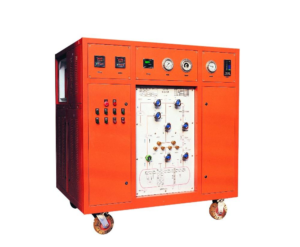 |
Equipment maintenance, recovery, filtration, and regeneration of SF₆ gas |
| SF₆ moisture analyzer | 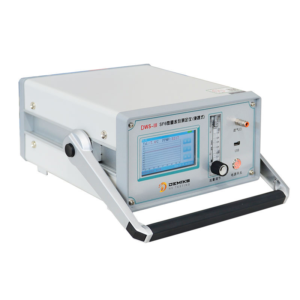 |
Detecting the moisture content of gas |
| SF₆ decomposition product detector | 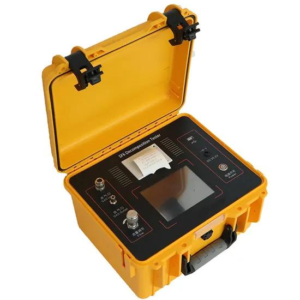 |
Determine if there is a discharge fault inside the equipment. |
| SF₆ gas leak detector |  |
Air tightness test |
| SF6 Inflationg Devices | 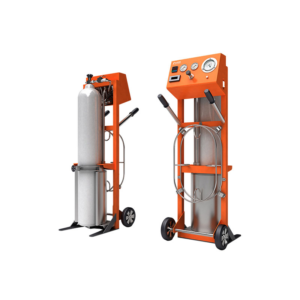 |
Refilling and replenishing gas |
| SF₆ Density Online Monitoring System | 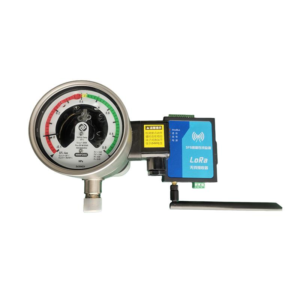 |
Real-time monitoring of chamber pressure, temperature, and density |
Key technological differences of SF6
- that distinguishes between insulation and arc extinguishing relies on both SF₆ insulation and arc extinguishing ; disconnecting switches, bus-bars, and instrument transformers only use SF₆ as the insulation medium and have no need for arc extinguishing.
- Simple Selection Reference
- Limited land area, indoor GIS in urban areas
- Outdoor renovation, medium budget → HGIS + open current transformer
- 10kV distribution network cable line → SF₆ ring main unit RMU
- Underground high-capacity power transmission channel → GIL
- Oil-insulated transformers cannot be used in fire- and explosion-proof locations → GIT gas-insulated transformers
- Environmental considerations : SF₆ is a strong greenhouse gas, and most countries require its recycling and reuse , prohibiting direct emissions; export projects often include gas recovery equipment.
Applications and working principle of the SF₆ gas recovery, purification, charging, and discharging device (equipment shown in the picture).
I. Overall Equipment Description
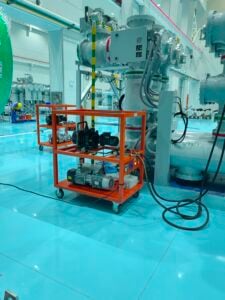
The following two types of equipment are both SF₆ sulfur hexafluoride recovery units :
| 1. Orange trolley mini machine: Portable SF₆ recycling vacuum machine, mostly used for on-site maintenance of switch-gear, transformers, and small GIS;
|
2. Yellow large cabinet unit: High-flow SF₆ recovery, purification and storage integrated unit, used for batch testing of GIS and high-voltage switch plants, large-capacity gas chamber treatment, integrating multi-way valves, pressure gauges, liquid storage tanks and deep purification units. |
 |
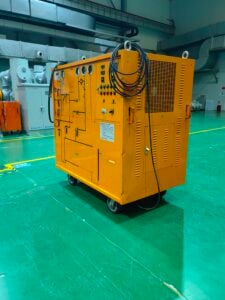 |
| Lightweight with casters, moderate flow rate, suitable for small, scattered air chambers. | Equipped with a built-in large-capacity liquid storage tank, multi-way control valves, and a large refrigeration unit, it boasts strong continuous operation capabilities and can handle multiple devices simultaneously. |
II. Core Uses
SF₆ is the insulating and arc-quenching medium for high-voltage electrical equipment (GIS, circuit breakers, instrument transformers, ring main units), but it is an extremely strong greenhouse gas (GWP=23500, direct emission into the atmosphere is strictly prohibited). This equipment achieves closed-loop recycling of SF₆ , with five core functions:
1. SF₆ recovery during equipment maintenance
Before powering down and maintaining a GIS switch, all SF₆ in the equipment’s gas chamber should be extracted to prevent gas leakage that could pollute the environment and waste raw materials after the cover is opened. The residual pressure of the equipment can be reduced to below 50 kPa to maximize the recovery of remaining gas.
2. Deep purification and upgrading of gases
The recycled SF₆ will contain moisture, fluorides from electric arc decomposition, dust, and air impurities. The equipment has built-in molecular sieves, activated alumina, and precision filters to complete drying, acid removal, and dust removal. The treated gas indicators meet the DL/T 662 standard and can be reused in electrical equipment.
3. Liquid compression storage
After purification, SF₆ is liquefied by a compressor and refrigeration unit and stored in a liquid state in an internal storage tank, which greatly reduces the storage volume and facilitates transportation and long-term storage.
4. Vacuuming of electrical equipment
After maintenance, first use a vacuum pump to remove air and moisture from inside the GIS/switch to ensure that there is no moisture or oxygen inside the equipment, in order to prevent insulation breakdown and the generation of toxic decomposition products after power is supplied.
5. Precise recharging of SF₆ gas
The purified liquid SF₆ in the storage tank is heated and vaporized, and then accurately filled into the high-voltage electrical equipment according to the rated pressure on the equipment nameplate. It supports two modes: low-pressure gravity filling and compressor boosting filling.
6. Additional supporting functions
- Transfer of old and new SF₆ gases, cylinder filling;
- Equipment and pipeline self-vacuuming and leak detection;
- Old and substandard SF₆ batteries are centrally recycled and processed to meet environmental regulations and emission reduction requirements.
III. Complete Working Principle (Mainstream Process of Cryogenic Liquefaction)
The entire system consists of five major processes: recovery and compression, purification and drying, refrigeration and liquefaction, vacuuming, and recharging and vaporization. It relies on the coordinated operation of the compressor, refrigeration system, vacuum pump, multi-stage adsorption filter, liquid storage tank, valves, and pipelines.
Process 1: SF₆ gas recovery (extraction from electrical equipment)
- The pipeline connects the GIS/switching air chamber to the air inlet of the recovery device, and switches the recovery valve;
- The oil-free compressor generates negative pressure to extract SF₆ gas from the equipment;
- The gas first enters the pre-filter to filter out metal dust and solid arc decomposition residue.
Process 2: Multi-stage purification and drying
After coarse filtration, SF₆ passes through two sets of purification units in sequence:
- Activated alumina filter canister : adsorbs acidic and toxic decomposition products such as HF and SOF₂ generated by electric arc;
- Molecular sieve drying tank : deeply adsorbs moisture in the gas, lowers the dew point to below -40℃, prevents moisture from corroding equipment and reducing insulation; after purification, the gas impurities and moisture index meet the reusable standard.
Process 3: Refrigeration, compression, liquefaction, and storage (core principle)
- After purification, SF₆ enters the compressor and is pressurized to high pressure;
- The supporting refrigeration unit continuously cools the high-pressure SF₆, which liquefies from a gaseous state under medium-high pressure and low temperature conditions.
- Liquid SF₆ is automatically stored in the built-in pressurized storage tank by relying on pressure difference; Advantages: the storage density of liquid is much higher than that of gas, and the same volume of storage tank can store tens of times more SF₆ gas.
Step 4: Vacuuming of electrical equipment (essential after maintenance)
After recycling is complete and equipment inspection and maintenance are finished:
- Shut down the SF₆ recovery loop and switch the vacuum pump pipeline;
- A two-stage rotary vane vacuum pump extracts air and water vapor from the GIS cavity and pipelines;
- The vacuum gauge monitors the vacuum level. Once the level is reached, the vacuum valve is closed to isolate the atmosphere and prepare for inflation.
Step 5: SF₆ refill (vaporization inflation)
- Turn on the tank heating device, and the liquid SF₆ absorbs heat and vaporizes into high-pressure pure gas;
- Two inflation modes are available:
- Low pressure differential: Gas is supplied by gravity flow from the tank’s own pressure.
- Insufficient pressure differential: Start the compressor to increase the pressure until the air chamber pressure reaches the equipment’s rated operating pressure;
- The pressure gauge monitors the inflation pressure in real time and automatically stops when the set value is reached.
IV. Environmental and Economic Value Supplements
- Environmental compliance : SF₆ has a greenhouse effect more than 20,000 times that of CO₂, and direct emissions violate environmental regulations. The equipment achieves zero-emission recycling.
- Cost savings : The high procurement cost of brand-new SF₆ gas, coupled with the ability to repeatedly recycle the purified gas, significantly reduces operation and maintenance procurement costs.
- Equipment safety : Removes moisture and acidic impurities, preventing corrosion of internal aluminum components and insulation aging of GIS, and extending the service life of high-voltage switches.
If you have needs for SF6 gas recovery and purification, such as batch testing in high-voltage switch-gear factories and GIS complete equipment workshops , emergency repair of distribution networks, and on-site maintenance of outdoor switch-gear/transformers , please consult the sales staff of DEMIKS POWER.
Contact email : contact@demikspower.com