Audits based on the pd testing method require a traceable relationship between the asset, test method, and decision. A partial discharge test report should allow an engineer to recover measurement conditions and let a purchaser identify exactly what was accepted.
- Audience: equipment buyers, quality teams and plant engineers.
- Handover: seven record groups organized into five evidence links.
- Method: identify the applied waveform, sensor and measurement units.
- Decision: distinguish measured results, laboratory conformity and buyer release.
PD testing audit requirements connect the identified asset to an agreed method, calibrated measurement chain, retained results and authorized decision. Review seven record groups before acceptance. Include a supplier demonstration of the actual files and report.
- A measurement-only report can be a valid deliverable without a laboratory pass/fail statement.
- Instrument certificates and calibration of the configured test circuit belong in separate record groups.
- Sensor amplitude, apparent charge and defect location need different supporting information.
- Ask the supplier to reopen a completed test and reproduce its signed report during the quotation review.
Partial discharge test evidence: what is being audited?

A partial discharge audit reviews whether the delivered test supports the ordered decision for an identified item of electrical equipment. Begin with the asset serial number, insulation system, test purpose and report request. Factory acceptance testing, cable commissioning and condition monitoring answer different questions, even if they all yield a PD value.
Partial discharge consists of localized electrical discharges within or surrounding electrical insulation. The detection of discharge activity assists in investigating a void, contamination or other defects; it doesn’t measure the remaining lifespan of all the assets. A transformer acceptance dossier and in-service switchgear survey therefore require different scopes.
Put three separate fields on the job cover sheet: measurement requested, conformity statement requested, release owner. The European co-operation for Accreditation’s laboratory FAQ 47.1 distinguishes reporting results versus reporting conformity. A green pass indicator may communicate conformity, even without a written judgment. Decide who makes that judgment before commissioning the work.
The first purchasing decision is straightforward: order a measurement if your engineering team will interpret the results; order an agreed conformity statement if the lab will judge a specified requirement. For system reliability, consider the PD along with the asset’s other inspections and maintenance.
IEC 60270 and the acceptance specification
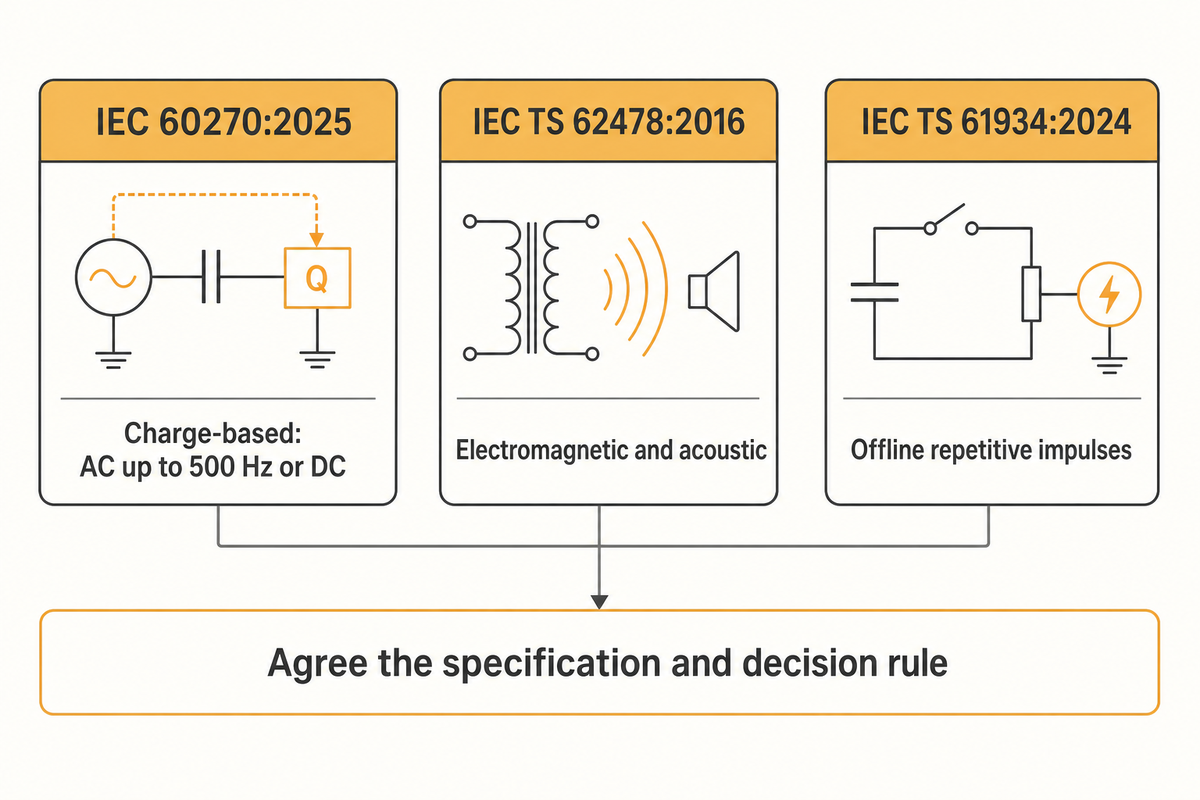
IEC 60270:2025 addresses charge-based PD measurement under alternating test voltages up to 500 Hz or direct voltage, according to IEC’s official scope. Pair this measurement method with the related equipment specification and the Contract Acceptance Criterion. Test voltage frequency and detector’s measurement bandwidth are distinct entries.
What standards govern PD measurement?
Use IEC 60270:2025 for charge-based measurements within its stated scope, and IEC TS 62478:2016 for related electromagnetic and acoustic methods. Repetitive impulses generated by power electronics require a separate method review: IEC TS 61934:2024 addresses that offline application, and its third edition does not describe charge-based measurements.
Record the exact edition, applied waveform, apparatus specification and any agreed departures. An AC record at 50 Hz or 60 Hz should identify its voltage sequence and duration; a record of repetitive impulse should capture its waveform parameters. Qualified personnel determine those parameters based on an approved procedure. The dossier should capture those settings.
Suppose a contract sets a 10 pC upper tolerance and explicitly agrees a 2 pC guard band. The acceptance limit is 10 pC − 2 pC = 8 pC. Under that stated binary rule, a 9 pC result fails acceptance even though it’s below 10 pC. These are example inputs, not recommended PD limits. ILAC-G8:09/2019 explains several decision-rule choices; the contract must identify the one being used.
“No single decision rule can address the diverse scope of testing and calibration covered by ISO/IEC 17025.”
For a conformity statement, agree the specification and decision rule prior to the test. The absence of a rule in a measurement-only report differs from the absence of a rule behind an explicit pass.
The 5-Link PD Evidence Chain
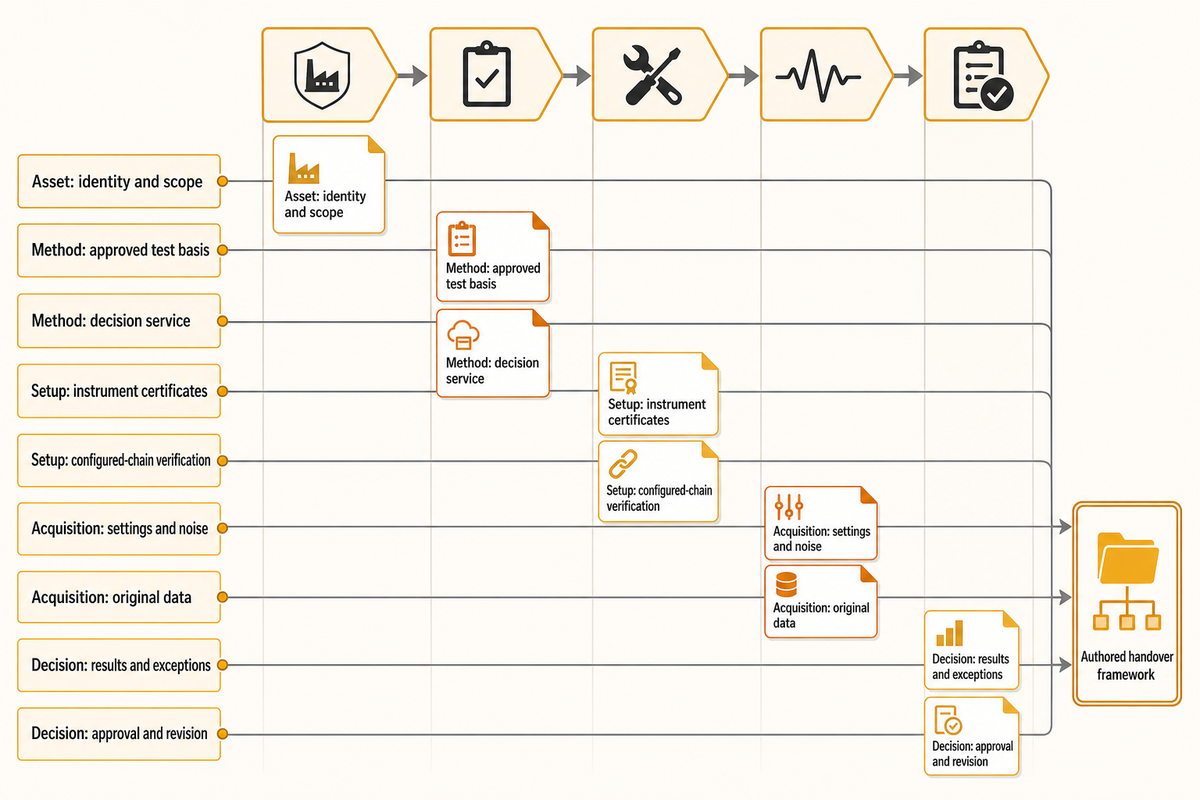
The 5-Link PD Evidence Chain is a purchasing framework that connects asset identity, approved method, measurement setup, acquisition and decision. Group the seven record groups within those links and determine if a reviewer can move between them without having to guess the filenames or settings. The grouping is a tool for handover, not an IEC checklist.
Use the table as a file index during a supplier review. Some record groups occupy more than one row because the document and its connection to the case require separate reviews.
| Link / record group | File or field to retain | Owner and review action |
|---|---|---|
| Asset / 1. Identity and scope | Serial number, drawing revision, tested connections and purpose | Quality: match the unit to the purchase order |
| Method / 2. Approved test basis | Standard edition, waveform and equipment specification | Engineering: confirm method applicability |
| Method / 2. Decision service | Measurement only or conformity statement; agreed rule where applicable | Procurement: match the commissioned service |
| Setup / 3. Instrument certificates | Detector, calibrator and reference-device identities and certificate scope | Quality: connect certificates to the devices used |
| Setup / 4. Configured-chain verification | Calibration connection, injected charge or sensitivity check, scale factor and settings | Test engineer: link the setup record to the acquisition |
| Acquisition / 5. Settings and noise | Voltage in kV, frequency in Hz, duration in s, bandwidth and noise assessment | Test engineer: recover the conditions of the reported result |
| Acquisition / 5. Original data | Raw files, channel labels, timestamps and software version | Plant engineering: reopen the data using the delivered software |
| Decision / 6. Results and exceptions | Reported values, units, excluded data and departure explanations | Authorized reviewer: assess each exception against the ordered scope |
| Decision / 7. Approval and revision | Signed report, revision reason, superseded version and release record | Quality: preserve the decision trail |
Source basis: NIST’s method-defined measurement guidance and ILAC-G8’s conformity guidance; file ownership and the seven-group arrangement are procurement recommendations.
Let’s hypothesize a transformer delivery with a signed report and separate calibration certificates. The plant engineer is able to identify the transformer, but the acquisition file employs an internal job code that’s totally absent in the report. Quality requests the lab demonstrate the connection of the job code to the serial number, measurement date and saved configuration. Per the original records, if the lab is able to do this, they can issue a controlled clarification or amended report. If the connection cannot be recovered, an authorized engineer must assess what further work is needed. In the meantime, procurement holds the documentary acceptance item open, until the work is done. No one rewrites a filename and assumes the measurement is now traceable.
Calibration, noise and raw-data records
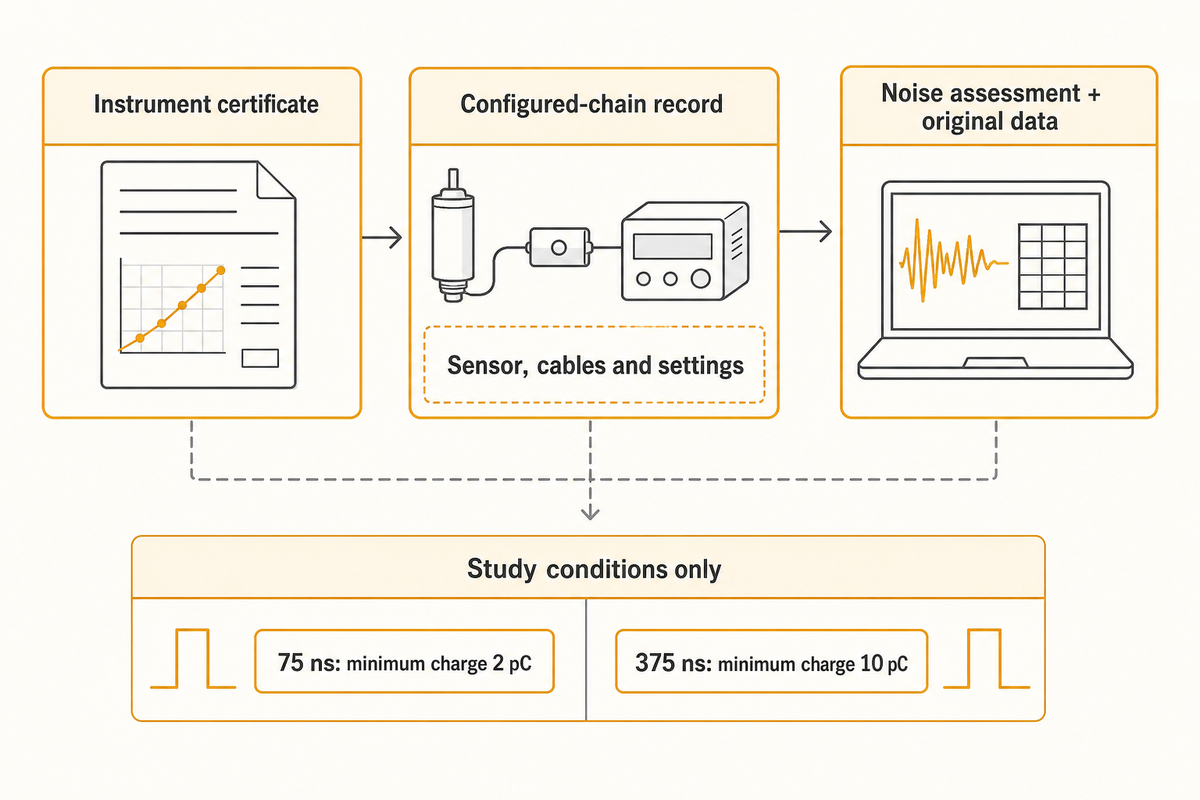
A calibration certificate identifies the instrument or reference device that it covers. A configured-chain record connects this evidence to the actual PD measurement. Keep the coupling device, sensor, cables, settings and reference injection along with the test data. A change in the signal path can alter the relationship between the input pulse and the displayed value.
As explained in NIST TN 1297, D.4.1, the implementation of a measurement method can also contribute to uncertainty, in addition to repeatability and reproducibility. For charge-based testing, record the calibration pulse in picocoulombs and the resulting scale factor. For other sensor families, retain the applicable characterization or sensitivity check.
How can I tell whether a signal is PD or noise?
A suspected PD signal is assessed using its relationship to the applied voltage, phase-resolved analysis, pulse characteristics and repeatable response across the measurement setup. The relationship of pattern recognition to discharge patterns is useful for classification of discharge activity; however, a recognizable PD plot by itself isn’t sufficient to classify a defect or locate a failure. Retain the noise assessment and the settings used to separate interfering signals.
A good review question is what changed when the operator moved a sensor or adjusted a filter? Save those changes with the corresponding data. Otherwise, a lower displayed level may be mistaken for lower discharge activity when the acquisition conditions changed. An observation below the demonstrated noise level should be reported within that detection capability.
The 2023 synthetic-calibrator study by Khamlichi and colleagues gives a useful illustration. Its Table 6 lists a minimum charge of 2 pC at a 75 ns pulse duration, but 10 pC at 375 ns. Those are the study’s laboratory conditions. A bare sensitivity number loses meaning when pulse shape and acquisition conditions disappear from the specification.
- Retain the original PD pulses and derived plots when the ordered system supports them.
- Record filters, gating, channel selection and excluded acquisitions.
- Keep the readable report alongside the data and software needed to reproduce it.
Demand the supplier show and save a reference signal for the configuration quoted. Retain evidence of the sensitivity with the configuration’s test files.
Online, offline and sensor records: when results differ
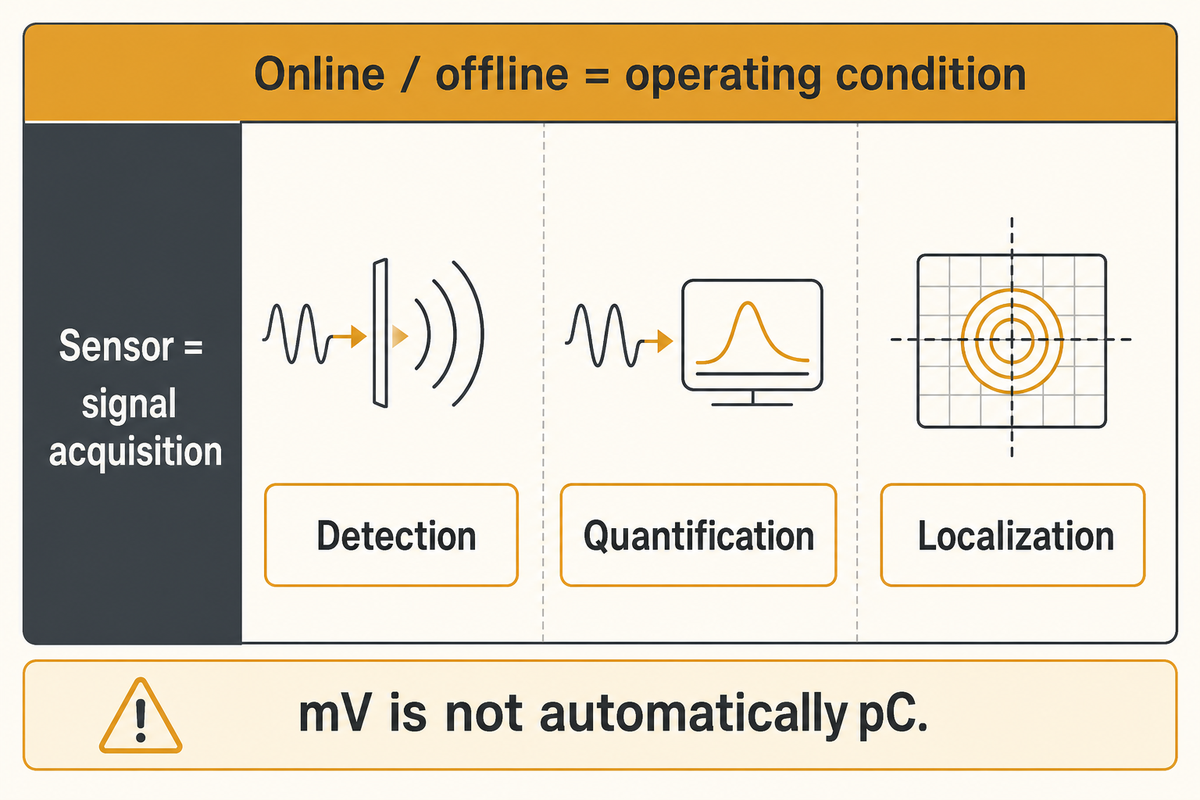
Online and offline testing describe operating conditions; sensor type describes how the signal is acquired. Neither label, by itself, makes measurement results interchangeable. The excitation, sensor response, coupling arrangement and units should be described before comparing apparent charge with ultrasonic, HFCT, UHF or TEV indications. Compare detection, quantification and localization capabilities separately.
IEC TS 62478:2016 covers electromagnetic and acoustic PD measurements with different frequency ranges and sensitivities. For example, in a GIS survey, an acoustic channel and a UHF channel might support a multi-sensor investigation. Their output scales need their own interpretation; a number in mV is not automatically a number in pC.
There’s a validated path from an HFCT waveform to a charge. The 2023 study defines the transfer function, rebuilds the current pulse and integrates it. A potential customer considering this path should request the characterized response, acquisition settings, reconstruction and evidence of uncertainty. A hard-coded conversion entered into a spreadsheet doesn’t do these things.
Imagine a cable contractor comparing an online survey with an offline acceptance test. The online record shows a strong response near a termination, while the offline report lists apparent charge under an applied test voltage. The project engineer first separates the jobs: the survey helped detect PD in service; the acceptance test addressed the ordered specification. A location claim needs another check. Rodrigo Mor and colleagues’ 2016 cable study describes near-end versus far-end ambiguity in single-sided time-domain reflectometry alone. The contractor therefore demonstrates the localization method and complementary evidence before scheduling work on a particular joint. The two reports remain useful without forcing their numbers into one ranking.
Keep the voltage condition and signal path with each trend. Comparing different sensor locations, loads or acquisition settings calls for an engineering explanation before a maintenance action is taken.
Missing records: release, clarify or repeat the test?
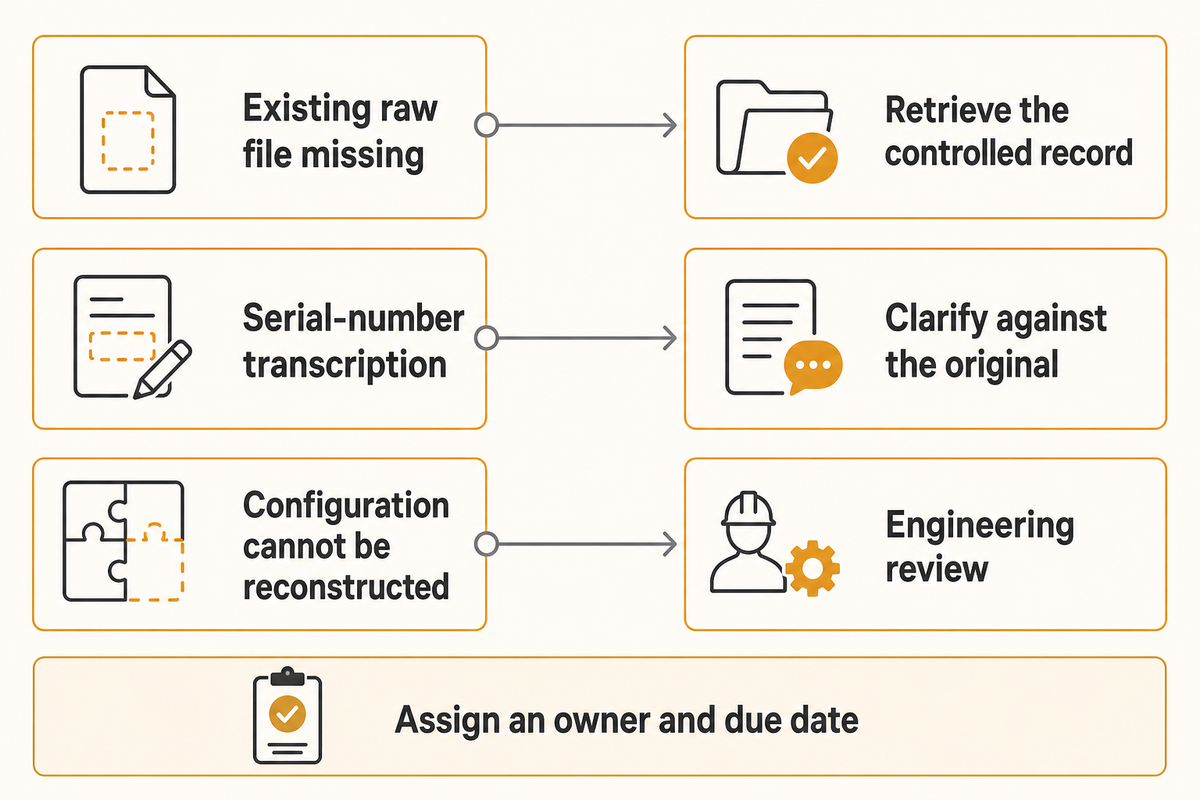
A gap in records calls for an equivalent remedy: recover a record, provide controlled clarification, determine if an additional measurement is necessary. The release decision maker makes the call based on the purchase specification. Completeness of records is one of the things reviewed. The others are the methodology and the interpretation of the result.
See ILAC-G8’s decision-rule guidance for reviewing conformity statements. For measurement-only work, check the contracted results and supporting information instead of requiring an unsolicited pass. A report amendment should maintain the connection to the original result and show what changed.
- Retrieve an existing raw file from the controlled archive.
- Resolve a serial-number transcription against original records.
- Explain the agreed decision rule behind a reported pass.
- Assess a calibration configuration that cannot be reconstructed.
- Review a method unsuitable for the applied waveform.
- Investigate a location claim unsupported by the measurement method.
Set an owner and a due date for each open item. A certificate issued today can’t recreate a measurement condition that was never recorded. Similarly, a recoverable filing error doesn’t automatically justify repeating a high voltage test.
Put evidence deliverables into the purchase order
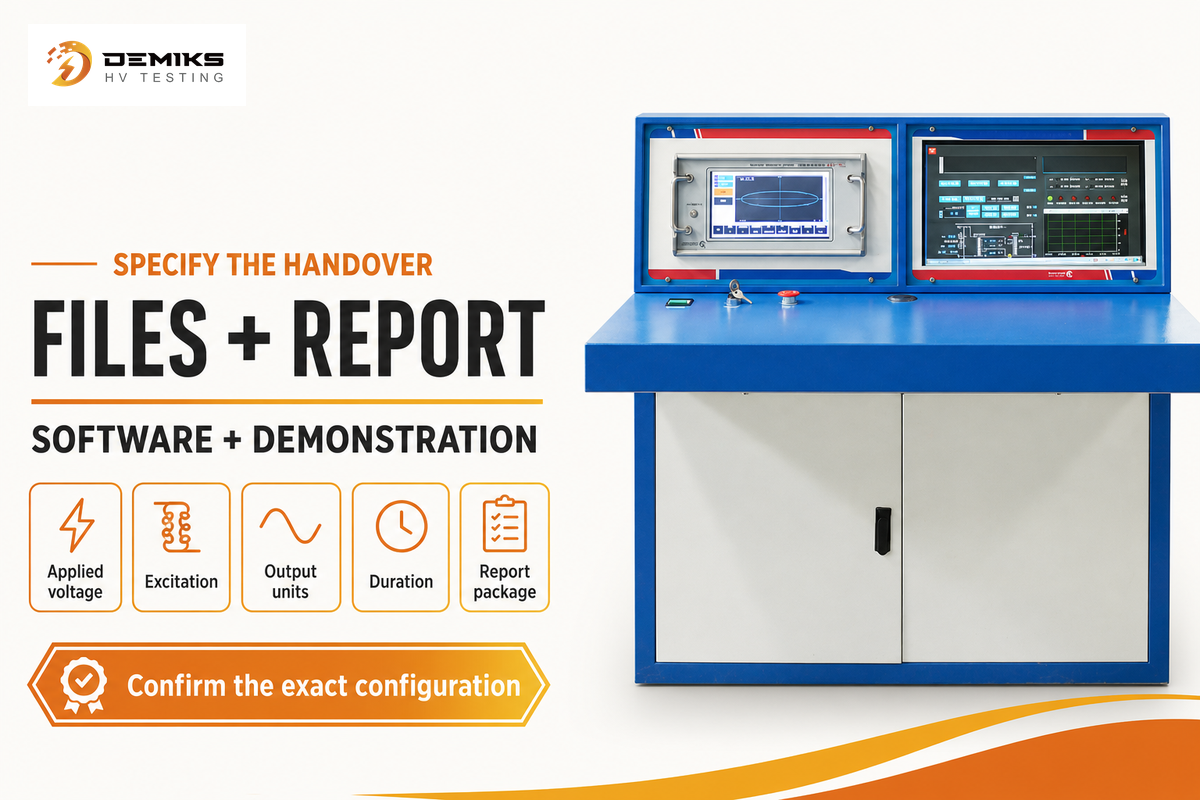
A PD test equipment order should stipulate the report service, measurement method, data handover, and demonstration to be provided at acceptance. State those items with the instrument and accessories. Procurement can check the delivered package. Quality can check the records, and plant engineering can verify the files are still usable after the supplier leaves.
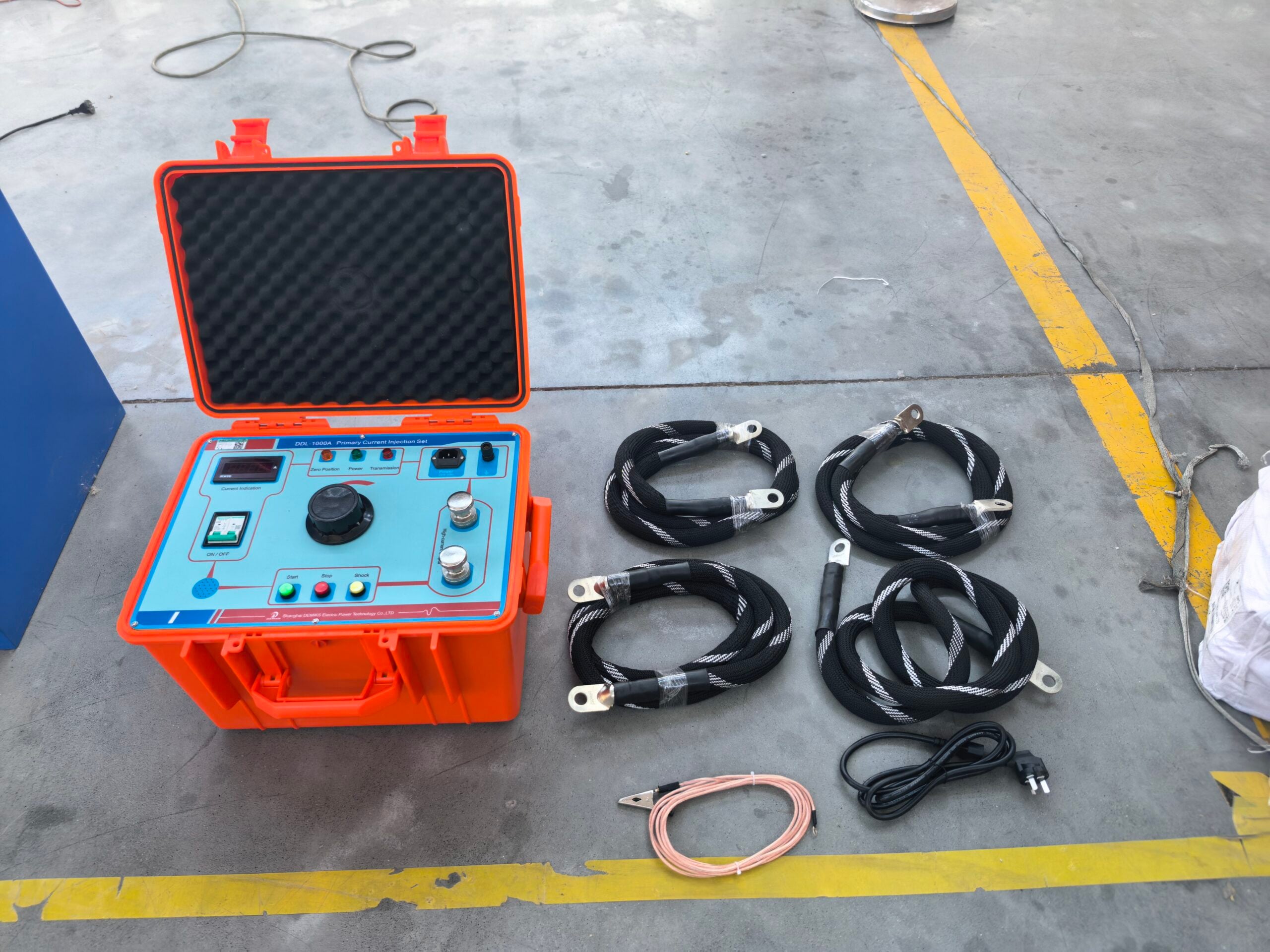
DEMIKS describes its DJF-1kVA-7.5kV system in its partial discharge testing equipment range, as supporting PDIV/PDEV assessments and A4 report generation. Stipulate the exact model, configuration and required report fields in the quotation. An A4 layout is a useful output format; the demonstration should also cover the data needed for your review.
Include the requirements in the request for proposal, replacing the contract specific ranges with your approved scope for testing. The units define the fields to supply rather than prescribing test settings.
| Parameter | Recommended range | Why it matters | How to verify |
|---|---|---|---|
| Applied voltage | Approved contract range, kV | Matches the asset and test method | Review the agreed test sequence |
| Excitation | Contract frequency in Hz or impulse parameters | Separates waveform-specific methods | Match recorded settings to the method |
| Charge or sensor output | Required pC range or sensor-specific units | Defines what the displayed result means | Demonstrate calibration or sensitivity |
| Acquisition duration | Procedure-defined duration, s | Links results to the ordered observation | Reopen a timestamped acquisition |
| Report package | One controlled report per agreed test item | Connects approval to the asset | Export and reopen the sample package |
The requirements render ILAC-G8’s specification-and-result linkage in a procurement handover. Discuss excitation sources and measurement chains jointly during the review of high-voltage test equipment.
For a hypothetical budget comparison, assume a supplier charges an additional $1,200 for a witnessed report-and-data demonstration. Finance estimates that an unplanned archive problem would consume two hours of an already booked outage at $2,500 per hour. That scenario costs 2 h × $2,500/h = $5,000. The demonstration fee equals 0.48 h, or 28.8 minutes, of that assumed outage cost. The plant manager can use this comparison to price the handover risk, while quality checks whether the demonstration actually exercises file retrieval. The calculation does not state how often the failure will happen or guarantee any savings. Replace the prices and the expected delay with your project’s numbers to approve the expense.
Compare partial discharge tester suppliers by sample evidence
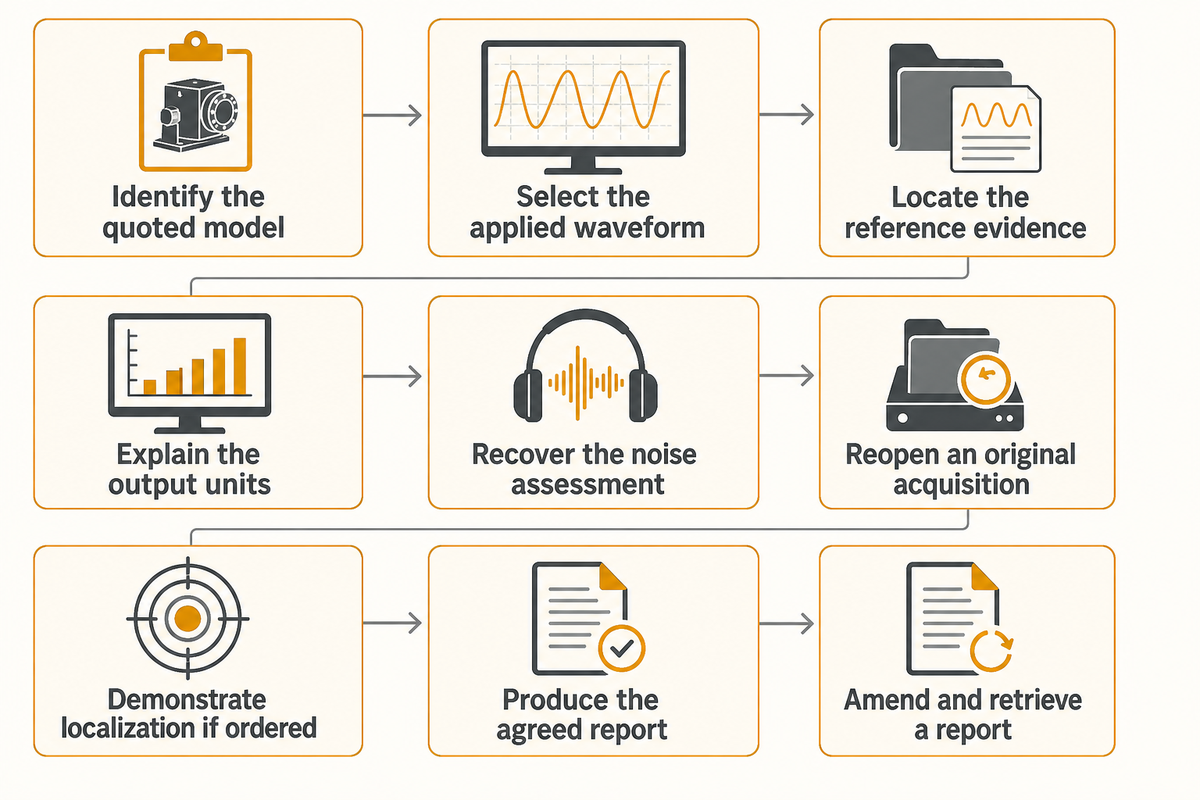
Let’s consider a partial discharge tester by asking each supplier to work through the same completed-test package. Let the operator retrieve the data, explain the configured measurement chain and reproduce the report.
The protocol below separates the tasks that often become mixed in a quotation. NIST’s measurement-method guidance supports retaining the method context; the demonstration steps are an authored purchasing tool.
| Demonstration | Observable result | Purchasing consequence |
|---|---|---|
| Identify the quoted model | Exact instrument, sensor and software configuration | Keep options and other product-family specifications separate |
| Select the applied waveform | Applicable standard and specimen scope explained | Exclude unsuitable methods before comparing price |
| Locate the reference evidence | Device certificates connected to the configured chain | Define calibration and verification deliverables |
| Explain the output units | pC calculation or sensor-scale interpretation demonstrated | Specify the ordered quantification capability |
| Recover the noise assessment | Filters, gating and acquisition conditions visible | Define what must survive report export |
| Reopen an original acquisition | Asset identity and settings recovered from delivered files | Identify licenses and archive dependencies |
| Demonstrate localization if ordered | Method, ambiguity and corroborating channels explained | Price location separately from detection |
| Produce the agreed report | Measured results or conformity statement match the service | Assign the laboratory and buyer decisions |
| Amend and retrieve a report | Original, revision and reason remain connected | Define ownership and retrieval after handover |
Often, the handover bottleneck is access: a readable PDF arrives, while the native file still requires a supplier laptop or an unquoted software license. Let plant engineering reopen the sample on the workstation of interest. Procurement records the scope of the license. Finance includes the cost and downtime in the comparison.
For a wider discussion on equipment selection, use the PD testing system comparison in conjunction with the demonstration provided in this record. Treat that comparison as equipment-category background: its ‘only calibrated method’ wording is not a universal rule; calibration and waveform-reconstruction evidence remain method-specific, as explained above.
What the IEC 60270:2025 revision changes for purchasing
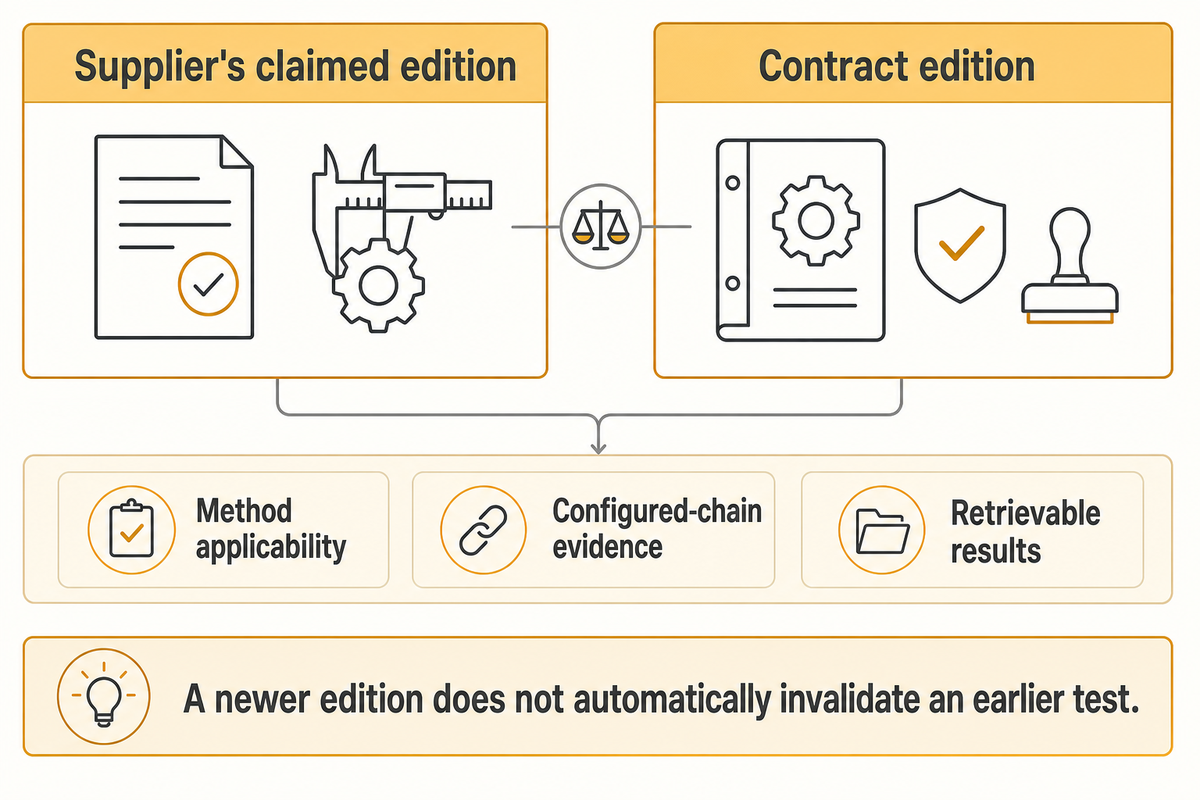
The June 2025 Revision makes the specified measurement method and edition a good quote check. The IEC notes a more explicit charge-based focus, revised and improved component performance checks, and an improved and updated normative annex for calibrator performance tests. New system buyers should relate the above changes to the exact configuration and contract, rather than rely on the IEC logo to determine specification compliance.
IEC’s fourth-edition summary states that the 2025 publication replaces the 2000 edition and Amendment 1:2015. It covers AC test voltages up to 500 Hz and DC. Its updated title emphasizes charge-based measurement. Ask which edition the supplier’s procedures, calibrator evidence and report templates address, then compare that answer with the edition named in the purchase specification.
For existing installations, the first step is to identify the contractual requirement. A newer edition of the Standard, by itself, doesn’t indicate that a previous test is unacceptable. Quality and Engineering should document the edition review, the differences relevant to the ordered work and any agreed changes. Preserve the original report when a later assessment adds context.
Attention should also be paid to waveform selection. The 2024 Third Edition of IEC TS 61934 addresses the repetitive impulses associated with power electronics. This method has implications on testing of motors and modules. A buyer of equipment for traditional AC work and repetitive impulses should request a separate explanation of each method, its output quantities, and its calibration or sensitivity evidence.
For a 2026 procurement review, place the contract edition and the supplier’s claimed edition side by side. Assign engineering to resolve differences before a demonstration; assign quality to verify the report fields; and assign procurement to record the included service. Utilities and OEMs can use the same division of responsibility without imposing an invented universal rejection threshold.
The important change in purchasing is a more complete acceptance package consisting of: the applicable method, exact model, configured-chain evidence and retrievable results. Keep that package attached to the order through commissioning and later maintenance. This gives the next reviewer a workable starting point when sensor placement, software or the tested asset change.
Frequently Asked Questions
Can PD testing damage cables?
An applied-voltage PD test can stress cable insulation; use the approved test procedure for the cable and its condition.
How often should partial discharge testing occur?
Set the testing interval through the asset maintenance plan, with commissioning and condition changes treated as separate triggers.
How precise is PD localization?
PD localization has method-specific accuracy; require a demonstrated location result for the quoted setup rather than a universal distance promise.
Can PD equipment be used online?
Suitable PD detection equipment can monitor energized assets using an approved online method.
Can partial discharge testing save costs?
PD testing can support targeted maintenance and reduce avoidable investigation, but a savings estimate needs project-specific inputs.
What is a partial discharge tester?
A partial discharge tester detects or measures signals associated with localized discharges in an insulation system.
When Should You Perform PD Tests on Cables?
Perform cable PD tests at the stages required by the commissioning, maintenance or repair plan.
Buy the test capability and the evidence handover together. A usable PD package links the asset, applicable method, configured measurement chain, original data and responsible decision.
Prepare a model-specific inquiry
Send DEMIKS the asset family, applied waveform, required output quantities and sample-report requirements. Include the raw-data and software handover you need for later review. Compare suitable PD test equipment and reporting options against the demonstration table.
Related Articles
- PD testing and factory release decisions — do not use its 30/100/500 pC framework as acceptance limits; use the asset-specific specification and agreed decision rule.
- Common mistakes in onsite PD testing
- Reducing operator dependency in PD testing
- Managing a complex PD testing system
References & Sources
- IEC 60270:2025: public scope and edition changes International Electrotechnical Commission.
- IEC TS 62478:2016: electromagnetic and acoustic PD measurements IEC.
- IEC TS 61934:2024: repetitive voltage impulses, public redline scope IEC.
- ILAC-G8:09/2019: decision rules and statements of conformity International Laboratory Accreditation Cooperation.
- NIST TN 1297, Appendix D.4: method-defined measurands National Institute of Standards and Technology.
- Synthetic PD calibrator research, Sensors 23(13):5955, 2023 Khamlichi, Garnacho and Simón.
- Laboratory FAQ 47.1: reporting statements of conformity European co-operation for Accreditation.
- Localization Techniques of Partial Discharges at Cable Ends, 2016 Rodrigo Mor and colleagues, TU Delft repository.